


July 4, 1776: Delegates from 13 colonies to the Second Continental Congress in Philadelphia unanimously vote to declare independence from Great Britain. Among the members is Charles Carroll, a 38-year-old from Maryland who spent much of his life abroad. The only Catholic signer of the Declaration of Independence, he was a leading voice for the cause.
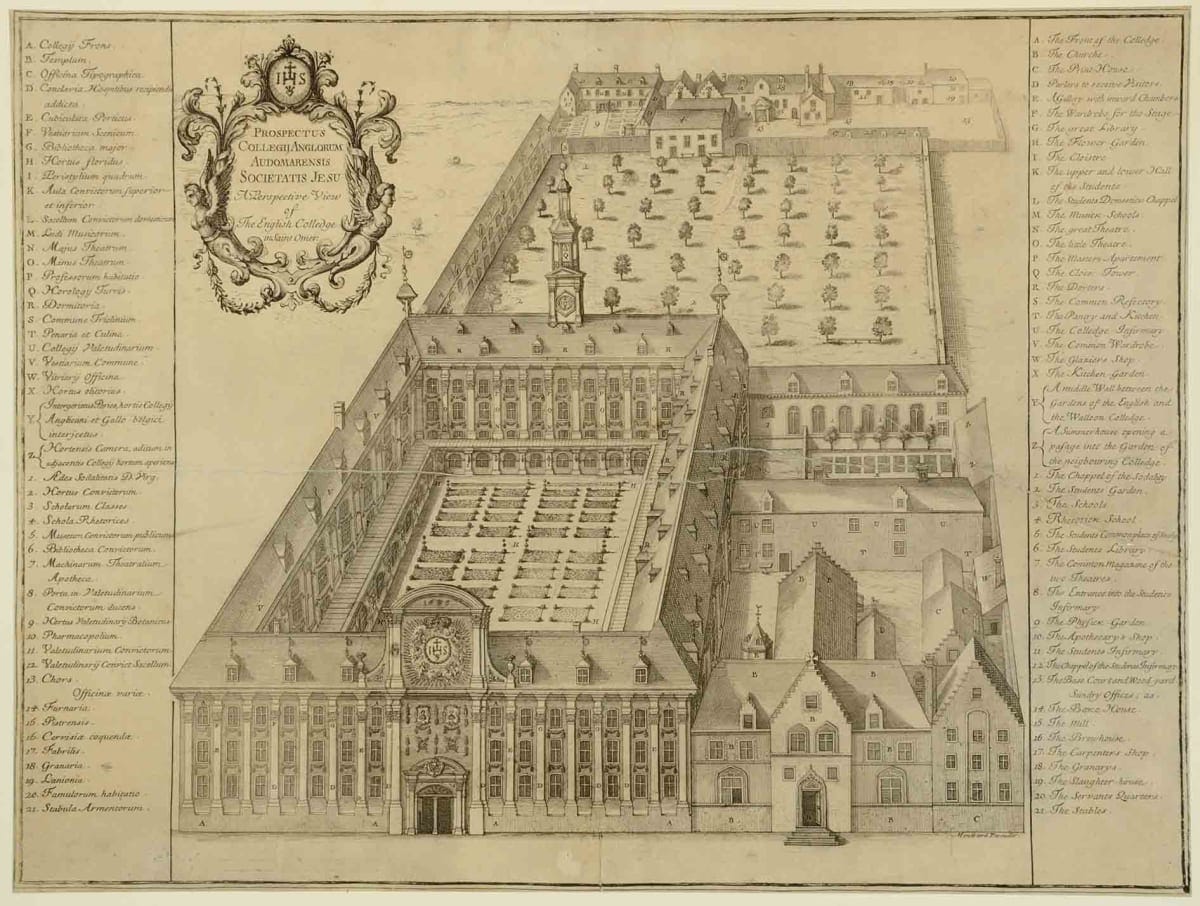
Charles’s grandfather, the Irish-born Charles Carroll I, had earlier established the family motto, Ubicumque cum libertate (“Anywhere so long as there be freedom”). In 1748, the family sent Charles, only 11 years old, to France, to attend a small Jesuit school in the town of Saint Omer, 30 miles south of Calais. He was expected to become a learned, reasoning gentleman equipped to contribute to society.
He was not alone. From 1730 to 1762, more than a hundred American boys made the journey to the College of St. Omer, where many spent up to a decade far from their families. Their parents wanted them to have the grounding in the values and philosophy that came with a Jesuit education.
Founded in the 16th century as a school for Catholic boys from England to avoid violent religious persecution at home during the reign of Elizabeth I, St. Omer later also took on Catholic boys from the colonies, where they were safer but also deprived of civil rights and denied participation in public life.
St. Omer graduates who would go on to leave their marks on American politics and culture included Aedanus Burke, judge and United States representative from South Carolina; James White, delegate from North Carolina; and Maryland Governor Philip Calvert.
Charles Carroll was perhaps the most emblematic. A signatory of the Declaration of Independence, he wasn’t the only member of his Maryland family to influence the future of the United States. His cousin and St. Omer schoolmate Daniel Carroll was one of only five men to sign both the Articles of Confederation and US Constitution. George Washington tasked him to oversee the construction of Washington, DC. Daniel’s brother John would become the first American Catholic bishop and founder of Georgetown University, whose first five presidents were St. Omer alumni.
At St. Omer, those future American leaders imbibed the Enlightenment ideals of humanism, freedom and human rights, drawing inspiration from Greek and Roman political thinkers and their modern successors. Cicero, Tacitus, Voltaire, Montesquieu, Rousseau, Hume, Locke and Burke were the diet at the school, which emphasized the humanities, literature, history, philosophy and theology. It also gave the boys lessons in music, dance and theater.
Life at St. Omer wasn’t easy so far from home. “I hope to accomplish my Studies to your greatest satisfaction,” the young Charles Carroll, an only child, wrote his parents in 1750. Learning of his mother’s death while he was still away at school, he pleaded, “I wish you would permit me to return to Maryland in the next fleet.”
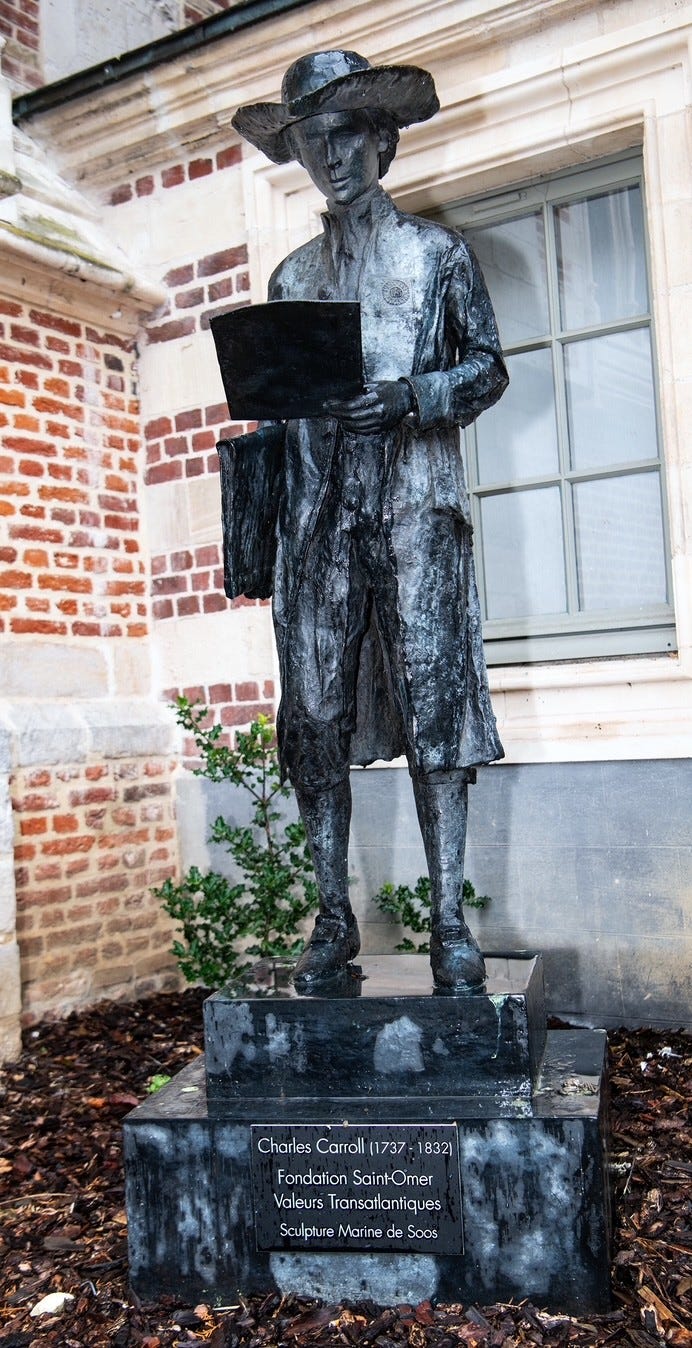
After St. Omer, Carroll was enrolled at the Lycée Louis-le-Grand in Paris, and later studied law in Britain, returning in 1765 to Maryland, where his family owned sprawling agricultural estates and some 300 slaves. He was at one point considered the colonies’ wealthiest man. But it was his debating skills and even temper for which he became widely known and even admired.
St. Omer students were taught that society should be focused on providing for the common good. Carroll adopted Cicero’s concept of natural law, that justice is inherent in nature, and laws should reflect moral principles.
Montesquieu—who epitomized the Enlightenment’s ideas about the separation of powers, central to the establishment of the US Constitution—was also key.
Like other Founding Fathers, he lost confidence in Britain’s ability to govern according to its own constitutional principles, common law and rights. Signing his name to the Declaration of Independence put his wealth at especially great risk due to anti-Catholic sentiment among Americans. And after independence, with the task of designing a new constitution, Carroll warned against “a slippage of natural law leading to unbridled individualism harmful to the common good” and resulting in the “tyranny of parties.”
He was wary of Thomas Jefferson’s more radical populism, saying true liberty requires a virtuous, duty-bound citizenry. He called for a “responsible” freedom, governed not just by “a political union but a union of sentiment and interest.”
Carroll’s part helping to develop the Senate was an important contribution; he later served as the first US senator from Maryland. And he helped write Maryland’s Constitution of 1776, successfully fighting to include religious liberty for all Christians, including Catholics.
He was a key proponent of states’ rights as part of the struggle, and championed the separation of church and state. The new country should have “multiple, overlapping government sovereignties, embodied with the principle of hierarchy and subsidiarity,” he wrote. “The flip side of hierarchy being subsidiarity.”
The United States was a bold experiment in balancing ambition with humanistic ideals, he believed, more than just a nation-state. “It was an idea, inseparably connected with the concepts of representative government, religious liberty, free inquiry and the spread of knowledge…extended to the whole family of man.”
Today, when those ideals are under serious threat and America’s policies oppose the country’s founding philosophy, we must help its return to the Enlightenment values that have long united both sides of the Atlantic. The St. Omer Foundation for Transatlantic Values is dedicated to helping preserve our largely forgotten transatlantic bridge and the ideas that formed it in the hope of helping to revive a democracy in danger and advance the deep roots of Franco-American friendship.
Charles Carroll was the last remaining signer of the Declaration of Independence when he died in 1832 at the age of 95. A few days before his death, he received a visit from Alexis de Tocqueville, who reported that “all his mannerisms and his turn of mind make him completely resemble a European gentleman. This breed of man disappeared after having provided America with the greatest men. With them the tradition of high morals is lost. The people become enlightened, knowledge expands, average ability becomes common. Outstanding talents and great characters are rarer.”
Edouard-François de Lencquesaing is the founder of the St. Omer Foundation for Transatlantic Values. In addition to sponsoring historical research, civic dialogue and transatlantic exchanges, it continues to bring American students to St. Omer, where the school is now called Lyceé Ribot. The foundation welcomes donations.