



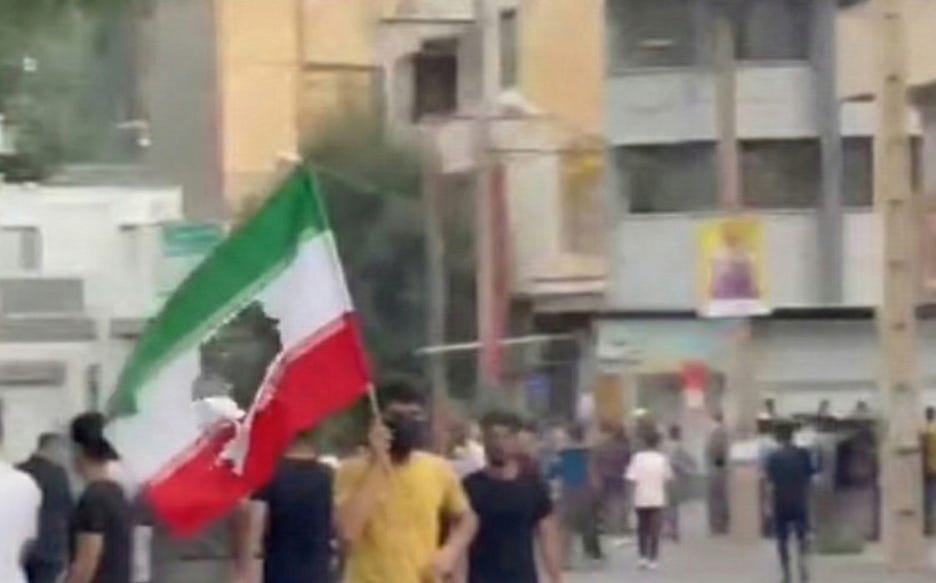
For weeks now, Iran has been roiled by national, antigovernment protests that have been met by a brutal crackdown. Thousands are believed to have been killed, and international tensions have spiked as the administration of US President Donald Trump has mulled responses from renewed negotiations with the Iranian government to military intervention.
Compass’s Robert Coalson discussed the situation with Barry Rosen, former press attaché at the US Embassy in Tehran who was held hostage for 444 days during the 1979-81 Iran hostage crisis. He is a co-founder and board member of Hostage Aid Worldwide, an NGO that assists in releasing hostages and supporting their families around the world, and maintains the world’s largest database on hostages.
The conversation has been edited for length and clarity.
Robert Coalson: We’ve seen multiple protests in Iran before, including the Green Movement in 2009. Is the current standoff different?
Barry Rosen: In many ways, this is so different from all the rest of the protests. This is not a protest; this is much, much more than what I would call a protest. This is almost revolutionary.
The previous protests in Iran were either political, about reforming the regime or concerned issues to do with women, life, freedom or even providing for oil workers in the south. But this time, it is a comprehensive, national upsurge of the Iranian people’s disgust with the oppressive regime, which is bankrupt. And that’s an important issue.
The unrest started in the bazaar with the bazaari [merchant class]. The bazaari and the ulama—the clerics—have previously been hand-in-glove. They have always been cohesive. This is the first time in modern times that the bazaari began the upsurge that is going on now. Then it spread all over the country. What’s interesting is that the Iranian middle class, for the first time in decades, is part of this upsurge against the regime.
They are disgusted about their quality of life. The entire situation in Iran is desperate, both economically and in terms of natural resources. The water table in Iran will practically go down to nil in a few years. There may not be enough water to serve the Iranian people. Because of this, they have even spoken about changing or moving the Iranian capital from Tehran to the south. How that would happen, no one knows.
But it is important right now to understand whether this amazing upsurge can succeed. The regime faces questions now in addition to the squeeze it has been under from the outside world, especially the United States. And from the loss of the war with Israel last June. The Iranian people have been fairly nationalistic, in terms of supporting the regime in many ways, but now they’ve seen that everything they’ve done doesn’t count, and that all the money that was spent on Hezbollah and other organizations surrounding Israel could have been spent differently.
Coalson: The Iranian government has shown a clear willingness to use brutal force to suppress the protests, having already reportedly killed thousands. Can the movement succeed if there are no significant defections from the security forces?
Rosen: The police and military are in the streets killing and maiming Iranians young and old. And the protesters are in the dark. There’s no internet service, and the regime has cut them off from the outside. Some things are coming in slowly through Starlink and other sources. But we see some of the footage In Tehran and beyond. In hospitals, black body bags are piled on top of black body bags. We don’t know the numbers, but we’re talking about thousands of victims.
So, you’ve asked the $64,000 question. I have not seen an indication of any defections from the regime. If there were to be any defections, I think the weakest link might be the military, which has not really been a hardcore regime supporter. But I have not seen any defections whatsoever.
Coalson: Some in the United States have raised the possibility of military action. How would that be perceived by the protesters if it were to happen?
Rosen: No one can predict what President Trump will do. He usually does things so that he can say he succeeded when in point of fact, nothing was done. For example in Venezuela, he took out the leadership but left the regime behind. If Trump is planning military action in Iran, it has to be precise. It has to go after the leadership of the Iranian Revolutionary Guards (IRGC) and even the clerical leadership.
The regime would bring out its supporters. There is support for the regime, possibly 30 percent. These are people who admire and are devoted to the regime.
But the average Iranian, who, because of the corruption that’s going on, can’t get food on the table and can’t live decently, could possibly be for some sort of intervention. But that is all conjecture.
My feeling is that there are going to be negotiations. But what will be negotiated? The Iranians insist they will keep their nuclear program. Still, I think negotiations could address the nuclear issue and sanctions, removing primary and secondary sanctions on Iran. Then the regime would be able to access the billions of dollars that have been sanctioned. But the Iranians would have to give something up in order to get that. That could be how the regime can survive.
Will it survive as it is today? That’s another question. We don’t know. Within the regime, there could be an IRGC movement for control that could even result in removing the clerical leadership, the supreme leader. That’s an extreme possibility.
But there needs to be a new social contract between the regime and the Iranian people if the regime is to survive. There needs to be a change within the regime toward the people. President Masud Pezeshkian is a pragmatist and he might be able to work within the system to bring this about. But he is under great pressure from the IRGC and others in the regime. It is very, very complex.
Trump has been speaking about keeping the regime from murdering Iranians. I don’t know what the planning is, but I think the best way to deal with this situation is to attempt to negotiate with the regime, to set parameters concerning the Iranian economy and possibly issues concerning human rights in Iran and how the regime treats its people. Whether this can happen…it’s a very, very difficult situation.
Coalson: We’ve been seeing a lot about Reza Pahlavi, son of the former shah. Is he really playing a role or does he just have a good PR team?
Rosen: I believe he has no organization that can oppose the regime. He hasn’t been in Iran in 47 years. He has not made any real progress in terms of building a faction or an organization that can oppose the regime. I think some people have been surprised that there is nostalgia for the Pahlavi period. Life under the Pahlavis, for those who weren’t opponents of the regime, was pretty good. But Reza Pahlavi has no real support. He is mainly supported by the diaspora living in the United States. But in Iran, his influence is minor if it exists at all.
The opposition in Iran is made of a wide range of people who coalesce into groups, but there is no real leadership. This regime is going to kill people, and the opposition has no means to oppose it. And that is sad because the regime is, as a matter of fact, at its weakest moment in 47 years. It has done nothing for the people of Iran and everybody knows that, even within the system itself. The only way out for the regime is to get rid of the sanctions so that it can survive. But Iran will have to give something up to achieve that. There must be some change within the system.
That could lead to a difficult fight because there are hardliners within the system who believe in the theocracy, that it is a divinely inspired regime blessed by God.
Coalson: Have these events affected you personally?
Rosen: Despite the 444 days that I suffered there, I know the people who took me hostage—now I know some of them personally—have changed in many ways. Iran is part and parcel of my DNA. So I feel unbelievably, profoundly saddened and disgusted by what this regime is doing to the Iranian people. Iranians have a great culture. They are a wonderful people. To see Iran in such a state for 47 years is something hard for me to live with. Personally, it really, really hurts me.

