


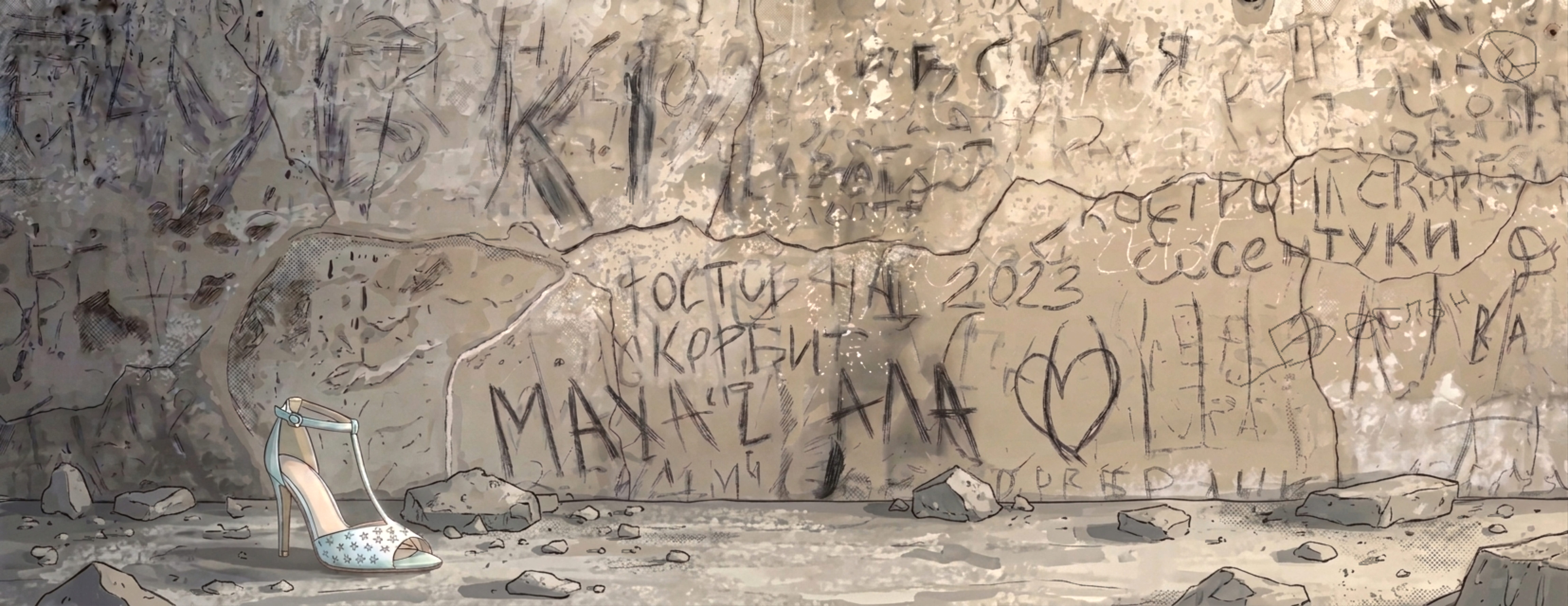
When I was very little, my mother owned one pair of stiletto sandals. For years, they were her only pair of fancy shoes. They had tiny flower-shaped perforations in the toe caps and thin leather ankle straps with minuscule shiny buckles. They were eggshell blue. Mama saved them for special occasions: a wedding, a symphony. There existed, in my mind, no more elegant thing in the world.
At first, when I would step into them, my feet fit almost entirely inside the pale blue toe boxes. But my feet grew, and when my heel reached midway up the arch, my mother said I would break the outsole and forbade me from putting them on. After that, just to touch something so feminine, so graceful, I would kneel in the anteroom of our Leningrad apartment on the old pile carpet, which it was my job to clean by coating it in spent tea leaves and then brushing them off with a short broom of bound straw, and slide my hands down the beige insoles smoothed by my mother’s fanciest journeys. The way the worn leather cooled the heels of my hands; the slightest indentations scalloped out by Mama’s toes and metatarsophalangeal joints under my fingertips.
Is it okay to think of this in Auschwitz? There is a display, in Block 5 of the Nazi concentration camp, of shoes. Heaps of them: children’s shoes, sandals, wing tips, winter boots, Mary Janes, a lady’s single red espadrille. The museum guide calls the exhibit “Deportees’ Shoes.” I read that there are 110,000 shoes here. This means someone must have counted the shoes, to know how many there are. I think of the many people who would have done the counting. First, the prisoners already interned when the shoes were confiscated from the new arrivals, deportees made to work in the camp until they could work no more, whose own shoes had been tallied by some previous prisoners. Then the Red Army soldiers, who had fought and killed and mourned their dead for months and possibly years before arriving in Auschwitz, where they were made to inventory the shoes. Then the conservators in the museum’s employ. I imagine slipping my hand into the red leather espadrille.
At the exhibit, I try to force my mind to see everything at once, to take it all in. But my mind rebels; it scatters, it wanders off, and then it is gone and the ghosts that have been stored in my eyes for years rise in flashback hopscotch spasms:
The mountain of shoes in a bombed-out school in Beslan; they have been sitting in the open only a year, but already they look the same as the shoes in Block 5, flat and halfway rotten; they are all children’s shoes; they belong, belonged, to some of the 1,100 students who were held hostage in the school gym rigged with homemade bombs. It was early September, hot; the hostage takers, who demanded that Russian troops withdraw from Chechnya, allowed the children to remove their shoes. They also allowed the boys to take off their woolen navy uniform blazers; the girls had to keep their dresses on, for modesty. After three days (three is a magical number, a number from a folktale), Russian special forces fired a tank gun at the gym; the blast and the explosions it triggered killed or wounded most of the children and almost all of their captors. The gym mostly collapsed. But the foyer remained, and for at least a year the shoes and the blazers remained in the foyer, in two separate piles, side by side, I remember each being as tall as my chest. Unlike the ones in the “Deportees’ Shoes” exhibit, these shoes were not arranged for viewing: They were left behind. Maybe the children’s mothers were too busy tucking in flowers on the tombstones to claim them. Maybe they were too devastated to claim them, the way the parents of the four boys from Forty Meters Street, my neighbors for a year in Mazar-i-Sharif, were too devastated to claim the mismatched sandals of their children. The boys had been playing in a ditch and saw the sheening curve of a shell—it could have been an aerial bomb left over from the Soviet occupation, or a projectile from one of the many times Mazar-i-Sharif changed hands in the internecine wars that followed, or an antitank mine the Taliban had buried when the Americans invaded, or an unexploded American bomb; impossible to know now—and they poked at it. The shock wave shattered windows five houses down the street, in both directions. My hosts and I heard the blast from our house, 10 blocks away. By the time we arrived to pay our respects, the men of Forty Meters Street had taken the boys’ remains to the parents’ homes and had begun to clean. They scraped the children’s blood off the dirt road with shovels, but blades fell off old handles with a clink, as though iron, too, failed in the face of such heartache. They scoured the children’s blood off their clothes under the corner water pump. And then a man picked up five singed flip-flops and dropped them into a ditch. Five. I remember the odd number.
I see a pair of a child’s flip-flops in other hands, a woman’s. She holds them out to me, one on each palm; they are that small. They belonged to her young son, she says, her boy, her little boy, who picked up a yellow cluster bomb an American warplane had dropped in his backyard. The cluster bomb had been the brightest thing in the village.
I see another woman holding one shoe, an adult leather sandal. The desert outside Babylon sags, similar to the way the desecrated earth of Birkenau sags with the ashes of the dead, but no valance of fog presses discolored grass over the mass graves. On the contrary, it is blindingly sunny, the earth is arid—arid, from the Latin arēre, “to be dry, like ashes,” from the proto-Germanic askon; both come from the Proto-Indo-European as, “to burn.” Scorching May wind blows tufts of hair against our bare ankles. (In Auschwitz, the hair of the dead is on display in Block 4. Visitors are not allowed to photograph the hair.) Not far from here, God jumbled men’s tongues and made us strangers to one another. Now, a single backhoe is excavating the remains of the hundreds of people Saddam Hussein’s secret police murdered in this field, and sometimes where the digging bucket jabs at the earth, it scoops several skeletons at once, and sometimes just pieces of a skeleton, and sometimes skeletons break. Or maybe they are already broken, from before. Spectral people walk among the remains, looking for relatives. Unthinking, with the tip of my shoe, I pry out of the soil what looks like a pottery shard and turn it over. An occipital bone. Immediately, a man appears and swiftly and silently scoops it into his hand, and walks away. In the distance, an old woman bends down, picks up a flat rotten leather sandal with both hands, brings it so close to her face that I think she is about to kiss it, then places it carefully back down on the ground. It is somebody else’s dead son’s sandal, not hers.
In the preface to their anthology of writing about the weather, Alice Oswald and Paul Keegan describe meteorology as “the art of looking up.” What is the word for the cursed art of looking at the detritus of our violence and our sorrow? The art of contemplating fundamentally human nature, of asking questions, filling voids, imagining and disturbing?
Literature.
Excerpt from To See Beyond. Copyright © 2026 by Anna Badkhen. Published by Bellevue Literary Press: www.blpress.org. Used by permission of the publisher. All rights reserved.
Anna Badkhen is the author of eight books of nonfiction, including To See Beyond and Bright Unbearable Reality, longlisted for the National Book Award. Born in the Soviet Union and a former war correspondent, she is the recipient of a Guggenheim Fellowship, the Barry Lopez Visiting Writer in Ethics and Community Fellowship, and the Joel R. Seldin Award for Excellence in Peace and Justice Journalism, among other honors. She is an artist in residence at the University of Pennsylvania and lives in Philadelphia. For more information, visit www.annabadkhen.com or www.instagram.com/annabadkhen.
Powerful and moving
Thank you for this visceral and touching excerpt.