


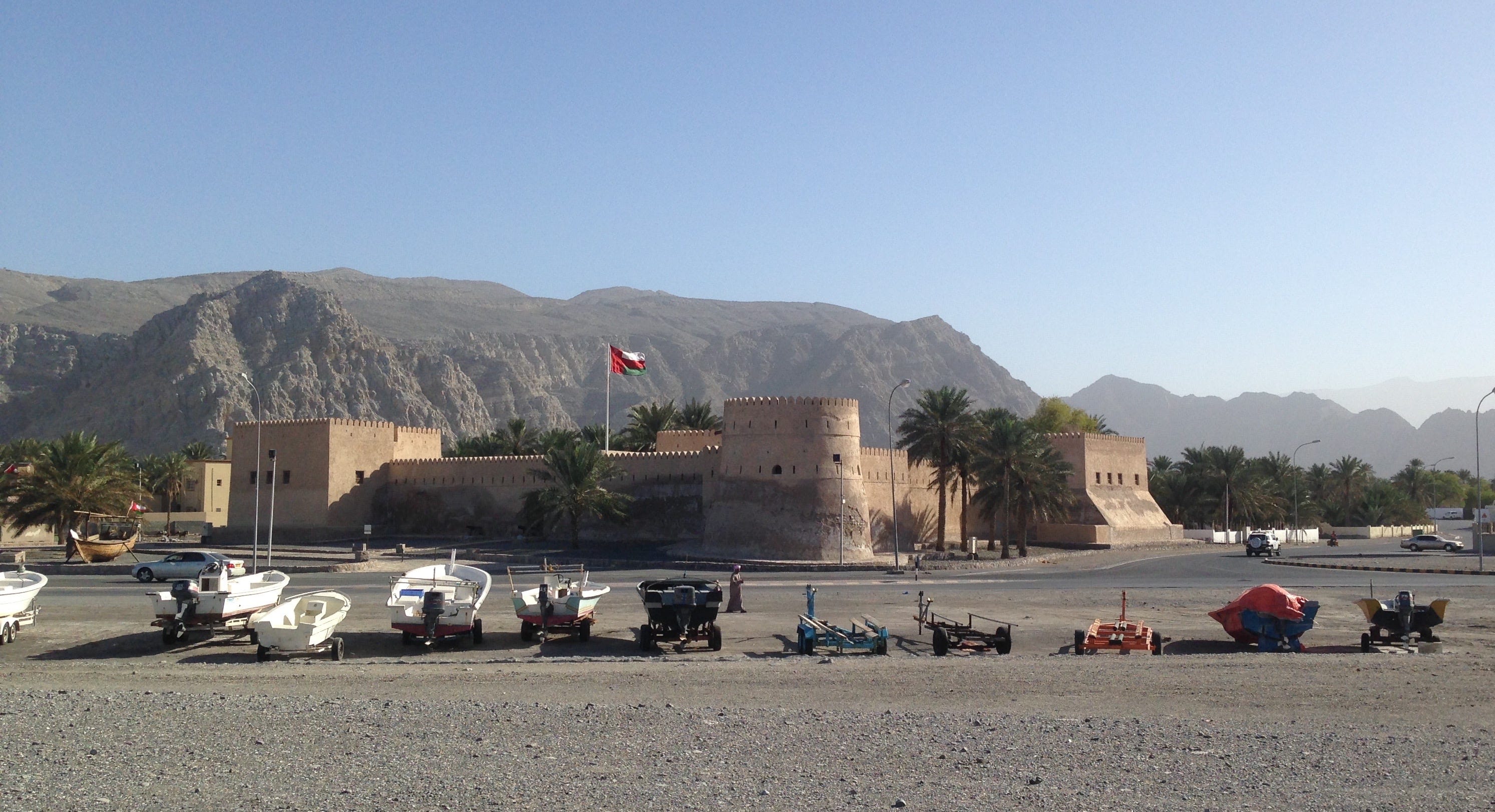
Editor’s note: Scott Erich was an Institute of Current World Affairs fellow in Oman in 2015 and 2016, when he examined the Sultanate’s society and history, together with cultural, political and economic ties across the Gulf, Arabian Sea and Indian Ocean. This dispatch was written from Khasab, at the southern shore of the Strait of Hormuz in December 2015. Some of the fears he mentions have since come to pass.
For centuries, Oman’s inhabitants have lived at the mercy of the ocean, drawing their livelihood from fishing and seaborne trade. Nowhere is that more evident than on the Musandam Peninsula, the country’s lonely exclave that reaches out toward Iran. Twenty percent of the world’s oil floats past its shores each day, past coves and inlets where Omanis live in stone villages accessible only by boat, making Musandam feel alternately like it is at both the center and edge of the world.
Geologically, the peninsula resembles a spike that pushes into Iran’s Hormozgan province, creating a divot near Bandar Abbas, that region’s capital and largest city. It is a mountainous, rugged and unforgiving landscape. Unlike the rest of the Hajar Mountains, Musandam has no coastal plain. Waves crash at the base of the mountains, in deep, narrow channels that resemble fjords (hence the somewhat confusing ecotourism tagline: “Norway of the Middle East”). As an exclave, Musandam is boxed in along its southern border by the Emirates, with just three overland crossings. The paved roads to the border checkpoints were sealed only in the 1990s, giving vital overland (rather than just sea) lifelines for this otherwise remote outpost.
Oman’s historical suzerainty over Musandam—itself a longer story about tribal allegiance and sheikhly dominions—became a strategic coup for the sultanate with the advent of oil and shipping in the region. It’s significant that Musandam comprises the entire southern half of the Strait of Hormuz, the erstwhile gateway to the Persian Gulf and waterway that the US Energy Information Administration (EIA) has called the “world’s most important chokepoint.”
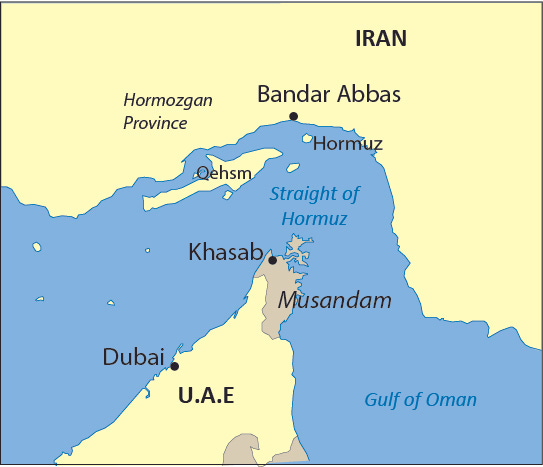
The EIA has estimated that 20 percent of all oil transported by sea passes through the strait, a total of 17 million barrels per day. The designated shipping lane that cuts through Hormuz is like a superhighway: a 2 mile-wide inbound lane, a 2 mile outbound lane, and a 2 mile median between. A constant armada of Very Large Crude Carriers (VLCCs), Ultra Large Crude Carriers (ULCCs), and supercontainers squeeze through the strait each day, with a steady swarm of fishermen and small-scale merchants ducking and weaving in their wakes. The lanes are largely within Omani territorial waters but also within Iran’s Air Defense Identification Zone (which is as subjective as the name implies).
The port of Khasab, Musandam’s largest town, is about 40 miles by sea from Iran’s shores, and about 65 miles from Bandar Abbas. Musandam was once part of Ormus, a medieval Persian seafaring kingdom that was eventually folded into the Portuguese empire. Bandar Abbas and Hormuz Island were, conversely, once leased to the Sultan of Muscat. That long history gave rise to Kumzari, an endangered language derived from Persian, Arabic, Portuguese and Hindi that is spoken in contemporary Musandam and the islands of southern Iran.
I went to Khasab hoping to learn more about what has been called “the most important nowhere on earth.” My ferry from Muscat was canceled due to choppy seas; instead, I caught an Oman Air flight to Khasab Air Base, an Omani Royal Air Force installation. A small building on the base serves as the commercial airport but the facility is staffed entirely by airmen save for a single Oman Air representative.
There are no taxis in Khasab so I walked the 6 kilometers from the air base to the port, where I had arranged to stay. Like many villages of Oman, goats wander indiscriminately throughout the town’s dusty streets and date palms tower above village walls. That night, as I ate fish kebab at an Iranian restaurant near the port, I heard a voice calling over to me.
“Siddiqi!” yelled a man smoking a cigarette, using the Arabic for “my friend.” He wore a Members Only jacket over his dishdasha and his turban was sloppily tied in the Bedouin style, cocked slightly to one side.
“Aywa!” I blurted mid-bite: “Yes!” We exchanged the usual greetings as his friends sat agape; Arabic-speaking Westerners are far less common in Musandam than Muscat.
“Ta’al, ta’al bil shai,” he said, signaling for me to join them for a cup of tea. He rose as I brought over my plate of fish and warmly introduced himself to me as Ahmed. A waiter brought a fresh pot of tea and empty cups, each of which had nabat (rock candy sugar) in it in the Iranian fashion. Ahmed explained to me how he had tea just like this when he visited Shiraz, something he seemed proud to tell me.
He and his friends were all fishermen and seafaring entrepreneurs, each with his own boat used for fish, tourists and hauling goods between Musandam’s many coves. They insisted on paying for my meal and giving me a ride back to my hotel, which was only a short walk away. As is typical of such encounters, I ended up spending the whole evening with them as they went about their evening errands and preparations for the next day.
The first errand: visiting every fish market in and around Khasab searching for kan’aad (Spanish mackerel or kingfish) for a fisherman named Abdullah’s clients for the next day’s boat trip. The clients were Emiratis, and kan’aad is a favorite there. As we rode around in a Toyota SUV, Abdullah was wringing his hands worrying they wouldn’t be able to find any. Finding none, they started calling restaurants, asking the kitchen staff if they could buy a fish from them.
Later, we stopped at another hotel in Khasab, which lies just around the other side of the cove from the main port and is geared toward Western tourists. We joined another table of seamen who were smoking and peering into their phones when an Italian man, looking lost, came out and was beckoned by one of our tablemates. It was an arranged meeting, I quickly learned, for the Italian to book a trip on Ahmed’s boat. I ended up being the de facto translator between them, and they agreed on 30 Omani Rials, or $75 for a trip to Kumzar Island, the northernmost tip of Musandam that looks over the strait.
As we drove through Khasab passing its Portuguese-era fort, Ahmed and Abdullah argued about which wind would be blowing on the way back from Kumzar tomorrow: the shamal or the suheili. When they took me to my hotel—nearly four hours after tea at the Iranian restaurant—a roadblock prevented them from getting closer than within a few blocks. The male half of a large wedding party was lined up on the street, its members beating drums, waving shiny swords above their heads and singing tribal songs, so we said our goodbyes and I passed through the festivities.
The next morning, I walked along the port’s jetty, watching fishing boats and tourist dhows ready themselves for the day. Khasab and Musandam are frequently associated with the smuggling trade with Iran, something I was eager to learn more about. I arranged to join some Omani tourists on a boat headed for Telegraph Island—named for the British communications station that once connected Bombay with London—and hoped that I would be able to catch a glimpse of some smugglers on the way.
I had heard that smuggling was on the wane, partly due to the resounding success of the Jebel Ali Free Zone in Dubai and the loosening of sanctions on Iran in light of the Joint Comprehensive Plan of Action (JCPOA, the nuclear deal with Iran signed during the Obama Administration). During the peak of smuggling, some estimates indicated that hundreds if not thousands of Iranian skiffs had arrived in Khasab each morning, small boats loaded with goats and fresh produce. On the return journey to Iran, they brought cigarettes, cosmetics, air conditioners and bulk food items like cooking oil, tea and flour. Khasab’s own marketplaces reflect this orientation: At the glistening new Lulu Hypermarket, air conditioners and washing machines dominate the appliances section, filling spaces labeled for fridges, stoves and microwaves.
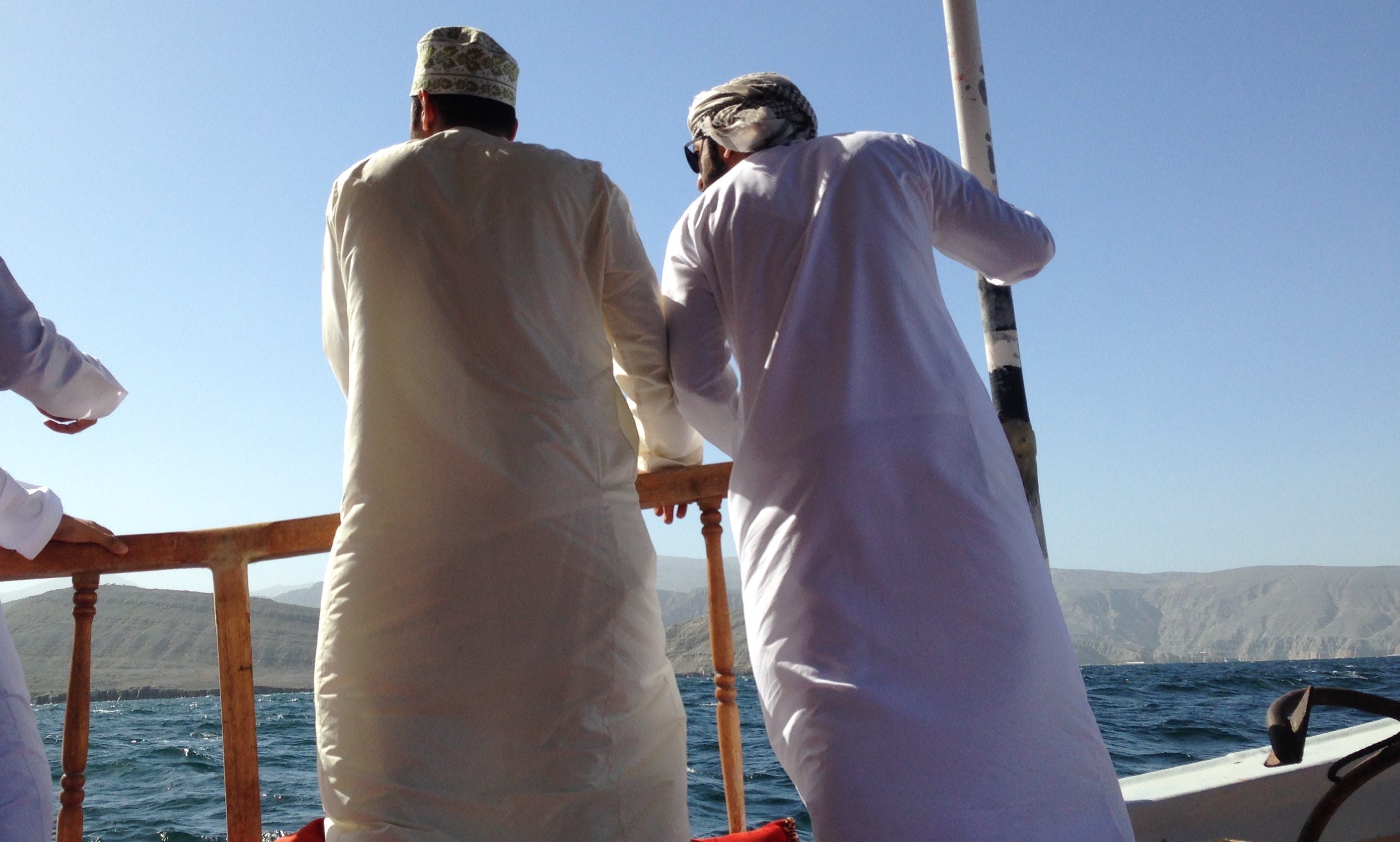
That morning, I joined a group of Omanis from Nizwa, a few hours south of Muscat, who had come to Musandam to see the fjords. They were bundled up in jackets and winter hats, bravely facing the 65-degree temperatures. A Khasabi onboard told me he was showing his Nizwi friends around. We laughed as our wooden boat hit rough currents, creaking and moaning in the waves.
Thinking I might learn about the smugglers from my Khasabi boatmate, I asked about muharaboon, Arabic for “smugglers,” which unfortunately carries a more criminal connotation than the English. My new friend wagged his finger at me, saying “smuggling” was not illegal in Oman. Omanis don’t take boats to Iran, he told me, they just sell goods to the Iranian men who come to Khasab in the morning and leave in the evening. By his reckoning, it’s the Iranians who were breaking laws, not the Omanis. I could see how it might be exhausting to explain this intricate system of illicit international trade to curious outsiders and didn’t press the matter further; later, I overheard him talking about goats, electronics and cigarettes while pointing out a skiff to his friends from Nizwa.
The scholar Michael Benz has observed that most of the allure around smuggling in Khasab seems to emanate from travel writers and journalists who “systematically try to sound adventurous and mysterious” in their dispatches. To the more neutral observer, the industry is fairly quotidian. Shops in what locals call the “Iranian souq” are all licensed as import-export businesses and operate wholly within Omani law. At the port, trucks carrying goods to be sold to the Iranians pass through a Royal Oman Police checkpoint and a customs depot where their goods are weighed and taxed. For the three days I spent in Khasab, I saw no more than a few dozen boats that were obviously smugglers. And of those, I caught a glimpse of only one instance of a truck offloading its goods onto the dock to be sent to Iran: crates of Lipton tea. Iranians who come to Khasab risk their lives taking small boats on the high seas; to Omanis, they are just like any other guest workers or passers through, and just the most recent iteration of an interconnected, centuries-old form of trade.
Many writers have called the Omani government’s stance on smuggling a “blind eye,” which seems appropriate, considering the otherwise friendly relationship the sultanate has with Tehran. In December 2015, Oman and Iran held joint military exercises in the Strait of Hormuz, the latest in a series of occasional war games held by the two countries. Joint agreements were signed in both 2013 and 2015 to boost military ties between them, drawing the ire of perennially suspicious Western observers. Iran, for its part, claims it wants to be able to secure safe passage for shipping.
Iran’s state-run English language service Press TV covered the war games, reiterating that “Iran and Oman are both in charge of maintaining security and stability on the two sides of the Strait of Hormuz,” a fact many Western governments are loathe to remember. Iran has a long history of anti-Western and anti-GCC (Gulf Cooperation Council) rhetorical grandstanding, and makes no exceptions for discussing the strait, which it has often threatened to close.
In April 2015, the container ship Maersk Tigris lumbered past the island of Kumzar when bullets whizzed over its deck. Within minutes, members of Iran’s Revolutionary Guard Corps had boarded the ship and redirected its course for Bandar Abbas. The ship and crew were detained by the military over a grievance issued by an Iranian court against the Maersk corporation, over containers it says were mishandled (and ultimately impounded) in Dubai in 2005. It was strange timing, on the eve of a breakthrough between the nuclear deal negotiators, and seemed less about the grievance with Maersk and more about reminding the West that the Iranian military has an expansive vision of its maritime jurisdiction. Oman played no role and offered no comment.
Many analysts have speculated that Iran will seek to control or even invade Musandam, giving it control of both sides of the strait. That seems unlikely. Khasab often feels like a military installation first and a port town second. The air force base takes up half the village, and Oman’s Royal Navy and Defense Ministry likewise have a substantial presence. Despite Oman’s close ties with Iran, it is also a direct and valued ally of the United States, and the US aircraft carriers that float around the Gulf would no doubt come to Oman’s assistance in the event of a crisis.
But considering Iran’s potential for increased antics, bypassing the strait is a logistical puzzle that Saudi Arabia, Qatar and the UAE have all laid out plans to solve. Only the Emirates has the port of Fujairah, on the Gulf of Oman side of the strait. But Fujairah’s overland pipeline is inadequate to transport quantities of oil from the UAE comparable to its loading terminals in the Gulf.
Similarly, the Omani government has poured billions of dollars into the redevelopment of its ageing ports and the construction of an entirely new deepwater port and free zone in Duqm, a fishing village of a few hundred people before construction began. With Duqm, the idea is that overland pipelines and trains for cargo from the UAE and Saudi Arabia might ultimately give them a way to circumvent the strait entirely and attract Chinese investments. Oman has thus hung its future ambition on the idea that it can be a strategically useful node in the logistics economy.
Until then, Musandam lends economic and political power and responsibility to Oman, gesturing at the sultanate’s maritime past and giving it a voice in contemporary geopolitics. The world’s superpowers and biggest corporations have all spent time worrying about the narrow stretch water offshore from Musandam, and many have expressed relief over Oman’s temperament of security and stability.
As the Nizwis and I arrived at Telegraph Island in our wooden dhow, deep in one of the rocky fjords of the Musandam, I looked out over the water as the Khasabi told me about a battle between the Portuguese and the Omanis in the 1600s.
“Makaan istratijia,” one of the Nizwis muttered. A strategic place.
Scott Erich is a visiting assistant professor at Washington College. His ICWA fellowship (Oman 2015-2016) explored the intersection of culture and rapid development, including ethnographic research on visitation rituals and the maritime history of the region. Scott researched Omani and Emirati fishermen facing environmental and industrial challenges for his doctorate in anthropology from the CUNY Graduate Center. He also holds a certificate in Arabic language and cultures from the University of Chicago and a BA from Gettysburg College.