


Some eight decades ago, well before he was born, a Nigeria-born immigrant in Philadelphia named Olusegun Jaji received a gift from a public works planner in the British colonial service in Sierra Leone.
Back then, Robin Halliday MacCartney decided that a Royal Air Force base should replace an aging airport in the then-colony’s largest city, Freetown. The decision solved the problem of its deteriorating runways but created another one: What became the new Freetown International Airport was notoriously difficult to reach from the capital.
It would take another half-century until Jaji addressed MacCartney’s folly. In so doing, he created a thriving enterprise, generating wealth for himself, his business partners and the country.
When Jaji had first arrived in Philadelphia in 1996 with a Nigerian MBA degree at age 29, the best job he could find was as a parking garage attendant. But pretty soon, he was managing a string of parking garages and went on to launch a car business of his own: restoring junkyard wrecks and selling them to other African newcomers.
“I’d get them for $300 and sell them for $3,000,” the 59-year-old said with a smile. “Some of my buyers, I let them pay off by the week: $150, $200.”
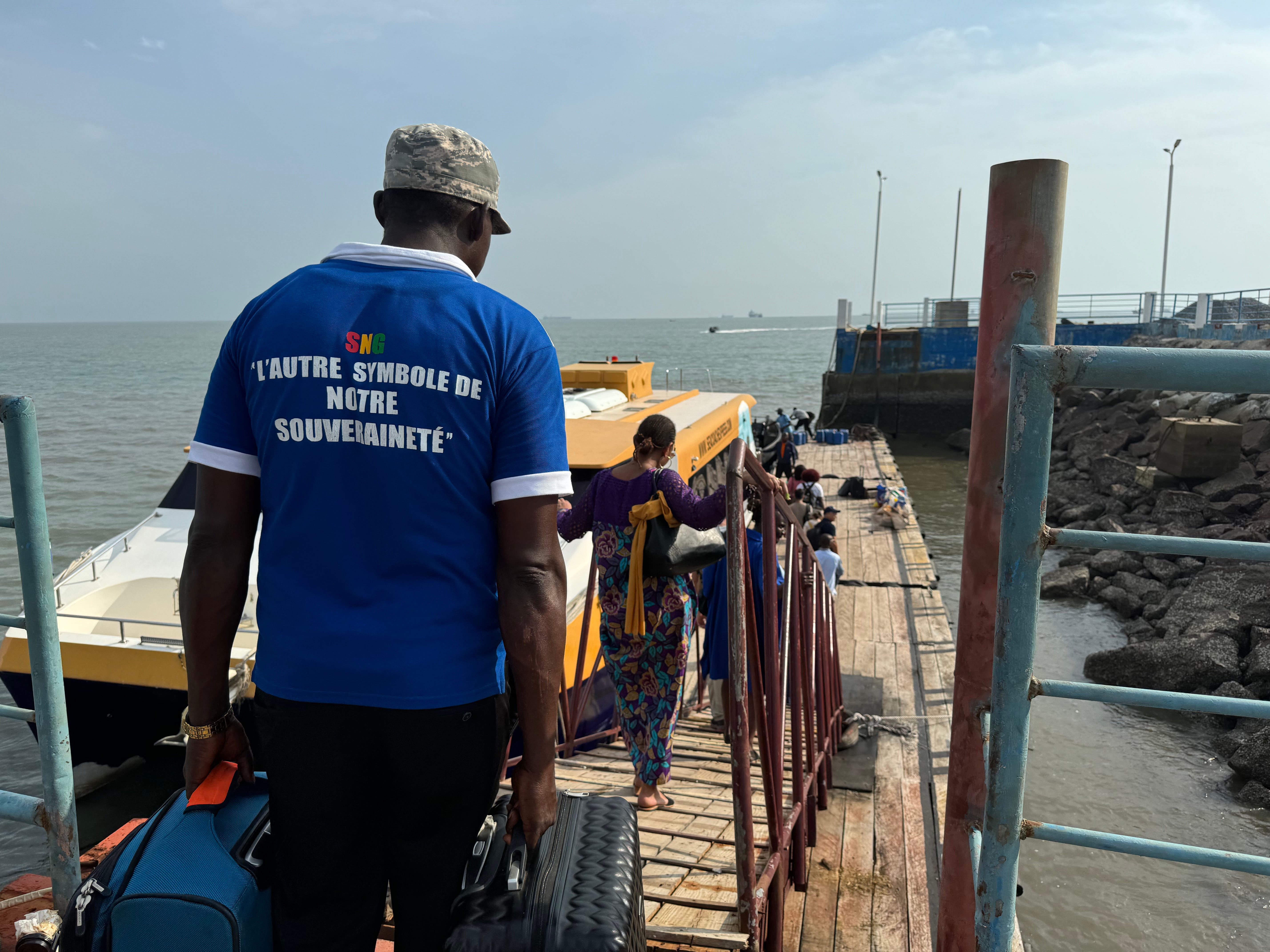
Jaji’s sense of know-your-product, know-your-customer led him to go on to launch a water-taxi service that today grosses millions of dollars a year by connecting Sierra Leone’s biggest airport to Freetown. He has other sea craft operations in neighboring Guinea and a third enterprise serving coastal Nigeria. Together, his companies provide jobs for some 300 people.
Jaji’s strategy of solving local problems by thinking globally is an important model in an ever-shrinking world, especially for Africa, and it may be catching on.
Foreign direct investment (FDI) on the continent more than doubled in just two years recently—from $40 billion in 2020 to $83 billion in 2022, according to the African Development Bank. The research, led by the bank’s then-president Akinwumi Adesina also showed that much of the wealth was being propelled by African expatriates in Europe, Asia and North America. That was not counting nearly $100 billion in annual remittances to Africa.
“The African diaspora has become the largest financier of Africa,” he told a conference at the time.
Each migrating professional represents a loss of $184,000 to his or her African homeland—this costly investment that Africans spend on their own citizens’ education effectively becomes a subsidy some of the world’s poorest nations provide the richest.
Other statistics were less encouraging. Some 20 million Africans currently live outside the continent, doubling in a generation. They are largely professionals, among their countries’ best trained and educated citizens. Even now some 70,000 skilled professionals are leaving Africa annually, their foreign earnings adding to the $50 billion or more the World Bank estimates diaspora Africans keep offshore.
It’s a vicious cycle. With an estimated 10-12 million young Africans joining the labor force at home each year, Africa is creating barely 3 million jobs annually, hardly enough. That inevitably leaves many of its best workers unemployed, forced by limited opportunities to seek work abroad. Today, there are some 11 million emigres in Europe, with another 8 million in North America, the Middle East and Asia.
Each migrating professional represents a loss of $184,000 to his or her African homeland, according to UNCTAD, the UN Commission for Trade and Development—the amount Africans spend on their own citizens’ education only to have those students leave to work abroad. This costly investment effectively becomes a subsidy some of the world’s poorest nations provide the richest.
But the dynamic isn’t necessarily all bad for African countries because the diaspora may give hope for more prosperity in its members’ homelands. Migration boosts capital flows back to Africa, first as remittances to family and others, then with the promotion of trade and direct investment. Migration also enhances Africans’ knowledge and spurs technology transfers.
Entrepreneurs like Olusegun Jaji represent two sides of the same coin: leavers who become productive returners.
After establishing himself as a junk-vehicle rescuer in Philadelphia, he discovered that what worked with restored cars could be applied to neglected real estate across a city where row houses stood abandoned by the thousands in the 1990s, many available for as little as $1.
He made his first purchase from the government, paying the Department of Housing and Urban Development (HUD) $60,000 for a single-family home that he later sold for three times the price to an immigrant from Benin. Jaji came to own some 30 properties he refurbished himself. “Some were in very bad shape,” he said.
Such holdings are not unusual in Philadelphia, where University of Pennsylvania researchers have tracked thousands of African migrants active in the local housing market. Nearly 70 individual Nigerian investors each own at least 10 buildings, according to property rolls on the city’s data portal. Together, they comprise a new generation of homeowners raising property values across the city.
Jaji converted one of his larger properties into a nightclub—which later became a mosque—where he met a politician from Sierra Leone in 2008 who was hosting a campaign event for diaspora voters. He suggested Jaji visit his home country to scout for business opportunities.
He found one upon landing on a flight from Europe.
Freetown International Airport is located in the town of Lungi across the Sierra Leone River from a long peninsula where Freetown juts into the Atlantic Ocean. Driving along the coastal route between them can take as long as five hours, making a taxi ride expensive. Alternatives over water, by ferry or helicopter, were neither frequent nor reliable.
Waiting for a hovercraft to Freetown for five hours, Jaji said, “I thought, ‘There has to be a better way.’” He decided to launch his own water taxi service on the spot. He sold four Philadelphia properties to capitalize his start-up, raising around $500,000 to build a jetty, and searched for discarded boats to refurbish.
Back in the United States, he spent time training with an old sea captain at a boat repair yard near Barnegat, New Jersey. “I learned everything: welding, diving, galvanized pumps, chains, cleats, ropes. You name it,” he said. “Barnegat was my university.”
Starting with six boats he found in China, Jaji launched his airport water taxi service, called Pelican, in late 2009.
The difficulties were daunting. Local regulators shook him down for payoffs, and local partners froze his assets then took him to court to demand a larger share of profits. Jaji spent 10 days in jail in 2011 after being accused of using his boats to smuggle drugs into the capital. He shut Pelican down, ditched his local partners and relaunched the service under a new name.
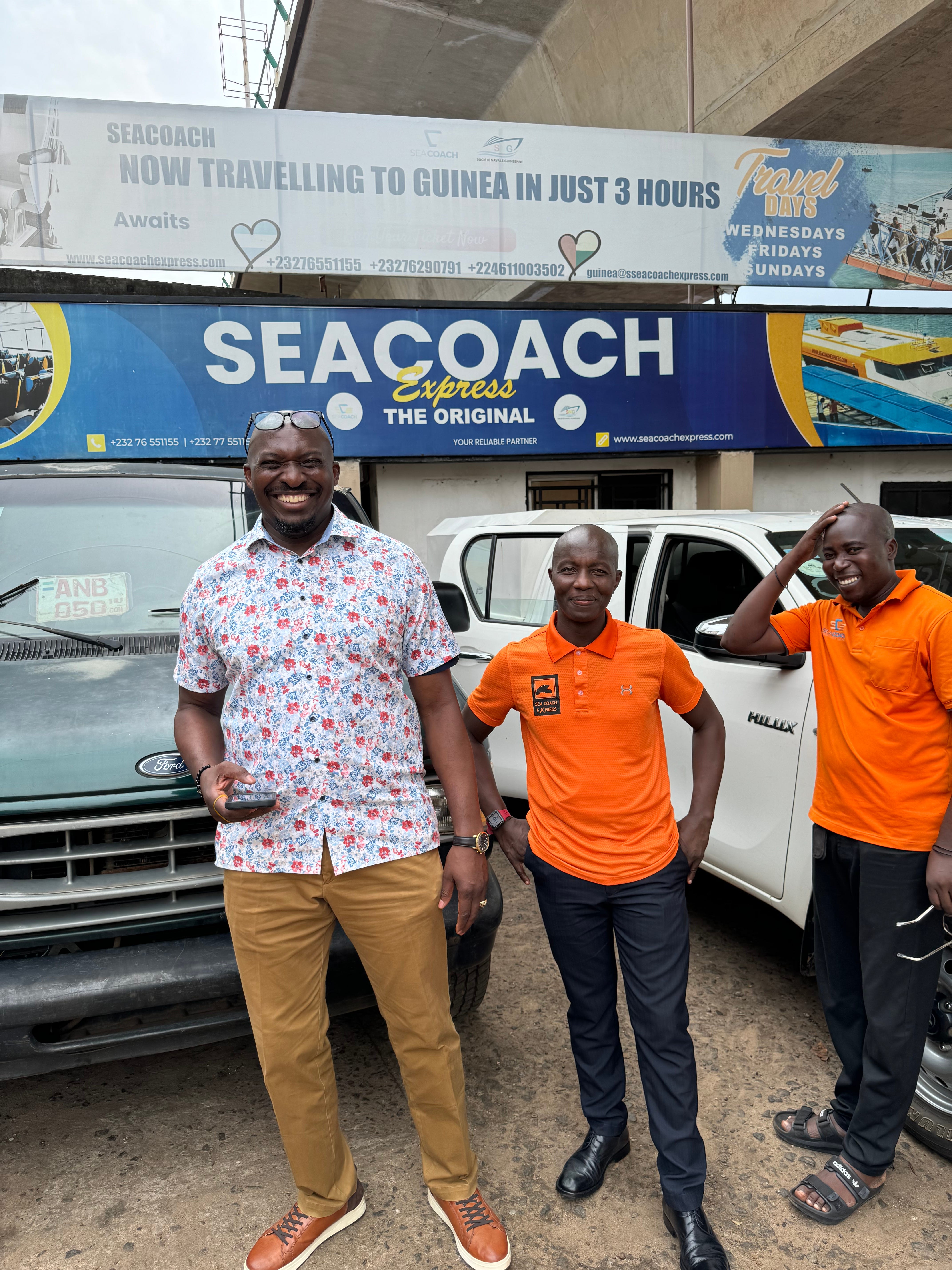
Today, Sea Coach Express runs 50 boats operating in three countries in Sierra Leone, Guinea and his native Nigeria. Jaji says his boats handle around 90 percent of the Freetown-bound passengers arriving at Sierra Leone’s airport. At $45 per trip per person, that tallies to some $5 million in annual revenues.
His story illustrates how brain drain also helps facilitate a mirror process that could be dubbed “brain chain.”
Rashid Conteh, a 56-year-old graduate of London’s Kingston University, spent over half his life in Britain, where he established a furniture manufacturing business. He returned to Africa in 2005 as a dual UK-Sierra Leone citizen and exporter, bringing in his furniture line to wholesalers in his native country. That led to other opportunities, starting with a staple food.
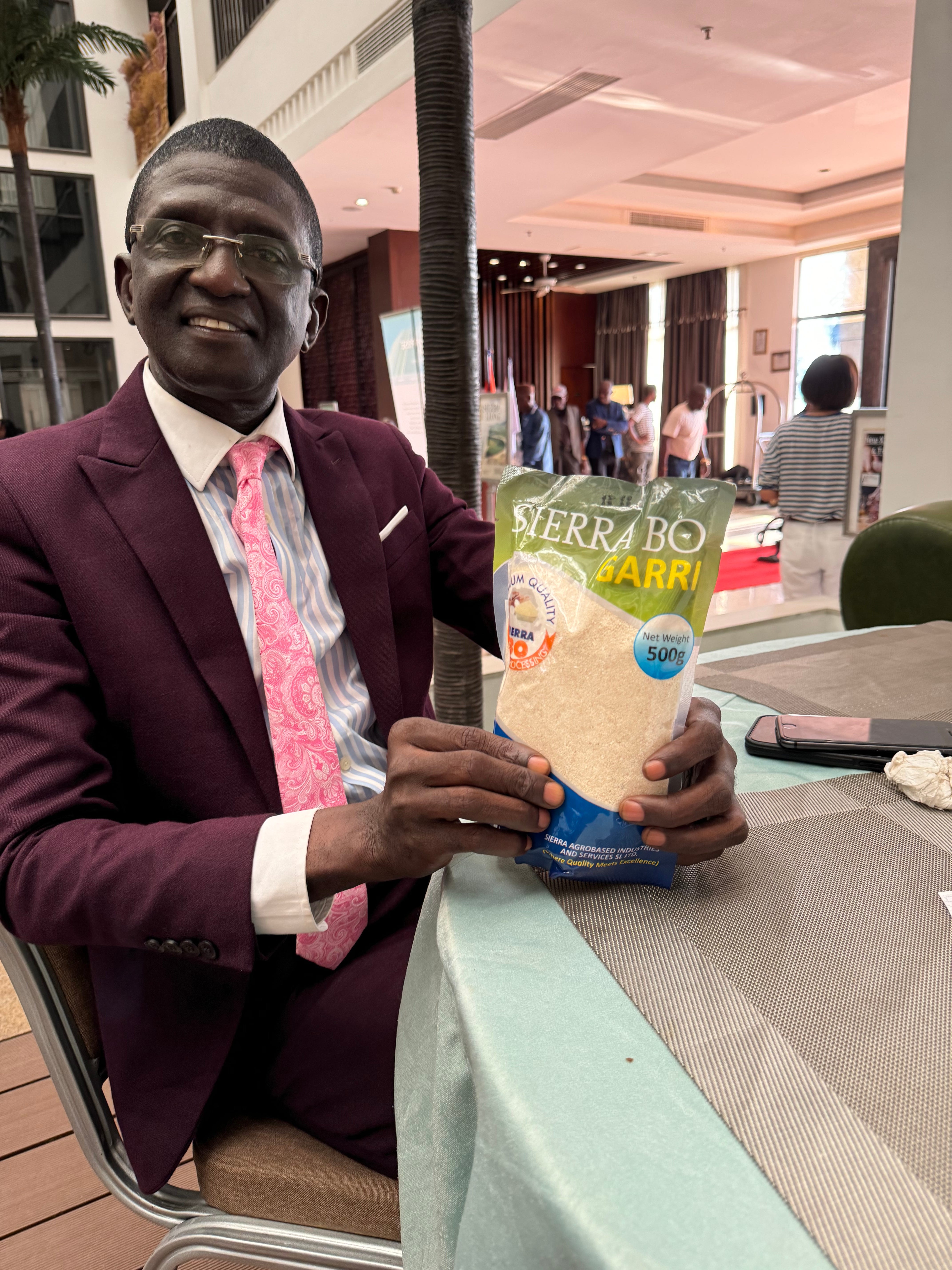
“Sierra Leone imports $250 million in rice annually,” he said, or nearly $1 million daily. Seeking an import-substitution model, Conteh explored growing the crop efficiently enough to replace some of the volume imported. Instead, he turned to cassava, a tuber native to Brazil that’s milled into a pellet resembling rice. It’s already a staple in Africa served under the monikers attieke and couscous. In Sierra Leone, it’s known as garri.
“We discovered we had no competitive advantage growing rice but plenty for garri,” Conteh said, pointing to the country’s 5.5 million hectares of arable land, of which less than 6 percent is currently under cultivation.
Conteh’s company Sierra Agrobased Industries and Services launched in 2013 with an investment of just under $1 million raised from his furniture business. That startup has grown from three employees to 45 and “indirectly, hundreds more,” he said.
Thirty-six-year-old Alexander Tounkara Kone returned to his native Guinea by a route more circuitous than most. He first came to the United States as a junior high school student speaking almost no English, and went on to earn degrees at two Ivy League schools, Brown University and the University of Pennsylvania’s Wharton School of Business. Along the way, he launched a second career as an athlete, excelling in American-style football—first at Brown, then as a practice player for top US professional teams—eventually taking his talents to Europe, where he starred as a wide receiver for the Berlin Rebels.
In November 2024, Tounkara’s Amsterdam-based Niandan Corporation launched Guinea’s first impact venture capital vehicle, The Nimba Fund. Today, Niandan and Nimba work to identify, mentor and finance enterprises in Guinea with the aim of creating jobs for young Guineans while growing profits for investors.
Although Guinea’s people are among Africa’s poorest, the country is among the continent’s richest in mineral wealth. Iron ore, bauxite, gold and diamond extraction are expected to draw $40 billion in foreign investment over the coming decade.
Some of that investment has begun arriving for the Simandou iron ore project, a joint venture between the mining giants Rio Tinto of Australia and China’s Bawou Resources. The project’s many contractors and subcontractors are required to invest in community improvement throughout the mining zone. That promises to attract the investors Tounkara intends to support and advise.
For now, the company is sticking to making equity investments by its Nimba Fund and offering clients technical assistance through its impact assistance facility. The investments are modest so far, some $9.3 million advising global investors putting their capital into Guinea’s mining sector. Another 114 local entities have been identified and tracked as potential suppliers—Guineans with small businesses Tounkara’s team believes can be mentored into big ones.
“Every opportunity is assessed for what additional impact our capital can have,” he said. “We take a forward-looking view.”
Back in Sierra Leone, Olusegun Jaji recently opened an international seaborne service connecting Freetown to Guinea’s capital Conakry. Located near each other on Africa’s Atlantic coastline—what should be a 20-minute flight—the two cities have no commercial airline service between them. The only alternative was land travel, which can take as long as 12 hours each way. The new Sea Coach Express service takes three hours, operating thrice weekly at a cost of $100 each way. Immigration and customs services are in place at both ends.
Jaji also offers charter services for tourists, sport fishermen and, increasingly, mining engineers. For $2,000 a day, Sea Coach Express can bring a team of mining executives and engineers close to operations in Guinea or Sierra Leone’s interior by dropping them at fishing towns far from either nation’s capital. While not as lucrative as his Freetown airport operations, those charters are helping Jaji build credibility for future operations, especially as Guinea’s big Simandou iron ore project proceeds.
“The African coast,” he says, “is wide open.”
Joel Millman is a journalist and community organizer based in Philadelphia. He covered immigration and Latin America for almost 30 years, mainly for The Wall Street Journal, before working as a press officer for the UN’s International Organization for Migration in Geneva. His interests include refugee protection and resettlement and assisting US communities as they pursue successful integration of migrants in their midst. He was a fellow of the Institute of Current World Affairs in Central America from 1987 to 1989.