


Ann Mische is interim director of the Kellogg Institute at the University of Notre Dame, where she’s an associate professor of sociology and peace studies. Known for her contributions to the field of political and cultural sociology, she examines processes of civic deliberation, social justice and political change, with a focus on social movements and democratic politics.
Ann has been editor and served on the editorial boards of numerous sociology journals. Her 2008 work Partisan Publics: Communication and Contention across Brazilian Youth Activist Networks received an honorable mention for the Best Book Award in Political Sociology from the American Sociological Association.

After she received her bachelor’s degree from Yale, Ann’s ICWA fellowship examined youth and education in Brazil from 1987 to 1990. In the April 1989 dispatch from which this excerpt is taken, she finds the roots of the environmental movement in the Amazon in the land reform and labor movements of Indigenous people.
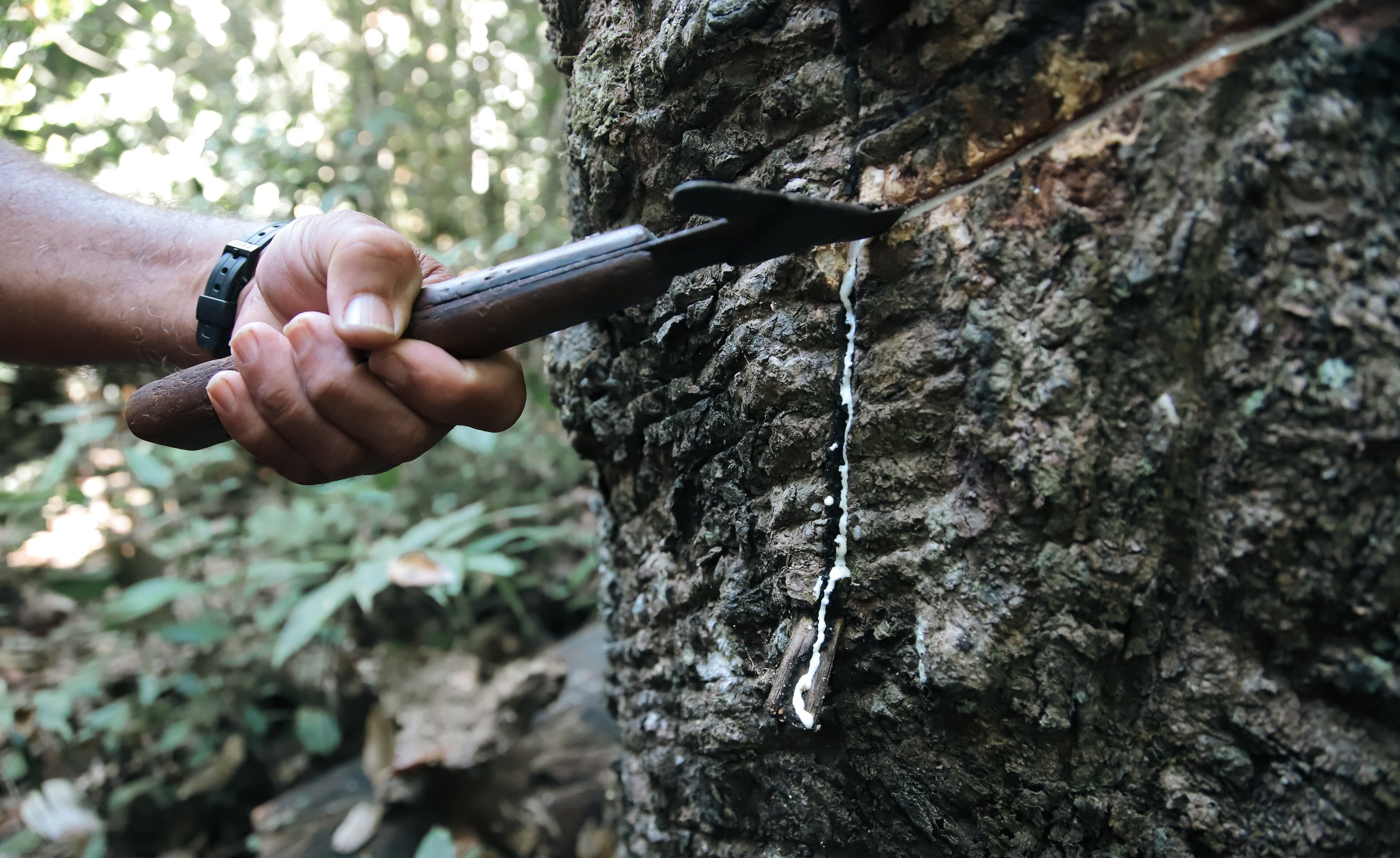
RIO BRANCO, Brazil (April 1989) — Seu Miguel invited me to take the knife and make a cut in the tall and ancient seringueira. The bark of the rubber tree was crisscrossed by a matrix of parallel slashes, the scars of over 60 years of continuous tapping. “Won’t it hurt the tree?” I asked rather timidly. Seu Miguel laughed at my reticence, and, gaining courage, I took the knife and slowly and firmly cut a shallow, parallel line immediately below the cut Seu Miguel had just made.
Within seconds, milky drops were forming, and as I and the other gringos watched in awe, the latex began to drip down into the tin cup Seu Miguel had fastened to the tree. We felt almost religious as we gathered around the tree, surrounded by dripping green forest, spattered with mud from the path the March rains had made nearly impassable.
To arrive at this seringueira, we had walked 40 minutes through the forest after having driven for three hours dodging floods and potholes on the only road (if it can be called that) that connects Rio Branco, the capital of the state of Acre in western Amazonia, to the rest of Brazil. With me were a Dutch couple, a young German journalist, an Italian union consultant and our guide, Sebastião, a young leader of the Union of Rural Workers of Rio Branco. A parcel of youngsters danced around us, grandchildren of Seu Miguel, whose family had tapped those rubber trees for over 30 years. The children were as fascinated by us as we were by the dripping latex, which turned into course, elastic grains as we rubbed it between our fingers. I would have thought our reverence was nothing more than gringo romanticism had I not heard the identical emotion expressed in a poem written by a local rubber tapper, a variation on the Our Father:
Seringueira, who is in the jungle,
Multiplied be your days.
Let your milk come,
Let our rubber be made,
Here on the press, as in the cashbox.
Give us this day and every day
For the sustenance of our children
Pardon our ingratitude,
As we confront the evils of the boss.
Help us to liberate ourselves
From the claws of the middleman. Amen.
In this prayer, one finds not only the devotion of the seringueiros (rubber tappers) to the trees they tap, but also the difficulties they face in the production and sale of their rubber. A discussion of the growing resistance of the seringueiros to the exploitation of themselves and of the forest had brought us to the woods that day. Our goal was to understand the “reality” (as outsiders say rather presumptuously) of what we had heard so much talk about during the past week of discussions between rubber tappers, Indigenous communities, agricultural workers, union leaders and observers from over a hundred governmental, national and international organizations.
The events that had united such a mixed crew in that corner of Amazonia were two simultaneous conferences in Rio Branco from March 25 to 31, the II National Encounter of Seringueiros and the I Encounter of Peoples of the Forest.
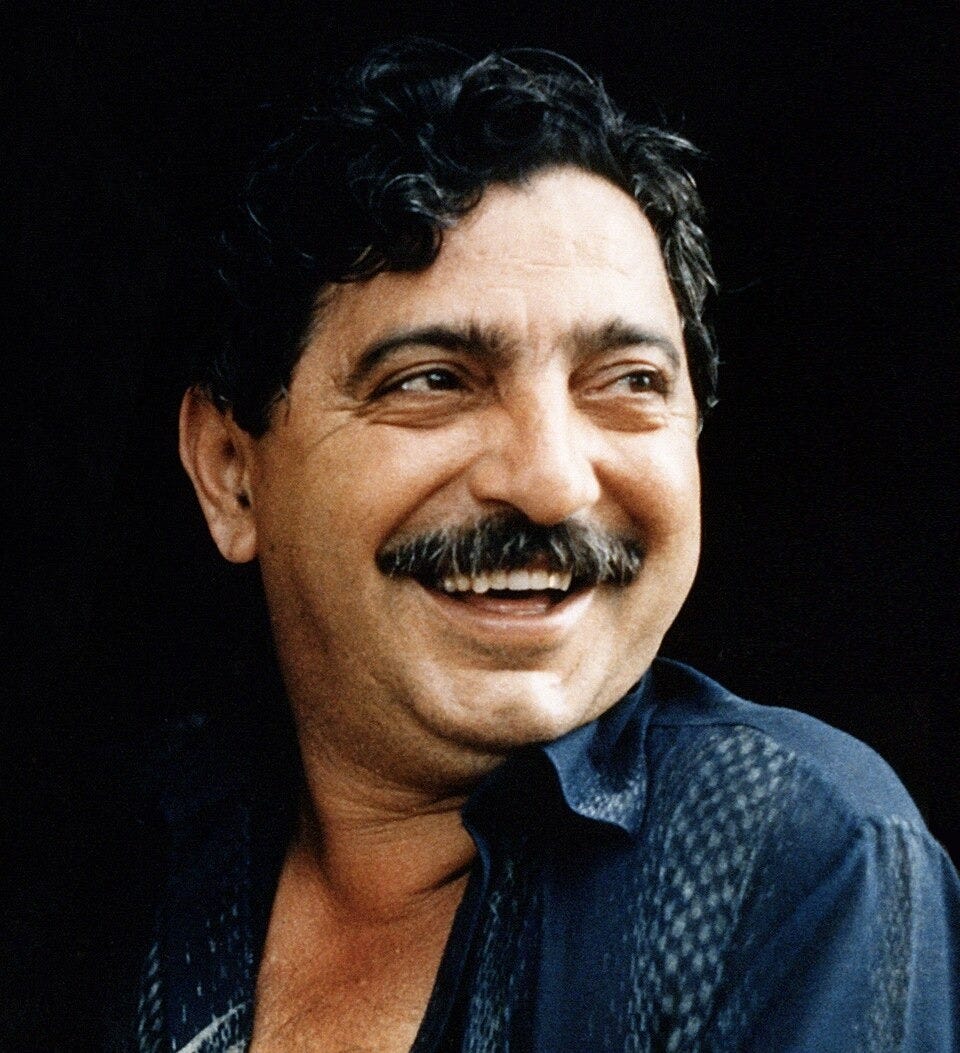
The person who had attracted such a heavy turnout of outsiders to the encounter was significantly not there. An empty chair was placed on the platform during the opening ceremonies to invoke the presence of Francisco Mendes Filho, union leader and ecologist whose assassination last December aroused international attention. Chico Mendes, as he is known here, would have presided over the encounter had he survived three months longer.
Although Chico himself was a seringueiro of simple origins, he was internationally recognized for his charismatic leadership in organizing local forest workers to prevent deforestation by the latifundiarios (large landholders) who are buying up Amazonia. He had served as a consultant to the World Bank and the US Senate on investment in the Amazon, and was developing a project with the Inter-American Development Bank for the non-destructive exploitation of forest resources by the local population. In 1987, he received the Global 500 award from the United Nations, as well as the environmental medal of the Better World Society.
But in Brazil, he was little known outside environmental and labor circles until his assassination on December 22, 1988, in the town of Xapuri, in Acre, where he was the president of the Union of Rural Workers. His probable assassin was a family of local farmers whose land had been expropriated to create a rubber-tapping reserve. Suddenly Chico Mendes became headline news in Brazil and the world, arriving as far as the front page and a leading editorial of The New York Times.
The disconcerting result of the hoopla about Chico Mendes was that at this encounter of seringueiros and Indigenous groups, there were more outside observers (274) than seringueiros (169) and Indigenous people (67). The contrast at times was comical. The floor of the covered gymnasium of Rio Branco was occupied by rows of rustic delegates from the seringals and roçadas (subsistence farms) of five states in the Amazon region. Many of them had traveled days on foot and by boat to arrive, somewhat abashed, in the capital city. One of the delegates told me in tones of awe that he had never ridden in a bus before.
The bleachers above them were filled with eager and mostly pale-faced observers, representing environmental groups, labor unions, political parties, government agencies, research organizations, student associations, newspapers and television. They were armed with cameras and notebooks and could be distinguished by the clothes they wore and often the languages they spoke from those they had come to observe. Among the international organizations represented were OXFAM, the Better World Society, Greenpeace International and numerous European environmental leagues. And the biggest star presence of international journalism was Alexander Cokburn of The Wall Street Journal.
Some of the delegates expressed irritation at all the attention. After all, the observation was rather one-sided, a bit like being in a zoo: “They come here and ask us all these questions but we don’t know anything about them!” The observers were asked to withdraw during the small group discussions about the living and working conditions in the forest, so as not to embarrass the often poorly educated delegates from saying what was on their minds. And the delegates had important work to do: discuss strategies to prevent deforestation, pressure the government to establish Indigenous and extractive reserves, strengthen the unification of seringueiros and Indigenous communities through the newly formed Alliance of Peoples of the Forest, and elect the new leadership of the National Council of Seringueiros.
But why was there so much interest in an encounter of rural workers in a corner of Amazonia? Chico Mendes aside, what one saw in Rio Branco was a convergence of some of the hottest themes on the world scene. Where else would one hear debated in one place the questions of ecology, of land control, of Indigenous peoples, of rural violence, of agro-business and Third World debt?
Where else would one find such a good story for the “tropical chic” that is sweeping Europe and the United States, where George Bush joins hands with Sting, the Grateful Dead and TIME magazine to protest the destruction of the Amazon? And where else would one find in real life all the drama of a good Western: Local hero mobilizes population to confront the bulldozers and is shot down by a gang of pistoleiros who terrorize a small rural town? The script is so good that the current competitors for rights to a film about the life of Chico Mendes include Robert Redford, Costa-Gavras and Ted Turner.
But behind the glitter, one finds a serious and unresolved question. The development of Amazonia has begun (and has, in fact, been going on since the 1850s.) Who, now, will control that development, using what technologies, and for the benefit of whom? This is a social and political question as well as an ecological one and involves high stakes for various opposing interests.
In its customary shortsightedness, the Brazilian and international press has sought to turn Chico Mendes into an ecologist. Chico himself was accustomed to saying that he became an ecologist by necessity; he began his fight as a labor organizer who sought to combat the century-long system of exploitation that had kept the seringueiros in a state of near slavery and that he himself had personally experienced from the age of nine.
But when he gained the political maturity to begin the struggle for the “liberation” of the seringueiros, the entire Amazonian region was in a process of violent transformation. The traditional system of the rubber barons was in decline and the government was financing the rapid development (read: devastation) of the forest by the newly arriving latifundiarios. The scope of the struggle expanded before the eyes of the seringueiros; suddenly it was not simply their own livelihood and right to autonomous production they needed to protect, but the forest itself.
From the labor disputes of poor and mostly illiterate forest workers has developed one of the current moment’s most innovative and politically defiant proposals for land reform and for ecologically sound economic development. It is so politically defiant that its principal articulator did not survive to see its implementation.