



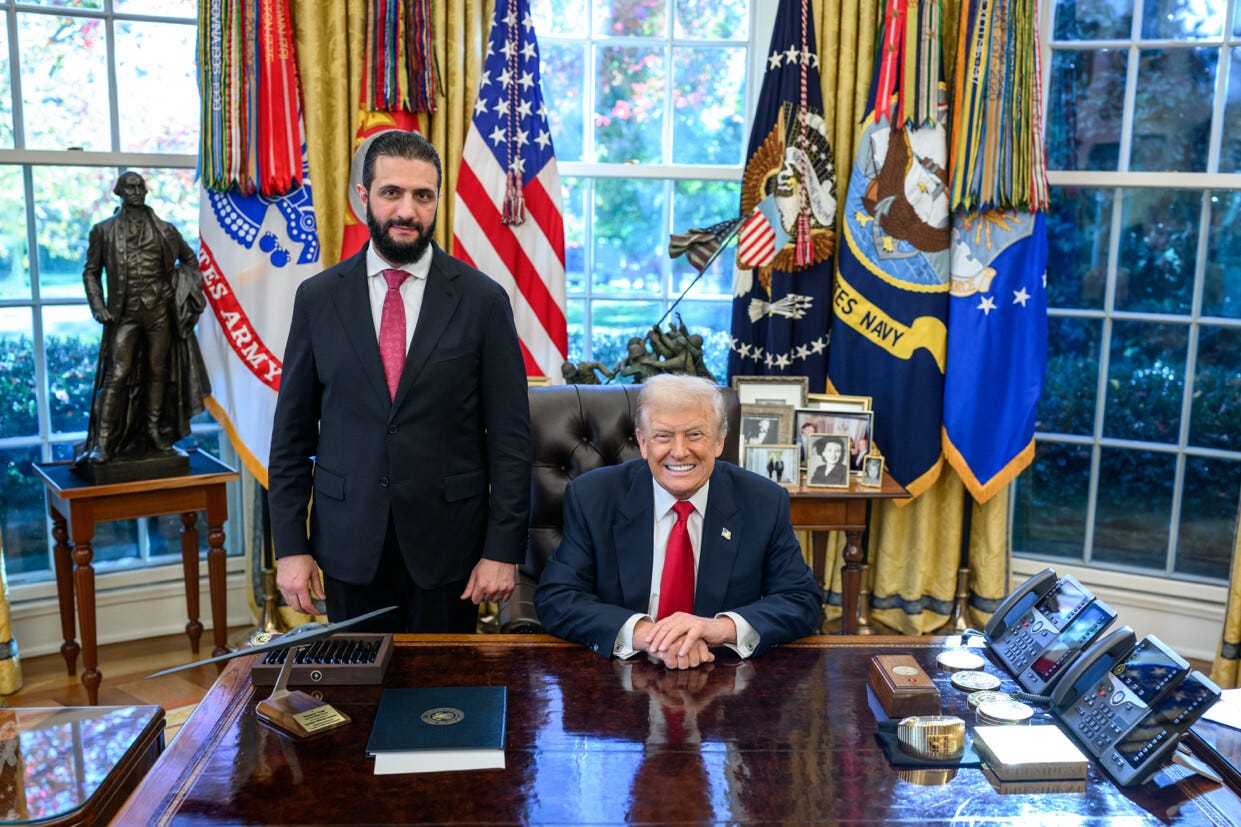
The US Senate is expected to repeal legislation imposing sanctions on Syria this week, shortly after Syrians celebrated the first anniversary of the fall of Bashar al-Assad’s brutal dictatorship in November 2024, which ended the country’s 13-year civil war. But the new state’s future is far from certain.
Even progress on the immediate hoped-for priorities of developing a representative, democratic government, attracting foreign investment and reaching a security agreement with neighboring Israel would represent just the beginning of a long path to stability.
To learn more, Compass’s Robert Coalson spoke to the leading Syria expert Andrew Tabler, a senior fellow at the Washington Institute for Middle East Policy and a former senior adviser to the State Department’s special envoy for Syria engagement. Andrew was an ICWA fellow in Syria in 2005-2007.
The conversation has been edited for length and clarity.
Robert Coalson: It’s been a year since the Assad government was overthrown in Syria. What’s been achieved and how do things there stand?
Andrew Tabler: First of all, you had a brutal regime that’s now out of power, which is a big change, people in Syria are able to look into what happened to their loved ones who went missing. Also, there has been a lot of diplomatic engagement with Damascus to try to bring them onside and that included, of course, with President Donald Trump starting in May. That’s a really big change.
Syrians have obviously been celebrating their liberation. The new interim government is less authoritarian, much less authoritarian, than the Bashar al-Assad regime, although it is still being formed. It’s not a major shift toward democracy by any stretch of the imagination, but it’s better than what was there before. In short, after one year, I think there’s been improvement.
However, a lot of issues remain. There are still a lot of political problems, some of which have to do with minorities—Kurds in the northeast and Druse in the southwest. It’s unclear whether their armed groups can integrate into the Syrian Army—especially because President Ahmed al-Sharaa’s government still has limited control over the country.
Coalson: How is President Sharaa seen inside Syria? As someone able to help overcome the deep ethnic and sectarian divisions to create a workable government?
Tabler: He’s very good at speaking and engaging with people. He has the right approach both to Syrians and the international community. It remains to be seen whether he’s able to cut the kind of deals that will be necessary to lower the political risk in the country and get foreign investment flowing.
Because that’s what Syrians need. They need energy companies to come in and make long-term investments and think they’re going to be able to get their money back. If the government can get some things changed—if they can make a viable settlement—then I think the money will flow. If they don’t, the major companies will stay out and there’s a risk Syrians will be very disappointed with the outcome.
Coalson: The United States could do a lot to help right away, starting with eliminating sanctions against Syria, right?
Tabler: Oh yes, and that’s already happening. They’ve already agreed on a text that’s a lifting of the 2019 Caesar Act sanctions. [After the Trump Administration previously suspended many sanctions, the US House of Representatives voted to permanently end them last week. The measures are part of the 2026 National Defense Authorization Act the Senate is expected to approve this week.] There are some provisions—about eight—that will still be subject to State Department reports, but they’re not binding and they wouldn’t lead to a snapback of sanctions.
The Caesar sanctions were very successful at draining the Assad regime, and now they will no longer be a hindrance to Syria. I think the biggest impediment now is just the lack of capacity of the government.
Corruption, the lack of rule of law and unresolved political problems—those things need to be addressed, and I think that’s what the interim government’s going to focus on in 2026.
Coalson: How is Syria dealing with the issue of justice for crimes committed during the civil war and under the Assad government? Is that a priority or a back-burner issue?
Tabler: A lot of it hasn’t been addressed, and there are still people roaming around Syria who carried out crimes against Syrians. And there are a lot of Syrians wondering about that. The Sharaa government insists they’re going to follow through on this. So far, the pace has been slow and it’s the subject of some criticism. But most Syrians have been pretty patient.
Coalson: I know the Sharaa government is just an interim government and still being formed. Still, is he making any effort to be inclusive of the country’s ethnic and sectarian make-up?
Tabler: It includes people from throughout the country and also some minorities. It’s not quite a complete representation of the country but for an interim government, it’s a step in the right direction.
Coalson: One big obstacle is the problem of a security agreement with Israel. Israel carried out airstrikes and IDF incursions into Syria as recently as last month. How realistic are hopes that a real, lasting security agreement can be forged, and what needs to be done?
Tabler: Israel, after October 7, 2023, has a very different mindset, and it doesn’t trust the security on its frontiers with countries that are at war with it. That goes for Gaza in terms of Hamas as we’ve seen. It also goes for Lebanon with Hezbollah and with Syria. Israel says there are extremist groups in southwest Syria that could be planning attacks across the frontier. And, in fact, there are some extremist groups down there.
So, there is reason to be concerned. But the Israelis want a buffer zone inside Syria and the Syrians want to return to the December 8, 2024, line, outlined by the 1974 disengagement agreement. In a larger sense, any kind of agreement would constrain Israel’s ability to act militarily inside Syria, to fly over the country and, of course, bomb things inside the country. Israel doesn’t want to be constrained. Israel is concerned about jihadis who are in and around the Sharaa government and also the role of Turkey.
Coalson: Is there a potential role for international peacekeepers? Has that been discussed?
Tabler: It has been in terms of trying to resurrect the 1974 disengagement agreement, and there are observers now, so there could be an agreement. But it doesn’t seem like we’re close. President Trump has invited [Israeli Prime Minister Benjamin] Netanyahu to the White House to try to deal with this but we’ll have to see what happens.
Coalson: What will you be watching for next year? What’s at the top of the country’s to-do list?
Tabler: Some kind of deal to integrate the Syrian democratic forces—particularly, the Kurdish forces that the US has backed over a decade—into the Syrian military. Will that go well? Also, the negotiations between the Damascus government and the Druse Suwayda National Guard in the southwest.
Those are big, big obstacles, but by-and-large I’m also looking at whether they’re able to pass laws that allow them to bring in the needed foreign investment and whether foreign investors are comfortable with those laws. I don’t think they have a lot of experience doing that, and until that is solved, it’s going to be hard to capitalize on the real opportunity President Trump has given them with the very rapid and blanket lifting of US sanctions.
Andrew Tabler is a senior fellow in the Program on Arab Politics at The Washington Institute for Middle East Policy, where he focuses on Syria and US policy in the Levant. He achieved unparalleled long-term access to Bashar al-Assad’s Syria during his 2007-2009 ICWA fellowship. He has lived, worked and studied extensively in Egypt, Israel, Jordan, Lebanon, Syria, Tunisia and Turkey. His articles and opinion pieces about Middle East affairs and US foreign policy have appeared in The New York Times, The New York Times Magazine, The International Herald Tribune, Newsweek, Foreign Policy and Foreign Affairs. He has also appeared in interviews with CNN, NBC, CBS, PBS, NPR and the BBC. He is author of the 2011 book In the Lion’s Den: An Eyewitness Account of Washington’s Battle with Syria.
Robert Coalson is a retired journalist who spent more than 20 years reporting on Russia, the former Soviet Union and former Soviet Bloc for Radio Free Europe/Radio Liberty.

