


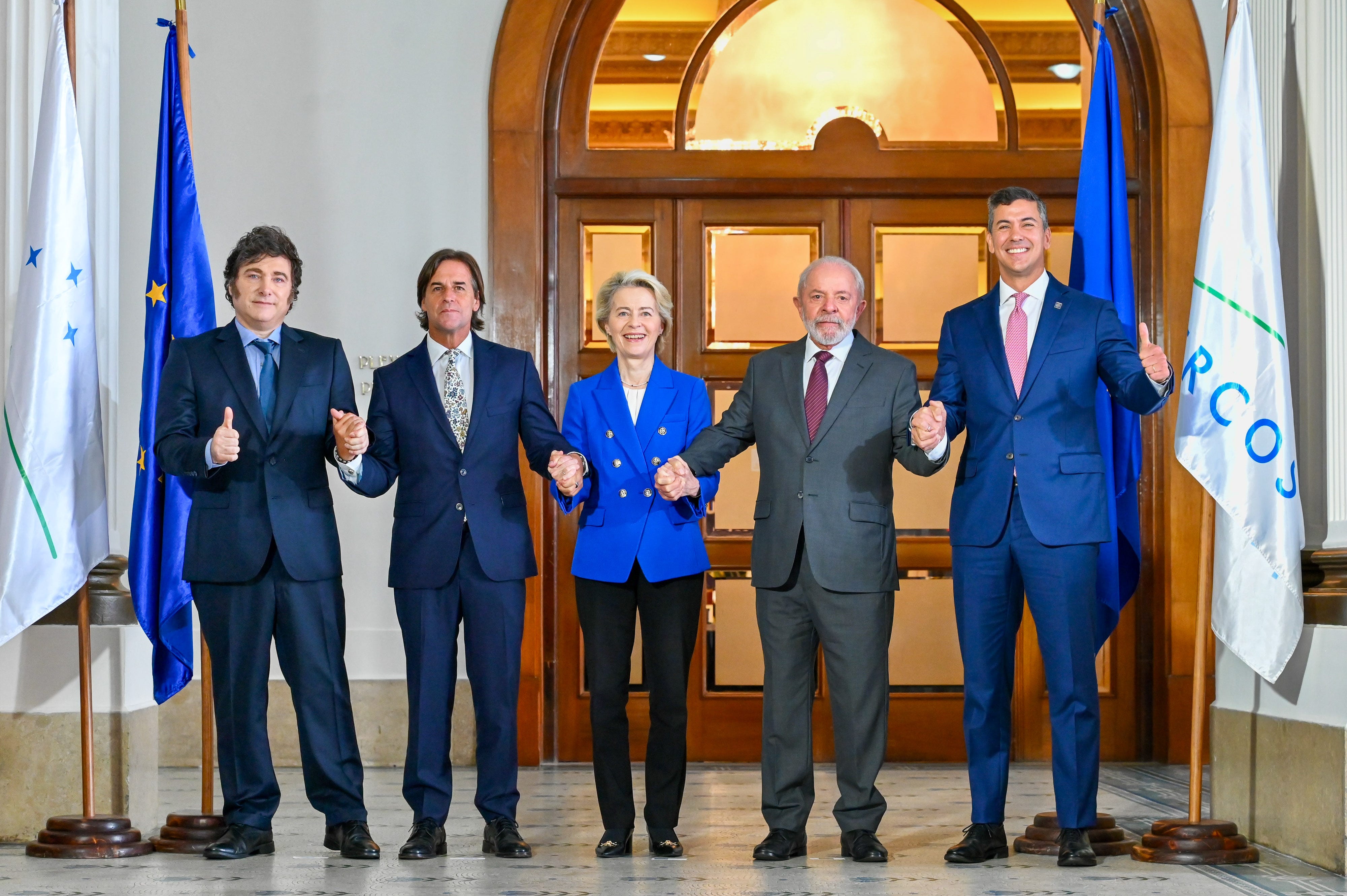
It’s here, finally. After 25 years of negotiations, the European Union plans to sign the largest free trade agreement in its history, with the South American economic bloc Mercosur in Paraguay on Saturday.
One could complain about the time lost over the past quarter-century of delay but coming now, the deal will boost the European economy at a critical time by eliminating some 4.6 billion euros a year in tariffs on EU exports, providing a blunt response to the predatory global tariffs imposed by US President Donald Trump, who’s declared the Western Hemisphere “ours.” The deal will also strike a clear geopolitical blow to Chinese and broader Asian commercial expansion.
The pact will open the doors of Brazil, Argentina, Uruguay and Paraguay, markets whose consumers and businesses purchased 100 billion euros worth of European goods and services in 2025. With safeguards for European agriculture included by Brussels, the signing marks a crucial step toward turning around the lagging pace of economic development on the continent, which has not been performing as it could or should.
The Southern Common Market, Mercado Comun del Sur, or Mercosur, established in 1991, had a GDP of $5.7 trillion in 2023, making the bloc the world’s fifth-largest economy, covering a 2024 population of 295 million people. While only Brazil, Argentina, Paraguay and Uruguay will join the EU arrangement, the bloc also includes Bolivia. (Chile, Colombia, Ecuador, Guyana, Panama, Peru and Suriname are associate countries. Venezuela, formerly a full member, has been suspended since 2016.)
The case is simple for the European Union. Within 15 years, Mercosur will eliminate tariffs on 91 percent of EU exports, including the current 35 percent duty on cars, 27 percent on wine, 28 percent on dairy products and 35 percent on spirits. Customs duties will also be lifted on pasta and baked goods—“Made in Italy” is highly sought-after in Latin countries, where the middle class is rapidly growing and demanding quality. From prosecco to rigatoni, technical equipment to aircraft, the prices for European imports will fall. Demand can only rise.
In return, the EU will abolish tariffs on 92 percent of Mercosur products, balancing the concession with the protection of 344 European geographical indications; Parmigiano cheese, to mention one, may not be imitated. The agreement will also guarantee the quality of new and future imported goods to Europe: They will be blocked if they don’t comply with EU standards because “health is not negotiable,” the European Commission says.
The deal will also facilitate a preferential channel for the purchase of rare South American raw materials such as graphite, nickel and manganese, essential to accelerating technological innovation.
Expect a spicy reaction from Washington. The agreement will make the Western Hemisphere a little less “theirs,” with four dynamic countries soon able to trade with Europe with zero tariffs. Put together, the deal will stimulate the economies of nearly 800 million people. China’s responses are generally more cautious.
But the EU’s success comes at the price of another internal fracture caused by its own fragilities. The agreement was ratified by a qualified majority last week without the countries currently sailing stormy political seas with ruling parties navigating weak or unstable majorities, including Austria, France, Ireland, Poland and Belgium (all abstained). Hungary voted against, but its President Viktor Orbán is now playing in a Eurosceptic league of his own.
German Chancellor Friedrich Merz was jubilant over the deal. But French President Emmanuel Macron failed to convince his country’s farmers and opposition forces wary of an unchecked influx of South American beef. He had no choice but to say “no,” staining his reputation as a great Europeanist.
The Italian prime minister, Giorgia Meloni, faced similar challenges, with ally Matteo Salvini—leader of the eurosceptic populist Lega Party—fiercely against and promising a battle in parliament. But Meloni pursued a smart strategy leveraging her strong leadership. (“I never had any ideological preclusions,” she said in a New Year’s news conference.) She also faced the skepticism of powerful agricultural lobbies she managed to outmaneuver.
The result will be stronger economic safeguards and more money, with the European agriculture sector receiving 45 billion euros from the 2028–2034 EU budget. Few paid much attention to the fact that the budget hasn’t actually yet been finalized, but so be it. The Mercosur agreement is done. The numbers add up and will deliver a healthy injection of trade for Europe. And tomorrow is another day.
Marco Zatterin spent 30 years at La Stampa as Brussels correspondent, head of the economic and financial editorial team, European editor, and then deputy director. He is currently a columnist for the six newspapers of the Nem Group. He has covered and analyzed macro and monetary economics, banks, new technologies and the European integration process. He is the author of several books, including Trafalgar (Rizzoli, 2005) and Il Gigante del Nilo (Mondadori, 2019).
