


Reviewed in this article:
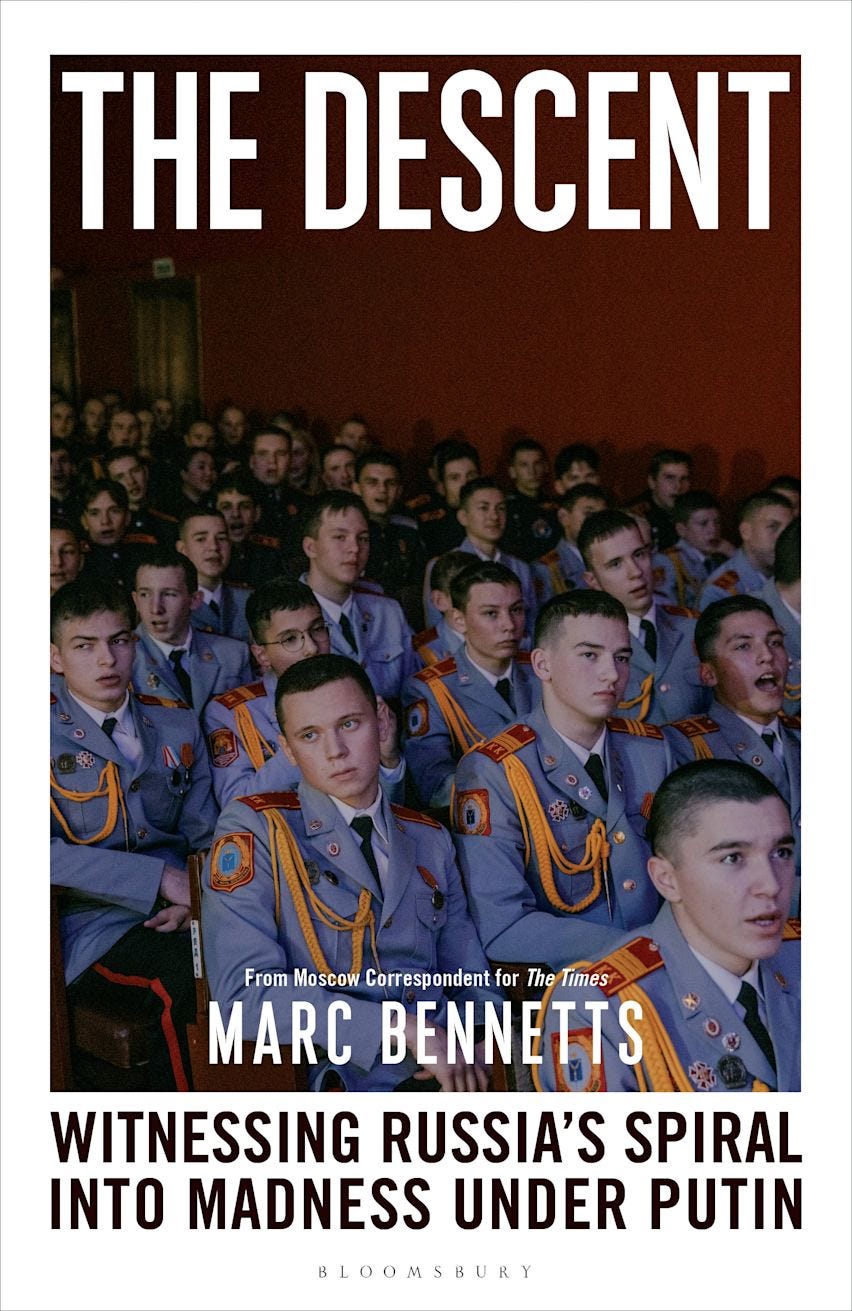
The Descent: Witnessing Russia’s Spiral into Madness under Putin
Bloomsbury Continuum, April 2026
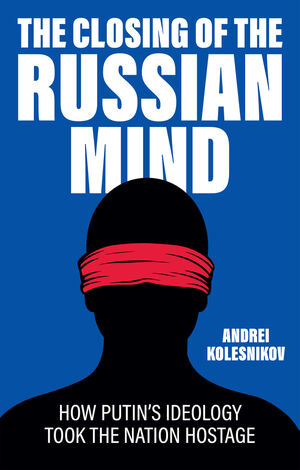
by Marc BennettsThe Closing of the Russian Mind: How Putin’s Ideology Took the Nation Hostage
Polity Press, April 2026
by Andrei Kolesnikov
On May 12, 80-year-old Nina Litvinova committed suicide in Moscow. A tireless dissident and human rights activist, she was the younger sister of Pavel Litvinov, one of eight protesters who famously demonstrated on Red Square in 1968 against the Soviet-led invasion of Czechoslovakia under a banner reading “For your freedom and ours!” Both are grandchildren of Stalin-era Foreign Minister Maksim Litvinov.
Litvinova left a note saying that life had become “unbearable” since President Vladimir Putin launched his full-scale invasion of Ukraine in February 2022. She had worked unceasingly to help political prisoners detained in Russia for opposing the war. “I tried to help them,” she wrote, “but I’m exhausted, and I am tormented day and night by helplessness. I’m ashamed, but I gave up. Please forgive me.”
The tragedy of Nina Litvinova is just one small, heartrending moment in the history of Russia’s devolution from a flawed but aspirational young democracy in 1999 into an ugly, aggressive and ultimately self-destructive hybrid dictatorship under Putin. For many Russians and foreign Russophiles, wrestling to understand that process has produced similar results, to varying degrees, that it did for Litvinova—exhaustion, torment, helplessness and shame.
Two new books have appeared to shed light on what has been done to Russia—and what Russians did to themselves—over the last quarter century: The Descent: Witnessing Russia’s Spiral into Madness Under Putin by Marc Bennetts, former Moscow correspondent for The Times (London), and The Closing of the Russian Mind: How Putin’s Ideology Took the Nation Hostage by the veteran Russian journalist and political analyst Andrei Kolesnikov.
The breathless subtitles already begin to convey the tragic urgency of what has happened. Both merit attention not only for what they tell us about Putin’s horrific war of choice against Ukraine and its broad popular support but also for the warnings they’re flashing to Western societies, some of which also seem to be decivilizing at an appalling rate.
Possessed by a demon
Bennetts spent nearly 25 years in Russia, leaving shortly after the Kremlin launched its 2022 attack on Ukraine. By then, he writes, “the power of Putin’s propaganda machine was truly frightening. It was like nothing I had ever experienced or had ever expected to. Russians had already relinquished many of their democratic rights to Putin in exchange for his promise of economic stability—now millions appeared to be surrendering their sanity as well.” Shortly before he left, Bennetts stopped by a neighbor’s flat to say farewell, but when the subject of Ukraine came up, she “growled” at him “as if she was possessed by a demon.”
“This kind of craziness, I feared, was infectious,” he adds. “If we stayed much longer, would we also succumb?”
Both Bennetts and Kolesnikov marvel at the power of the Kremlin’s propaganda, which they see as the keystone of Russia’s transformation. It may be a cliché of sociology that a political leader can get a small number of people to do horrendous things by offering rewards, but to get a large number to do so requires some kind of ideology. The demons Bennetts describes are conjured up by emotionally driven creeds like communism, fascism or religion, as history has demonstrated.
But getting at precisely how the Kremlin’s malevolent propaganda has worked so effectively in Russia—a country where millions of people still had relatively fresh memories of repudiated state-driven political repression and where as recently as the mid-1990s people would stand in line for copies of formerly banned books by figures such as Vladimir Nabokov, Marina Tsvetayeva and Alexander Solzhenitsyn that were sold alongside bottles of vodka at metro station kiosks—is no easy riddle.
Still, well before Putin began stoking the flames of nationalism and anti-Westernism when he took power in the year 2000, Bennetts notes, Russians were already well-practiced at ignoring human rights abuses and eye-opening corruption scandals.
“Most people cared about little beyond their immediate families and the everyday business of living,” he writes. “Sometimes, they didn’t even care that much about those things. It was so easy for Putin to fill this vacuum with his own violent compulsions.”
‘Mental, intellectual, spiritual violence’
Kolesnikov—a longtime fellow of the Carnegie Endowment’s Russia Eurasia Center who still lives and works in Moscow—takes a more academic approach, broadly grounded in the literature of sociology and political science. But his conclusions jibe remarkably with Bennetts’s. He points to the direct relationship between the state’s ratcheting up of literal physical violence against Russians and what he calls “the mental, intellectual and spiritual violence” by the Kremlin’s ideological machinery.
“The state’s monopoly on violence is supplemented by a monopoly on the formulation, production, and implementation of ideology,” Kolesnikov argues. “The invention, production, and implementation of a systematized and de facto state ideology is becoming a distinct industry involving schools and universities; teachers and professors; television, press, and the internet; the education and science ministries; the Russian Orthodox Church; and the Culture Ministry. All these agencies offer serious support to Russia’s security agencies—and vice versa.”
Many Russians, he adds, were particularly susceptible because of their deep-seated “learned indifference” and “passive conformism.” They fell for the key illusions of “all totalitarian ideologies,” which, as described by the prominent Russian sociologist Lev Gudkov, include “an archaic and idealized idea of a lost original collective integrity…; an image of an enemy, which is presented as a metaphysical evil; and a utopia of revived collectivity projected into the future.”
Both authors identify key turning points in Putinist Russia’s history, the most important of which were the last major pro-democracy protests in 2011 and 2012 (triggered by Putin’s equally key decision to return to the Kremlin for—so far—a third, fourth and fifth term as president) and the full-scale invasion of Ukraine a decade later. The failed protests clearly signaled that Russian society could be corralled into going along with whatever vision of the future Putin would concoct, they both argue.
The Ukraine invasion signaled the end of the period when apathy and passivity on the public’s part were sufficient in the Kremlin’s eyes, and the beginning of its demand for active complicity. That came in the form of denunciations (Kolesnikov describes them as “a new social norm”), participation in the war as needed, support for the military-industrial complex and much more. “A young person taking an exam in the humanities can no longer enter adulthood without expressing public loyalty to the state,” he points out.
The speed at which Putin has pressed his advantage is also remarkable. “It is amazing that a contemporary, modernized and urbanized society can degenerate at such a staggering rate, especially in terms of morality and psychology,” Kolesnikov marvels. But for those with any official authority, from police to judges to teachers to petty bureaucrats, the post-invasion system demands the “public demonstration of super-obedience.” As conformity increases and becomes the norm, tiny nonconformist acts or omissions become more noticeable and thereby easier to persecute.
Of the two books, Bennetts’s is the easier read, full of colorful stories and pithy quotations from emblematic figures of the period including Alexander Gabyshev, an Indigenous Sakha shaman from Russia’s far east who was thrown into a psychiatric hospital for declaiming that “Putin is a demon…the antichrist” and a washed-up American mixed martial arts fighter named Jeff Monson, who converted his vocal admiration for Putin into a Russian passport and a political position in the Moscow suburb of Krasnogorsk.
The Descent tells the story of Russia’s deterioration through a mélange of small stories that, somewhat surprisingly, form a coherent and devastating whole. It lacks the power and immediacy of Bennetts’s excellent 2016 book about Putin’s dismantling of his political opponents, I’m Going To Ruin Their Lives: Inside Putin’s War on Russia’s Opposition, but it effectively conveys the author’s personal pain from losing friends, relatives and one cultural touchstone after another as Russia’s “madness” spreads. Although that suffering may be small compared to that of Ukrainians enduring atrocities and noble Russians like Nina Litvinova, it’s immediate and relatable.
Despite Kolesnikov’s more scholarly detachment, the story of democratic Russia’s demise touches him closely, too. A prominent liberal journalist throughout his country’s Westernizing 1990s, he now finds himself a lonely voice inside Putin’s whirlwind. He writes tersely about his mother, the daughter of a Stalinist “enemy of the people” who didn’t live to see her son branded a “foreign agent” under the new wave of dictatorship.
During the less restrictive earlier days of Putin’s rise, a prominent fellow journalist named Sergei Parkhomenko initiated a project to place small plaques on buildings where innocent victims of Stalin’s political terror had lived before their murders. One such sign honored Kolesnikov’s grandfather, but like many of the memorials across Russia, it disappeared as the Kremlin renewed the practice of rewriting its past myths.
“Russia is heading once more towards totalitarianism,” Bennetts quotes Parkhomenko as saying. “The aggressive nationalism that we are seeing now leads directly to the idea that the individual’s life is worth nothing and that only the state’s interests are important.”
Neither author offers saccharine predictions about where Putin may ultimately lead Russia or whether it will recover from its authoritarian ethos, although Bennetts is unable to surrender the hope he might someday return to Moscow. “I am not hopeful about [Russia’s] future,” he writes in conclusion. “Change may come, eventually, but I fear that much of Russian society has been hollowed out of the qualities necessary to build a freer and fairer country.”
“Evil and madness have the upper hand,” he adds, “and the road to normality, or something resembling it, has been rendered almost impassable by bullet-ridden corpses and the charred ruins of Ukrainian towns and cities.”
Robert Coalson is a retired journalist who spent more than 20 years reporting on Russia, the former Soviet Union, and the former Soviet bloc for Radio Free Europe/Radio Liberty.