


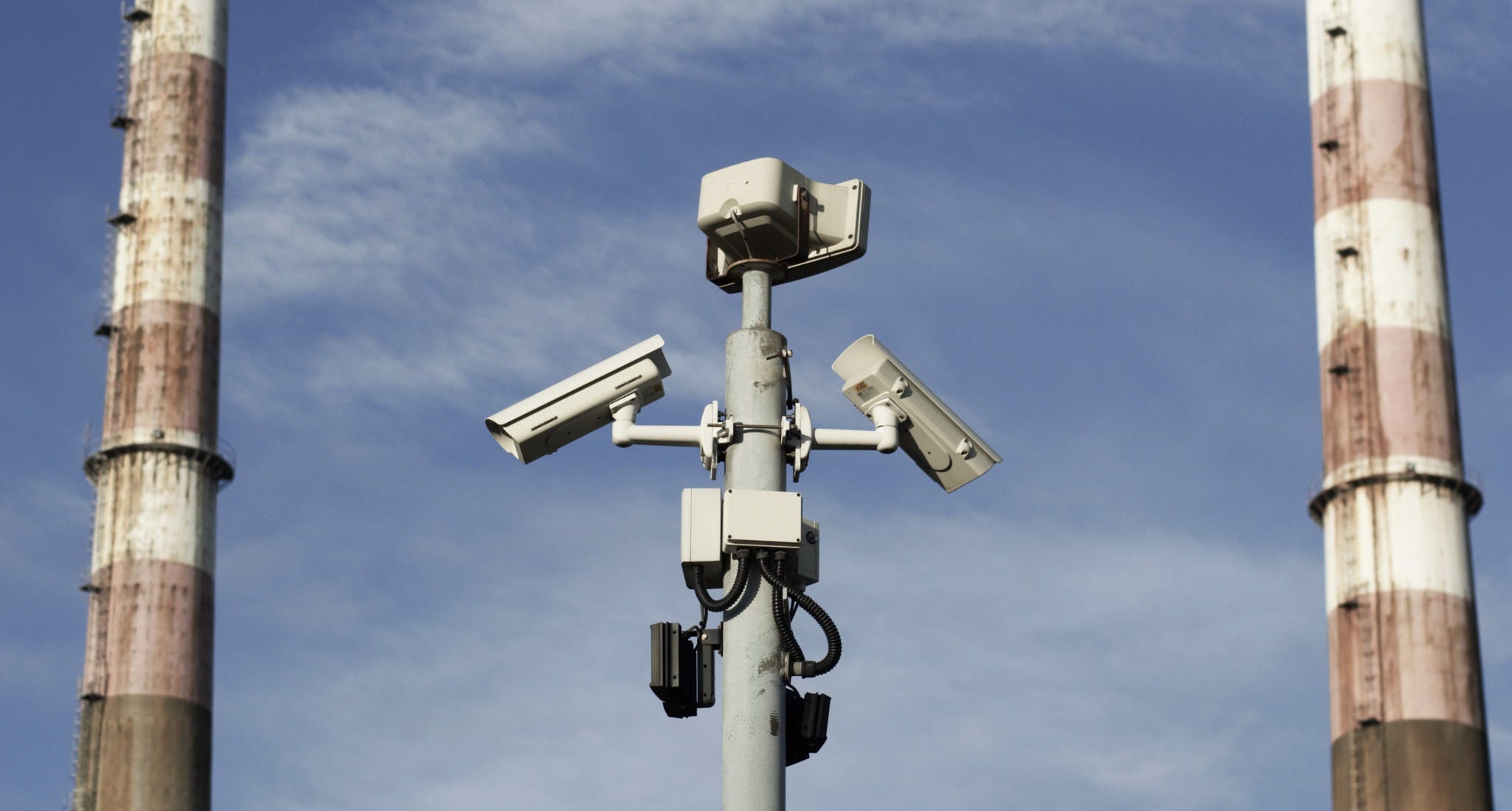
A CCTV camera detects someone lingering by a jeweler’s storefront. It’s connected to a surveillance system that uses artificial intelligence (AI) to analyze posture and pacing. Is the person a potential thief, about to smash the window and grab a fistful of rings? Within seconds, the system flags the situation as “high risk” and alerts a nearby police patrol—before any crime is committed.
That’s a world away from the camera technology most of us grew up with, but it’s no longer hypothetical. For decades, CCTV offered a detailed record of what had happened. Its function was archival. That began to change in the 2010s. So how did CCTV learn to anticipate trouble?
Strictly speaking, it never did.
When a teenager named Taki Allen was eating Doritos outside his Baltimore high school waiting for a ride after football practice last October, police swarmed in with guns drawn, ordering him to the ground. Surveillance software had flagged his behavior; it had appeared the Black teen was holding a gun instead of a snack.
Now as the world debates the existential risks of AI, its widespread adoption is also raising questions about its threat to liberty in a time of mounting authoritarianism. A camera that merely keeps a record changes nothing about how you walk down a street. A camera that decides—through mere malfunction or deliberate misuse—whether your walk is normal can change everything.
Both the promise and the failure of AI-enabled CCTV originate from the same design choice.
Video anomaly detection, as this field of machine learning is called, doesn’t rely on human-written rules. Instead, the AI models are shown vast amounts of training footage. That’s how a model learns what is normal in a specific location—and can identify what’s unusual.
Point such a surveillance system long enough at a train platform and it establishes patterns. A crowd surging toward the edge at 7:35 a.m. is the morning commute. A single person drifting toward that same edge at noon, when mainly freight trains pass through, is an anomaly—and a potential reason to alert the station’s authorities.
The surveillance system doesn’t know what’s suspicious. It registers only that a configuration of pixels is rare compared to the footage on which it was trained.
It took a century and two lineages for surveillance systems to learn to point to what’s unusual. One begins in Stalin’s USSR around 1927. The inventor Léon Theremin is believed to have wired a camera to a television screen for the Kremlin, reportedly enabling the operator to see people passing through the courtyard at a distance of roughly 100 feet from the camera. But the historical evidence for that project is sparse.
The first system for which historians have plenty of sources came 15 years later. In 1942, the German authorities installed a closed-circuit setup at Peenemünde on the Baltic coast. Its purpose wasn’t surveillance but remote observation: It enabled engineers and military staff to watch rocket launches from the safety of a distant bunker. The United States would later use CCTV during some of its nuclear tests.
But the early systems shared a significant limitation: They didn’t record. The picture existed only in the instant it was transmitted. Unless someone was sitting in front of a monitor and paying attention, the camera was of little use.
Videotape solved that. From the 1970s, the spread of video recording made it practical to store CCTV footage for later inspection. The camera became a witness. When the Symbionese Liberation Army robbed Hibernia Bank in San Francisco in 1974, CCTV documented the raid—and produced the legendary image of the 19-year-old hostage Patty Hearst holding an M1 carbine.
The 1990s brought the Internet Protocol (IP) camera, streaming its picture over the World Wide Web. Now a warehouse in Rio could be watched from a computer in Rotterdam. The advances also made pictures sharper and storage cheaper.
But for systems to watch out for the unusual, the second lineage needed to be added. That stream had begun decades earlier in an office at the Massachusetts Institute of Technology. MIT was an epicenter of computer research in the 1960s thanks to the Project on Mathematics and Computation, an ambitious program funded by the Defense Department’s ARPA (Advanced Research Projects Agency), the predecessor agency to the military’s DARPA.
In 1966, a mathematician and AI researcher named Seymour Papert wanted to spend the summer building a seemingly straightforward computer system: It should describe what was in a camera picture, thereby offering a rudimentary analysis of the image. The task didn’t take a summer but over half a century. That’s because images are full of shadows, reflections, textures, overlapping objects and shifting light—none of which the algorithms of the day could handle.
Papert’s Summer Vision Project illustrated the deceptive effortlessness of human sight. We spot a friend in a crowd, in the rain, in an outfit we’ve never seen before, and do so without noticing the extraordinary task we just completed.
MIT remained dedicated to video analytics. In the 1990s, its scientists helped develop ways to classify and track activity in footage. But those early systems worked only with simple scenes. Since the 2010s, AI has learned to extract far richer patterns from video—it was then that the lineages of the lens and the algorithm met.
Today, avoiding surveillance systems has become close to impossible. According to industry estimates, 4.3 billion cameras are in operation worldwide. That’s more than one lens for every two people alive. And the technology is used in ways that can violate human rights.
In China, CCTV cameras are a central element of a surveillance state in which the authorities regard behavior such as not socializing with neighbors and using the back door as suspicious, according to Human Rights Watch. Those who deviate in such ways risk being detained and interrogated.
China exports its surveillance technologies around the globe. The buyers form a clear pattern: Fragile democracies and autocracies are particularly likely to obtain the devices—especially in years of protest and unrest at home. Under China’s Belt and Road Initiative—and its Digital Silk Road program—Chinese companies have sold camera networks and behavior-based analytics across more than 50 countries from Azerbaijan to Zambia.
Western institutions are among the buyers, too, drawn by equipment that’s cheap and technically excellent. Both qualities have roots in China’s mass surveillance. The government is the largest supplier of training data and biggest customer of Huawei, Hikvision and their domestic peers. They are far more likely to export surveillance AI than companies from other countries, including the United States, according to a study by the National Bureau of Economic Research in Cambridge, Massachusetts.
Chinese firms invented neither the lens nor the algorithm. But they collapsed the distance between them. Hikvision and Dahua began with recording. First video recorders, then cameras—and from the mid-2010s, they added the algorithms. Today, they run deep-learning models on a chip in the camera itself. The surveillance systems do not require a server to study people, vehicles and events. The archive and analysis are combined into one object, small enough to sit above a shop door and cheap enough for a shopkeeper to buy. The camera now decides, at the lens, what needs intervention.
In England, Hikvision and Dahua cameras were found at 73 percent of local government councils, 57 percent of secondary schools, and numerous universities and police forces. Even the security cameras protecting the Magna Carta at Salisbury Cathedral were supplied by Dahua. That historical document sought to limit the powers of a sovereign. Now it’s kept safe by a technology that’s making another sovereign halfway around the world even more powerful.
Throughout most of history, watching a population required people: informants to report on neighbors, police to tail suspects, clerks to sift through files. Each need sleep and might have second thoughts. AI-based surveillance removes that constraint. Software that flags “suspicious” behavior never tires and never questions a command.
Tyranny once required countless accomplices. Now that AI can do the watching—and far more of it—dictatorship increasingly requires only a purchase order.
Anna Gielas is a research associate at Oxford University’s Emerging Threats Group. She earned her PhD in the History of Science from the University of St. Andrews, has published more than a dozen peer-reviewed academic articles on special operations forces and the integration of emerging technologies into the armed forces, and held fellowships at Harvard University and the University of Cambridge.