


On a perfect spring Saturday in Georgetown, Delaware, the heart of poultry country, Jenifer Marilú Méndez is preparing to receive hundreds of families lining up for a weekend social at the Old Paths Church of Christ. It’s a half-mile from Georgetown’s “center,” a Norman Rockwell-like town of 6,500 residents.
For all its old-timey Americana charm, a majority of its residents are from an equally tiny village called Tacaná in Guatemala’s western highlands. As many as two-thirds of Georgetown’s inhabitants today are Spanish speakers, almost all Guatemalans. An estimated 30,000 of them live and work within a 30-mile radius.
Most of the labor is raising (then slaughtering) millions of chicks hatched for the area’s biggest employer, Perdue Farms, or as the Guatemalans call it, “La Per-DOO-AY.” Others work in construction, landscaping or agriculture. It’s safe to say most of these workers arrived here without valid entry visas in their passports—or even passports—and lack proper employment authorization. Despite being “undocumented,” their 60-to-80-hour workweeks can last decades.
Although the government deems such workers fit for expulsion, Méndez is here to help her fellow Guatemalans navigate life in America as “illegals.”
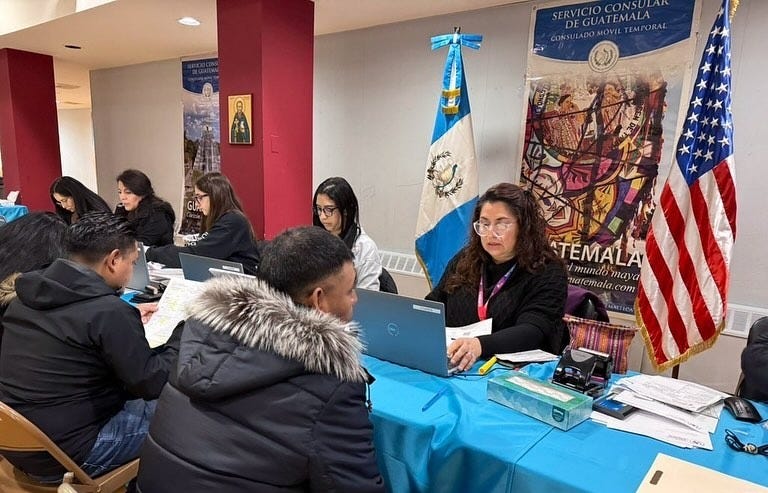
She is not a member of a religious order, but a fully credentialed diplomat assigned to Guatemala’s Philadelphia consulate as deputy consul, having recently served as her country’s ambassador to Cuba. Much of her work now includes monthly consulados moviles, or mobile consulates, held on weekends wherever paisanos living far from major US cities require attention.
A team of 19 consulate staff arrived here on a recent Friday night, rising early Saturday to fill the church’s social hall with workstations where Guatemalans fill out forms, have their photos taken and pay for documents they’re seeking. Most want Guatemalan passports, sold here for $65; others bring US-born children whose births they wish to register on Guatemala’s official rolls as they pursue dual citizenship.
Guatemalan passports serve as identification papers they can display if, say, they’re rushing an injured child to a hospital emergency room. They’re also required as a form of ID when cashing a paycheck or to show a landlord when renting an apartment.
“In the US, even to get cable TV you need some form of official ID,” one man waiting his turn outside said. Nowadays, another explained, it’s good to have a valid Guatemalan passport in case of deportation, easier to access services from Guatemala’s authorities at the end of a flight home.
Mobile consulates are not new. They rose in popularity after the September 11, 2001 al Qaeda attacks, when travel around the United States suddenly required meeting more stringent ID standards. I attended my first mobile consulate session in 2006, joining diplomats from El Salvador in Kodiak, Alaska, serving paisanos employed in salmon canneries.
Renewing passports and securing other documents was an expensive proposition for those working families, who would have had to spend hundreds of dollars flying to one of El Salvador’s consulates in California. Instead, the consulates came to them.
On any given weekend you can find mobile consulates serving migrants from El Salvador, Honduras, Ecuador, Mexico, Colombia, Peru and other “sender” countries whose US residents now number in the tens of millions.
Hundreds of diplomats each year travel to places far from any major city. A consul based in Los Angeles, for instance, may send a team to Hawaii each year to attend to pineapple plantation workers. Midwestern consulate staff fan out to meat-packing centers across Iowa, Kansas, Nebraska and the Dakotas.
Other consulates practice a hyper-local strategy: In New York, the Dominican Republic’s mid-town Manhattan consulate sends “mobile” teams up to Washington Heights or the Bronx, saving their fellow citizens the hassle of a subway ride downtown.
Honduras runs its mobile consulates like traveling convenience stores: selling passports but also notarizing documents paisanos might later mail home to close a purchase of farmland or settle an inheritance dispute. Registering marriages and divorces with the Honduran authorities also may be attended to.
Hugo Hun Archila, the senior diplomat in Guatemala’s Philadelphia consulate, conducted 10 mobile assignments last year, including venturing deep into Pennsylvania’s vast hinterland: to mushroom country outside Kennett Square and the bustling warehouse district near Chambersburg, where two busy interstate highways intersect—locations where acute labor shortages have drawn growing Guatemalan colonies.
Besides the usual logistical challenges of sending caravans on the road, Hun Archila has lately had to deal with a new impediment: Guatemalans’ fear of gathering in public. “I get calls,” he said. “People ask: ‘Can you guarantee there won’t be an ICE raid?’ And of course we can’t. People are afraid.”
An immigration raid on an official consular location would be almost unheard of, a true diplomatic incident. But that almost happened in Minneapolis this past winter, when ICE agents attempted to apprehend people entering Ecuador’s consulate. Hun Archila says he and other Guatemalan consuls in the US routinely alert State Department counterparts about their weekend itineraries whenever they send staff on official business beyond consular grounds.
“We don’t think they [ICE] would dare” obstruct the visits, the consul said. “But you never know these days.”
While hundreds waited for passports at the Georgetown church, a Latino shopping mall 14 miles away in Laurel, Delaware, was practically empty. “It’s been this way for more than a year,” said Concepcion De Leon, owner of the mall’s Tienda Tacaná store. “Customers are afraid to leave their homes except to work.”
In fact, there has been almost no reported ICE activity around Georgetown beyond a few traffic stops leading to document checks and detention. Perdue Farms, where many of the folks attending the mobile consulate work, does not appear to be under scrutiny for hiring undocumented migrants.
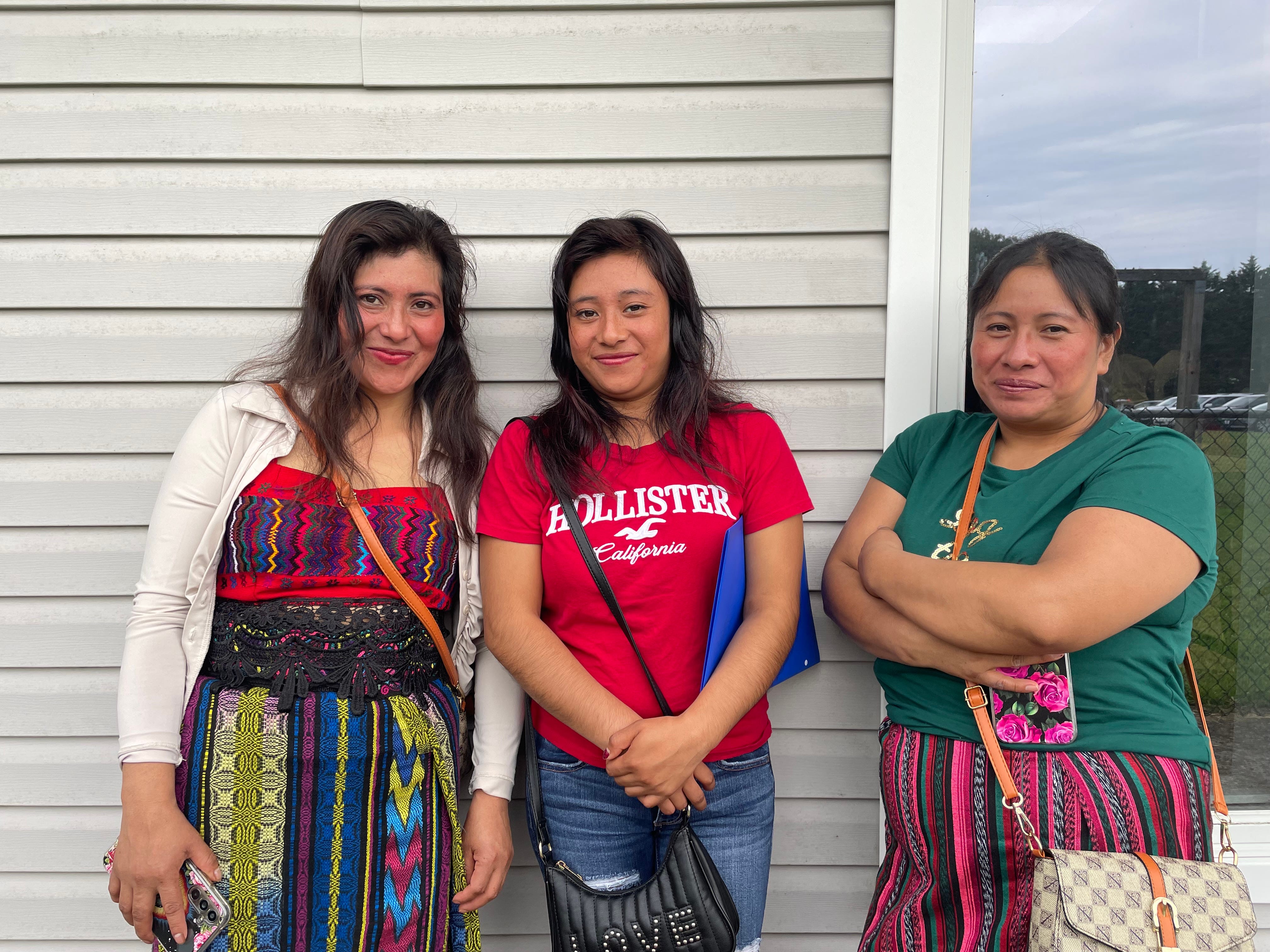
While waiting, paisanos spoke freely about the economics of coming to the United States illegally and working without permission. As long as their names were withheld, they were happy to reveal how much it costs to hire smugglers to get from Tacaná to Georgetown ($15,000 per person) and what it costs to buy a birth certificate attesting the bearer was born in Puerto Rico and therefore a US citizen ($1,200-$1,500).
Once they get here, the work is plentiful. A roofer named “Pedro” said he earns $20 per hour and seldom works fewer than 11 hours a day. Two men who told me they work as agarraderos de pollo (literally, chicken rustlers—grabbing live birds and shoving them into cages for transport to processing plants) said they earned $19 an hour to start, adding they could quickly get up to $25 if they stay in this high-turnover workforce.
I met members of two families who told me they had traveled together from Guatemala to Delaware, each in a party of four, paying $15,000 per person to smugglers who brought them into the United States via Arizona. I wasn’t shocked by the amount each family paid—$60,000 for three weeks’ travel—as much as the speed with which each was able to retire its smuggling debt.
“A year and a half,” one husband told me; “just over a year,” the other said.
Both families were in line at the church to obtain papers for a US-born child. The mothers praised the local schools in which their older children were enrolled. The dads reported being satisfied with prevailing local wages.
It made me ponder: If there really are 30,000 Guatemalans in this corner of Delaware and each paid $15,000 to get here, that’s almost half-a-billion dollars’ worth of smuggling proceeds just from this one district.
Which begs a question: Why are we allowing smugglers to earn such enormous riches? The workers are desperately needed for jobs employers still can’t adequately fill. Wouldn’t it make more sense to sell authorization permits allowing migrants to work legally and put the proceeds toward local communities’ needs?
And another: Why do we claim undocumented workers are undermining American prosperity when they’re so evidently essential to the American economy?
At the end of the first day of the consulate’s weekend visit, Deputy Consul Méndez told me her team had seen 500 people, the largest number of whom bought $65 passports. While the next day’s session would run only until 1 p.m., she speculated she would see even more.
“Sunday is the one day they don’t work,” she said. “So maybe they’ll come here.”
Joel Millman is a journalist and community organizer based in Philadelphia. He covered immigration and Latin America for almost 30 years, mainly for The Wall Street Journal, before working as a press officer for the UN’s International Organization for Migration in Geneva. His interests include refugee protection and resettlement and assisting US communities as they pursue successful integration of migrants in their midst. He was a fellow of the Institute of Current World Affairs in Central America from 1987 to 1989.
Mr Millman's mention of pineapple plantation workers in Hawaii is, arguably, out of date. There's very little pineapple production at plantation scale in Hawaii these days.
A corrupt, rigged system working for the benefit of a powerful few. When the greed and sheer incompetence of the current regime causes the whole rotted structure to collapse, we must build something better, that let's all of us flourish and thrive.