


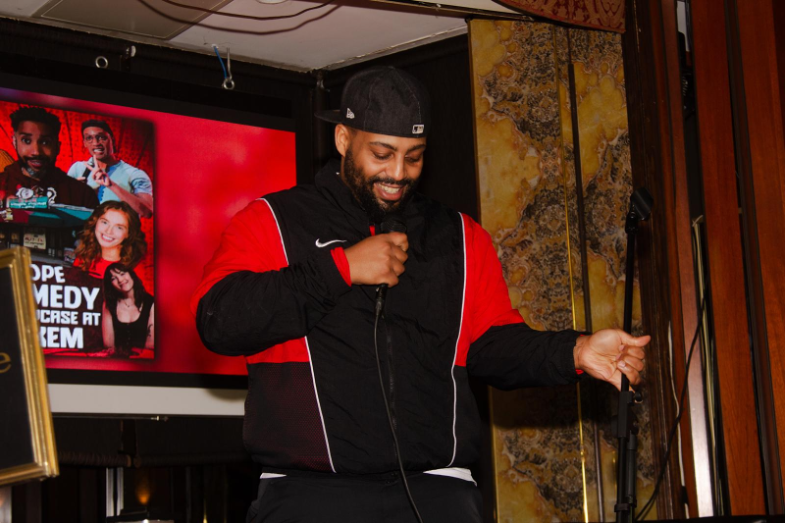
On a breezy Tuesday evening, lanky Simone Shiferaw, the son of Ethiopian immigrants, paces outside a restaurant on Washington DC’s vibrant U Street, positioning himself before commuters emerging from a nearby metro station. He flashes flyers for the evening’s Dope Comedy Showcase at Dukem, an eatery popular with Ethiopian immigrants and local foodies.
“Comedy and Ethiopian food tonight!” he chants cheerily. “It’s a great combination!”
Members of the Ethiopian diaspora—close to 2 million worldwide—call themselves “Habesha,” referring to any ethnicity from the Horn of Africa, a region of many cultures, including Amharic, Oromo, Tigray and dozens more.
Of all the Habesha comics working in the United States today, Biniam Bizuneh is the biggest star. The Indiana-born Eritrean-American started working clubs in Indianapolis before moving to the West Coast, where he joined the writing team of Jimmy Kimmel’s late-night show. He’s also done sets in the Ethiopian capital Addis Ababa, where he enjoys a dedicated following.
“If you’re Ethiopian,” he says beginning a typical sketch, silencing murmurs offstage.
“And you go to high school…” (scattered chuckles)
“And the cross-country coach finds out?” (shriek of recognition)
“I mean, you don’t even have a choice! You just join the team!” (rolling laughter)
Such cultural exchanges with the homeland are a slice of global trade that rarely rates economists’ scrutiny. But they’re essential to the commerce of ideas that spurs migration and rewards it. If all the world really is a stage, to paraphrase Shakespeare’s “As You Like It,” then immigrants and expats are players.
Performers like Bizuneh are also continuing an enduring American show biz tradition—immigrants who successfully master their host communities’ storytelling techniques.
It’s the legacy of Charlie Chaplin, a circus acrobat who left London for New York. He arrived expecting to cavort on sawdust under a tent but instead gravitated to silent film, where he connected with a multilingual audience of new Americans who delighted in seeing versions of their own experiences in his screen antics. Chaplin practically invented silent film comedy with his 1917 directorial debut, “The Immigrant,” many believe, and became a touchstone for migrants everywhere.
An industry that welcomed immigrants, Hollywood provided a form of storytelling that crossed back to Europe, essentially inviting audiences there to become immigrants, too.
Today, YouTube, Instagram and TikTok carry on those traditions for the Habesha comics, who are giving rise to a new comedy scene.
You could call it the Injera Circuit—after the staple Ethiopian sponge bread—a latter-day Borscht Belt, the cradle of comedy for legendary New York performers from Jerry Lewis to Jerry Seinfeld.
Those comics, the children of 20th-century immigrants from Europe, crafted humorous bits from typical immigrant encounters with American life—everything from how to get a sweetheart to how to get a job to how to satisfy ambitious parents.
And just as the Borscht Belt turned the performers Joseph Levitch and Irwin Kniberg into icons named “Jerry Lewis” and “Alan King,” today’s Habesha comedians draw stage monikers from hip hop culture. Yonas Berhe tours as “Lost Lyrics,” frequently joining “Felonius Munk”—born Arif Bilal Shahid in Chicago. Atlanta’s Michael Kebede tours as “Mr. Goopie.”
Back in Washington DC, Simone Shiferaw serves jokes and mild insults to diners hungry for authentic Horn of Africa fare as well as topical schtick. Common themes in his routine include dating while Ethiopian, being neither authentically “Black” nor authentically “African” and the comic standard, disappointing one’s striving immigrant parents.
“My father says: ‘You’re doing comedy now, Simone?’” Shiferaw moans. “‘Your life is just a joke!’”

Warming up the crowd, he zeroes in on a table where diners are deftly scooping up lamb cubes and lentils with bits of injera bread.
“Are you Habesha?” he says, cocking a skeptical eyebrow. “I dunno. I think I smell Silver Spring on you,” referring to the sprawling DC suburb.
Inferring diners may be visiting Maryland suburbanites rather than homeys down with the neighborhood, Shiferaw’s dig adds a dash of insult to their injera.
Such fare isn’t limited to big metropolitan areas like the capital, which boasts the largest concentration of Ethiopian and Eritrean immigrants in the United States. Habesha comedy is a mainstay at restaurants like Minneapolis’s Red Sea, Abyssinia in West Philadelphia and Addis in Richmond, VA.
Houston’s Yonas Berhe got his start as a Bizuneh protégé. After he graduated from Prairie View A&M University in Texas, his first professional gig brought him to Toronto and Winnipeg to warm up audiences for Bizuneh on a brief tour. The apprenticeship persuaded him to ditch his day job with the accounting multinational Deloitte and throw himself into Habesha comedy.
“Social media is my funnel,” says Berhe, 29, whose road schedule features three or more comics appearing together at Ethiopian restaurants. Recent gigs included a hookah lounge in Charlotte, NC, the Zanzi nightclub in Oakland and a Dallas eatery called Yenat Guada.
Berhe has also begun testing markets overseas. Last year, he teamed up with Atlanta’s Filmon “Gergish” Yohannes to do shows at Ethiopian eateries in the Netherlands and Sweden.
Last month, he took his material all the way back to Ethiopia to perform in Addis Ababa, where some 1,200 local fans packed into a converted warehouse. The Heineken brewing company, whose Harar Beer is brewed in eastern Ethiopia, sponsored the event.
Many came eager to rehear jokes they’d already shared with each other on social media. Others came to express solidarity with an American expat’s comedy journey.
The Habesha circuit also welcomes comics who aren’t of Ethiopian descent, continuing comedy’s tradition of blending immigrant and American cultures. Shawn “PeeWeeJr” Neverson, a native New Yorker, got his start on the stand-up circuit as a student at Richmond’s Union College, staging weekly performances at the Addis restaurant, owned by an Eritrean refugee.
In 2024, he returned to Richmond on a reunion tour, bringing in protégés to perform each week for almost two months.
“Addis helped me create a lane for up-and-coming comics,” Neverson said. “It felt great coming back.”
Joel Millman is a journalist and community organizer based in Philadelphia. He covered immigration and Latin America for almost 30 years, mainly for The Wall Street Journal, before working as a press officer for the UN’s International Organization for Migration in Geneva. His interests include refugee protection and resettlement and assisting US communities as they pursue successful integration of migrants in their midst. He was a fellow of the Institute of Current World Affairs in Central America from 1987 to 1989.