


Like many in Europe in August 2008, I struggled to make sense of the Russian invasion of Georgia. Although Dmitry Medvedev was president at the time, it seems clear now that the brief blitzkrieg was Vladimir Putin’s unmistakable break with the West, a marker thrown down against the European Union and NATO asserting their expansion would go no farther, particularly in the strategically vital Black Sea region.
Back in 2008, Russian friends were saying the reason for that “small war” was Georgia’s alleged mistreatment of its minorities in “occupied lands.” After all, I was reminded, NATO had done the same thing nine years earlier in 1999, when it had bombed Kosovo and detached that autonomous province from Moscow ally Serbia. Isn’t that how the great powers played the game, they concluded?
With those competeing narratives still clattering in the back of my mind, I jumped when the chance to learn more about the Russo-Georgian war—and how it ended the last hope for constructive relations between Russia and the West—came in spring 2023 when I decided to travel there with my folding bicycle.
At night, tucked in train berths en route from my home in Switzerland, I read about the many conflicts involving Russia along the fault line that runs from Vienna to the Caspian Sea. In effect, it seemed, we have been fighting the Crimean War for almost 200 years. The 19th-century British statesman Prime Minister William Gladstone said in 1858: “Surely the best resistance to be offered to Russia is by the strength and freedom of those countries that will have to resist her. You want to place a living barrier between Russia and Turkey. There is no barrier like the breast of freemen.”
My search began in Gori—a city in the north-central region that is notorious as the birthplace and childhood home of Ioseb Besarionis dze Jughashvili, better known as the Soviet dictator Josef Stalin. From the central Stalin museum, I biked up to the Gori Fortress, which echoes with the memories of medieval invasions, most often by the Ottomans. Russia annexed Georgia in 1801, and after that, the fortress was a colonial outpost of the Russian Empire at which Russian soldiers experienced decades of guerilla warfare and learned, in the words of the hero of Mikhail Lermontov’s A Hero of Our Time: “These mountaineers are a vindictive race!”
From the castle ramparts, I looked north across the broad, expansive valley toward the snow-capped mountains that separate Georgia from Russia. And there—comparing the landscape with my map—I came up with a plan to get a closer look at the ghosts of the 2008 front line.
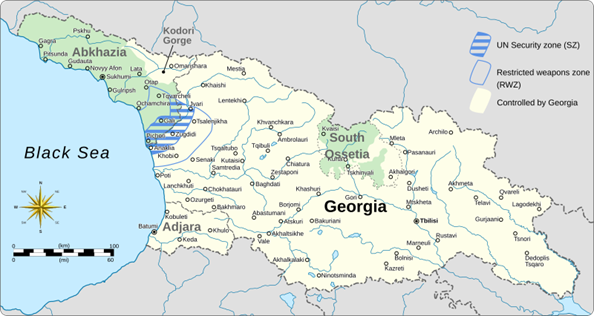
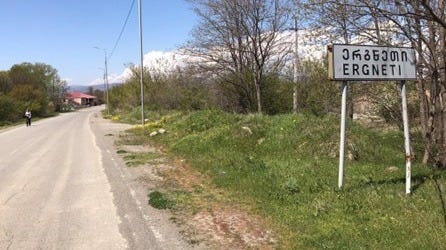
I could not figure out the bus route to Ergneti (the last village in Georgia before the administrative line demarking breakaway South Ossetia, the region over which the fighting ostensibly broke out in 2008). But as I stood beside a bus shelter, a taxi stopped and, after some haggling, the driver agreed to take me to the end of the line. His car was dilapidated and could not exceed 35 m.p.h. but we had the windows down and Georgian music blasting on the radio. It was a surreal ride to the still-tense frontier.
The road ran through farmland dotted with small villages. Wreckage from the 2008 fighting, mostly in the form of shot-up buildings and pock-marked signs, was still evident. Halfway to Ergneti, the driver stopped for gas, which involved a man pouring a jug of petrol into the car in exchange for a wad of cash.
After an unpleasant encounter at the military checkpoint just north of Ergneti—stacked high with sandbags and manned by Georgian troops, the last outpost before the Russia-backed territory of South Ossetia—I set off on my bicycle back to Gori, 20 miles to the south. It was a perfect spring day. For the first half of my ride, I had the road to myself.
Along this stretch, the battle was fought to separate Tskhinvali, the regional capital of South Ossetia, from the rest of Georgia. Russian tanks pushed down the Ergneti road into Gori. Had they wished, they might well have turned east and rolled into Tbilisi, as Georgian forces were unprepared for such a maneuver. Instead, the Russians were content to occupy Gori briefly and draw what they hoped would become a new international border between Ergneti and Tskhinvali.
Back in Tbilisi, seeking to understand better what I had seen, I bought a book of essays called The Guns of August 2008: Russia’s War in Georgia, edited by Svante E. Cornell and Frederick Starr and published in 2009.
Presciently, the book includes this paragraph:
Among the likely consequences of Russia’s successful aggression in this instance are the likely permanent truncation of Georgia, its long-term exclusion from NATO, further divisions within NATO, and the emboldening of Russia to undertake further military actions in neighboring countries when it considers it necessary to do so.… The reality is that the August 2008 war was neither provoked nor a product of miscalculation. It was initiated and waged by Russia for well-articulated geopolitical reasons. Georgia behaved diplomatically—perhaps too long.
The book, like the war in general, can be read as a foretelling of the more recent Russian war in Ukraine.
After the 1991 collapse of the Soviet Union, Georgia became a newly independent state in a fractious part of the world, the Caucasus, which remained a dangerous intersection of Russia and Turkey, of Russia and NATO, and of Islam and Christianity.
Into that mix Georgia was asserting not just its independence but its claim to borderlands (notably, Abkhazia and South Ossetia) that in the last century had been a mix of populations, including ethnic Ossetians and Abkhaz, as well as Russians and Georgians. Although Russia had annexed Georgia in 1801 during its long marches south to the Caucasus, the country had always been a melange of Orthodox Christians, Muslims, Armenians, Russians, Turks, Jews, Kurds, Assyrians, Azerbaijanis, Greeks, Kists, Yezidis and others.
When all were under the thumb of the Soviet Union, it didn’t matter overly much whether you were living in Georgia or Russia. With independence, however, some of the old internal demarcations of autonomous regions and republics across the Caucasus became international boundaries, and many ethnic groups were left dismayed that they were not granted independence when others were. Many fostered hostility toward Orthodox Georgians, remembering their oppression under the Georgia-born Stalin and accusing Georgians of complicity. Stalin, as the museum in Gori attests, is still lionized by many Georgians.
After Georgia regained its independence in 1991, there were competing models of nationalism on offer—one that continued to mix easily with Russia and the more Moscow-friendly states of the former Soviet Union and another that looked for integration with the West, aiming for membership in NATO and the EU in a path similar to that followed by many former Warsaw Pact countries.
For a while in the 1990s, when Russia itself seemed to be integrating with Western capitalism and the international community, it wasn’t problematic when pro-nationalist politicians stood up in Georgia to speak favorably about capitalism, democracy and the West. But when Russia—after Putin’s ascent in 2000—started drifting out of the orbit of Western organizations, Georgia’s domestic political assertions began to sound like a threat to Moscow.
Back in 1991, the year of the Soviet collapse, Georgians had by an overwhelming majority elected the human rights activist and professor Zviad Gamsakhurdia as president. In The Guns of August 2008, the Georgian political scientist and politician Thornike Gordadze writes:
Moscow viewed Gamsakhurdia as a Russophobe and as a danger to Russia’s dominance over the entire Caucasus. Gamsakhurdia, whose term in office was characterized by serious mismanagement of both domestic and foreign affairs, was strongly attached to the idea of a “Common Caucasian Home.” This was a rather utopian idea of a “United Caucasus” that would challenge Moscow’s domination of the region. The first fruits of this idea were already apparent with the sealing of an alliance between Gamsakhurdia and Jokhar Dudayev’s independent republic of Chechnya.
In response, Russia twisted the screws against Georgia, beginning in Abkhazia. Gordadze writes: “The Abkhazia war also signaled a return to imperial notions of regional politics.”
The nationalist Gamsakhurdia was deposed in early 1992 by a group of warlords, many of whom had previously supported him. He fled Georgia for Dudayev’s de facto independent Chechnya and was replaced as president by former Soviet foreign minister Eduard Shevardnadze. Gamsakhurdia attempted to regain power by force in 1993 but his rebellion was put down by Shevardnadze’s military, aided by Moscow. Gamsakhurdia was shot dead in early 1994; the circumstances remain unknown.
After years of playing a largely behind-the-scenes role in Georgia and focusing on reestablishing control over its own restive Chechnya region, Moscow seemed to re-think its posture in the region after NATO’s 1999 bombing of Belgrade and its support for Kosovo’s independence.
Putin saw Serbia’s claims to Kosovo as identical to Russia’s long-standing bonds with Abkhazia and South Ossetia. At the same time, he claimed there was Western meddling in Chechnya aimed at pulling Russia—a hodgepodge of nationalities comparable to the former Yugoslavia—apart at the seams.
In April 2008 at a summit in Bucharest, NATO expressed a willingness at some future time (to be determined and mutually agreed by all members) that Georgia and Ukraine should be considered for NATO membership.
Putin, looking to assert Russian claims in a Soviet risorgimento (in Italian, “rising again), saw Georgia sliding into the Western alliance and decided to act. In an essay titled “The Russian Leadership’s Preparation for War, 1999-2008,” Andrei Illarionov, who served as Putin’s economics adviser during his first presidential term, writes:
On July 13, [2007], Vladimir Putin signed a decree terminating Russia’s participation in the Treaty on Conventional Forces in Europe (CFE). He cited the US’s plans for an anti-missile defense shield in Poland and the Czech Republic as the reason for his decision. No one at the time noted that the decision on such a deployment had not been taken, and no part of the shield had been built (nor has it yet). It took another year before the true motive of this move became clear, namely, that it removed all limits on the deployment of Russian troops and equipment in the North Caucasus in preparation for a war against Georgia.
Privately, Putin told the Georgians the matters of Abkhazia and South Ossetia were now in the realm of great-power politics. According to Illarionov, Putin told Georgia’s pro-Western President Mikheil Saakashvili:
As for the disputed territories of Abkhazia and South Ossetia, in this regard we shall respond not to you, but to the West—America and NATO, and in connection to Kosovo. You should not worry, it shouldn’t bother you. What we do will not be directed against you but will be our response to them.
The road to the sealed border between Georgia and Russian-occupied South Ossetia
It took me about two hours to bicycle down the Ergneti road to Gori. I stopped for water and to take pictures of war damage and memorials along the road. The burned-out tanks are gone but crosses remain in adjoining fields, where Georgian soldiers and civilians lost their lives.
At one point, I stopped and took a picture of a road sign that indicated it was 4 kilometers to Gori, 83 kilometers to Tbilisi, and 361 kilometers to Sukhumi, capital of the Russia-occupied Georgian province of Abkhazia.
The sign reminded me how Stalin, as the people’s commissar for nationalities, had brutally managed the patchwork that the Caucasus presented when the Soviet Union was cobbled—and later cemented—together.
Initially, Georgia was incorporated into the larger Transcaucasian Federated Soviet Socialist Republic, which also included Armenia and Azerbaijan. Within Georgia, South Ossetia was an “autonomous district” while Abkhazia was an “autonomous republic,” as was Adjara.
Part of the reason Putin (at heart a Stalinist) felt secure in invading Abkhazia is—to quote from the essays—“the Abkhaz insisted that they were ‘federated’ with Georgia as an equal partner.”
I can see why that logic worked well both to keep the Turks out of the Caucasus and secure votes in the Politburo, but also why it fell apart the moment the Soviet Union came unglued, enabling Russia to return to something akin to its 19th-century imperialism.
Russian foreign policy, at least in its expansionist phases, seeks to erect buffer client-states on its borders—beginning with North Korea and extending across Central Asia to Belarus.
In Putin’s mind, a partitioned Ukraine achieves the same goal as does a partitioned Central Asia, a divided Germany or an occupied Poland.
Geopolitically, the Ergneti road north from Gori ending at a sand-bagged border strongpoint does not seem to mean much in international relations. But along that route one is reminded of a quotation from Rudyard Kipling’s novel Kim, in which a character tells the puckish hero: “Here begins the Great Game.”
Matthew Stevenson is the author of many books, including Reading the Rails; Appalachia Spring; The Revolution as a Dinner Party (China throughout its turbulent twentieth century); Biking with Bismarck (France during the Franco-Prussian War); and Our Man in Iran. Out not long ago were: Donald Trump’s Circus Maximus and Joe Biden’s Excellent Adventure, about the 2016 and 2020 elections, and The View From Churchill, about the places that shaped the life of the British wartime prime minister. His next books are Playing in Peoria (by bike across the American Mid-West) and Friends of Kind, a literary travel history of World War I.

A short account of the Russian Empire’s abolition of the ancient autocephaly of the Georgian Church and its subjection to the Holy Synod in Saint Petersburg.
• Before the Russian annexation (1801)
The ancient Georgian Orthodox Church possessed full autocephaly with its own Catholicos-Patriarch of All Georgia (historically also styled Patriarch of Iberia). It was independent of both the Ecumenical Patriarchate of Constantinople and the Church of Russia, and had enjoyed this status since the 5th century.
• After Georgia’s incorporation into the Russian Empire
East Georgia (the Kingdom of Kartli-Kakheti) was annexed by Imperial Russia in 1801. The last reigning Catholicos-Patriarch, Anton II, was removed from Georgia in 1805, deprived of authority, and eventually exiled to Russia, where he died in 1827.
On 18 July 1811 the Russian Holy Synod formally abolished the autocephalous Georgian patriarchate and transformed the Georgian Church into the Georgian-Exarchate of the Russian Orthodox Church, subject directly to the Most Holy Governing Synod in Saint Petersburg.
Consequences
• All Georgian dioceses were fully integrated into the Russian Orthodox Church.
• From 1817 onward, the exarchs appointed to govern the Georgian Church were almost invariably ethnic Russians who did not speak Georgian.
• The Georgian language was gradually suppressed in the liturgy in favour of Church Slavonic, ancient frescoes were whitewashed in many churches, and Georgian ecclesiastical literature came under strict censorship.
• Motives of the Russian authorities
• To consolidate imperial political and administrative control over the newly acquired territories in the Caucasus.
• To impose uniformity of ecclesiastical governance throughout the Empire according to the Petrine synodal system.
• To eliminate an independent patriarchate that had long served as one of the strongest pillars of Georgian national identity and could potentially become a centre of resistance against Russian rule.
The autocephaly of the Georgian Orthodox Church was restored only in March 1917, following the abdication of the Tsar, and was formally recognised by the Moscow Patriarchate in 1943 (and reaffirmed in 1990).