


Casey Kelso has had a long career in policy, advocacy and communications with major international NGOs. He was chief of advocacy and strategic communications at the International Crisis Group and worked for more than a decade for Transparency International as policy and advocacy director and regional director for Africa and the Middle East, serving a worldwide movement of national organizations against corruption, leading global integrity campaigns, working with investigative journalists on large-scale corruption scandals and creating a global security system for rapid reaction and risk preparedness. Previously, he headed the Coalition to Stop the Use of Child Soldiers and worked for 10 years for Amnesty International, including as interim worldwide communications director and deputy director for research and action on Sub-Saharan Africa. He currently works as an independent consultant and senior advocacy officer for WINGS, a global network of philanthropy support and development organizations.
Casey reported about social and political issues and the economies of countries in Southern Africa during his ICWA fellowship, with a focus on rural life and farming. From 1991 to 1994, he traveled to Botswana, Namibia, Zimbabwe, Lesotho, Zambia, Malawi, Mozambique and England. As he and his wife Bobbie Jo prepared to move to Namibia in January 1992, Casey put together a dispatch about “odd incidents and interesting mishaps” that didn’t neatly fit into his regular reports from Botswana. In this excerpt from the capital Gaborone, he recalls advice from the government’s chief press officer about how to go about asking questions, admitting that good advice isn’t always heeded.
GABORONE, Botswana (January 1992) — During the first weeks in Botswana, Bobbie Jo and I registered at the Botswana Press Agency as journalists to receive official permission to ask questions of people in this country. The government’s chief press officer, Moreri Gabakgore, gave us some succinct advice about Botswana culture that has proven invaluable. Had I heeded all his advice, in hindsight, I could have avoided a particularly unpleasant confrontation.
“Look a Botswana person only in the face,” Gabakgore has cautioned. “Don’t ever look him up and down, taking his whole body. This is an insult.” When interviewing a person, he also told us, start first and talk a while. “Say anything,” Gabakgore said. “Even an amusing little story about something that has happened to you. Then you ask your questions. If you haven’t said one word, a Botswana man here will not want to talk. He won’t feel comfortable.” And before entering a village for the first time, get some background before walking in. “If you know a little information first, that will make a man want to add to your understanding of his village. If you walk straight in, they won’t accept you. A better way is to find the elders, the headman, or the principal of the school to help you.”
Best of all, the press officer said, is to find someone to announce your presence at a public meeting. “You’ll have no trouble then, if you can be introduced there. We’re a young country and the people can be…ahh…backward. Especially here in the south where South Africans have been active. If you ask questions, people will expect you to pay them money. South Africans were the ones asking questions and buying information, so an explanation of your presence sets everyone at ease.”
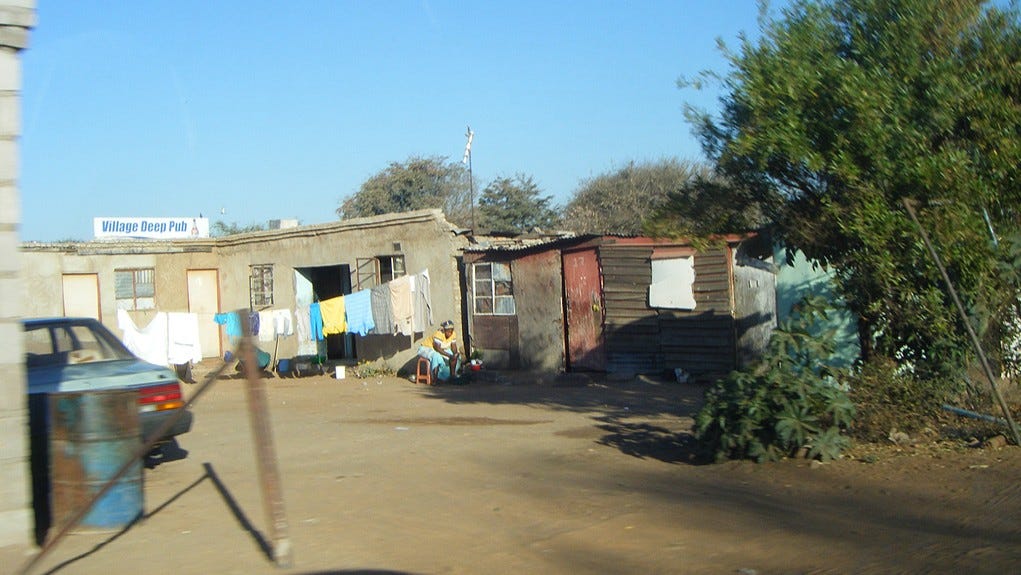
I had forgotten that last bit of advice when Bobbie Jo and I hitchhiked out to the oldest, most disreputable shanty town on the outskirts of Gaborone to attend a Sunday afternoon political rally. Old Naledi had been a squatter camp for workers migrating from neighboring countries to work in Gaborone, until the mayor acknowledged the terrible health hazards and put in sewer lines, public water taps and electricity. Even after the renovations, though, most people consider Old Naledi a dangerous part of town where hoodlums live in squalor. The man who gave us a lift in his car asked us three times, to be sure, if we wanted to get out. “They call this place the Beirut of Botswana,” he warned us.

The rally sponsored by the ruling Botswana Democratic Party was supposed to start in an hour, giving us plenty of time to visit a bar we spotted while walking through the heavily rutted, garbage-strewn dirt streets to the slum. Our entrance into the bar was a scene out of a Wild West movie. No, nobody was wearing chaps or cowboy hats. But everyone stopped talking, stopped smoking, stopped sipping their beers all at once to watch us walk in. In total silence I asked for two Coca-Colas, before my curious eye shifted elsewhere. Bobbie Jo and I sat uneasily on barstools next to a lone man, who started up a conversation with us with an alarming remark. “I would get out of this area before nightfall,” he said. “It’s very violent here. That’s why I’m drinking alone. I came to visit some friends living here, while all these other people—all of them—are criminals.” Our drinking companion didn’t help us break the ice with the locals.
A pickup drove unsteadily past the bar while the driver, a one-man show, shouted unintelligible things into the microphone of a bullhorn mounted on top. When the high-decibel summons grew faint as he drove slowly off, I figured the rally was starting. We walked out of the bar and through the trash heaps, in the direction of another amplified voice. When we arrived at a small clearing in the shade of a big tree, a woman was alternately singing and shouting encouragement into another public address system aimed at an audience of 25 small children. After we waited two hours past the official meeting time, the crowd had not grown appreciably larger or older. Several pickups suddenly rumbled into the clearing with party supporters trucked in for the occasion, all dressed in black and red. I didn’t conclude the ruling party is unpopular, but that Old Naledi hosts Zimbabweans, Zambians and Malawians who don’t care about local politics.
Bobbie Jo and I felt swamped by the sea of Setswana language pouring out of the amplified loudspeakers. Once, when many eyes fixed on us in unison, I had an uneasy sense of being talked about by the microphone woman who kept pitching to the slow-gathering mob in a sing-song chant. “What does she say?” I whispered to another party member sitting nearby. “Oh, she says people can gather here to ask questions and the party will try to answer,” the woman said. “But she says the party doesn’t know everything. They can’t answer all questions. Sometimes we don’t know the answer, like ‘Why are the white people sitting here?’ That’s what she says.”
At that point, I should have asked to be introduced to the assembly. It would have made everyone feel comfortable, like Gabakgore had said. Instead, I got up and walked to the back of the crowd in hopes of finding someone who could translate the proceedings for me. I approached one man in a brown two-piece suit. I never got a chance to ask for his help. “Good afternoon,” I began with a big, foolish, howdy-do smile.
“Don’t say anything to me!” he shouted. “You can’t talk to me! You don’t know me! You can’t say ‘Good afternoon’ to me.” I was confused by his unprovoked animosity. “I’m sorry for you! Sorry! But I don’t have to talk to you!” he shrieked. He was very frightened and, in a panic, looked like he would attack me if I stuck around. I carefully stepped back as he continued to cry out: “Get away! You can’t talk to me! Sorry for you, so sorry!” I turned to others standing near, who also shrank away from me.
The incident disturbed me for a long time afterward, for no one in Botswana had ever reacted so negatively to me. By chance, while leafing through my journal, I discovered the advice that Gabakgore had given us many weeks earlier. He was right. For some of the less sophisticated people, a white skin denotes a South African spy. Without a formal introduction at the meeting, held in Setswana for a crowd who didn’t know English and so had few dealings with whites, no one knew otherwise.
