


Barbara Bright Novovitch was a distinguished journalist who helped open the profession to women. On her fellowship in 1968–1970, she examined student protest movements in Europe and Pakistan. Over her long career in journalism, she was a staff writer for The Washington Post, Newsweek and Reuters, with foreign postings in Germany, Hong Kong, London and Paris. She was founding editor of the weekly magazine Woman’s World, and in the early 1970s she joined a successful sexual discrimination class action lawsuit brought against her employer, Newsweek. Her role is documented in the book Good Girls Revolt, later developed into an Amazon Prime television series. She wrote for The New York Times from West Texas from 2004 until 2008.
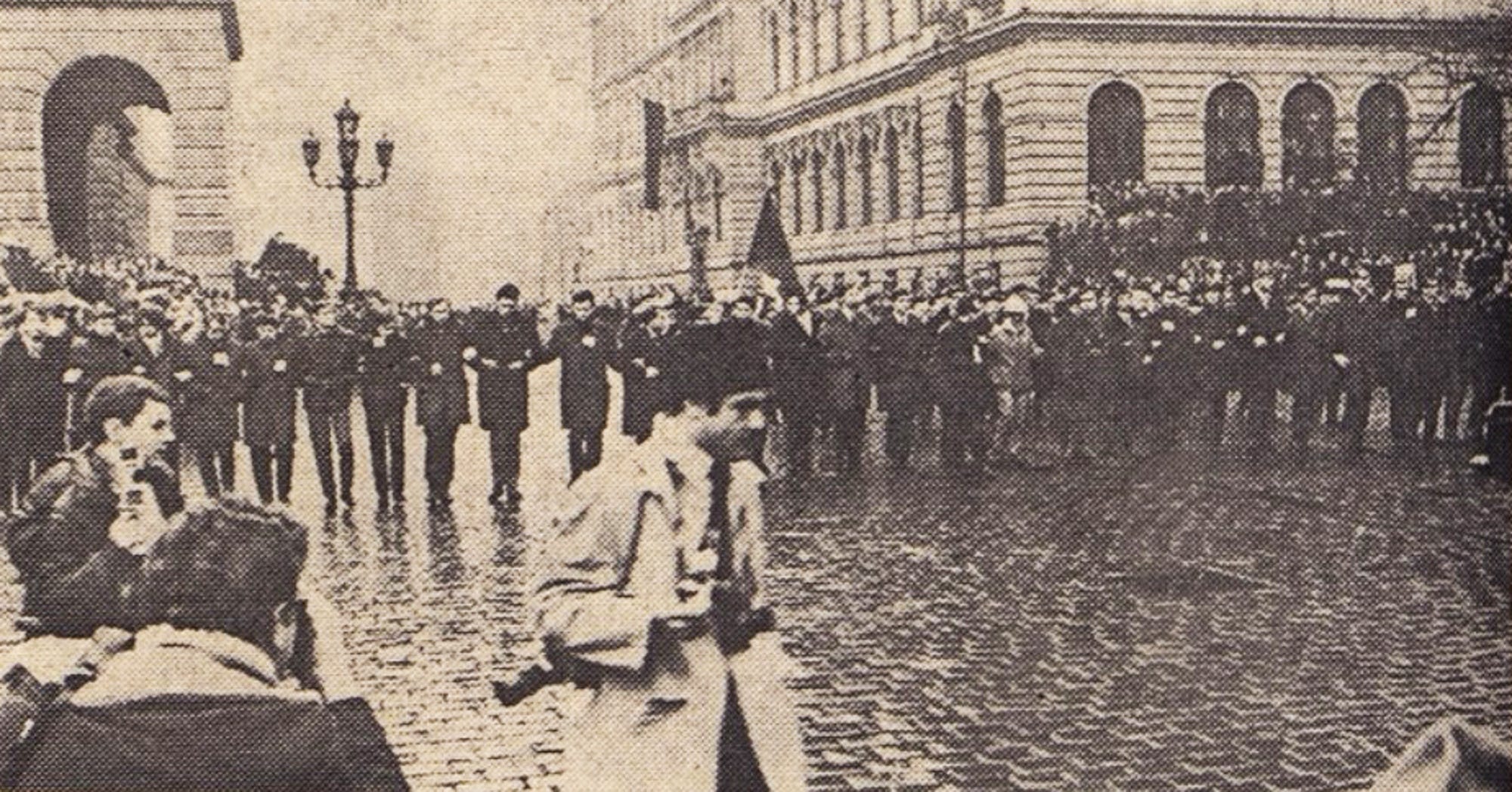
Barbara visited students in Prague in early 1969 shortly after the country was stunned by the self-immolation of the student Jan Palach to protest Czechoslovak passivity following the Soviet invasion in August 1968. The students had been in the formative stages of developing a resistance strategy of “pushing constantly” instead of a “sudden shove” they believed would alienate conservative society at home and further provoke Moscow.
PRAGUE, Czechoslovakia (February 1969) — Jan Palach’s sacrifice betrayed an extreme that was not discernible in the talks I had with Prague students. But I recall too this warning from a German journalist: “It’s difficult to make an outsider, even an interested one who reads more than the newspaper accounts, understand the depression of the Czechoslovakians now. I remember how disappointed some Czech writers were after Guenter Grass was here recently… Grass was delighted at how well things were going and didn’t grasp the underlying desperation. Of course, there is still freedom of speech and relative freedom of the press, but the Czechs and Slovaks never had it as bad as the East Germans. And pointing to that doesn’t remove the longing for what might have been.”
Rock-bottom economic conditions help to create the pervading gloom. Before Christmas, the Prague population queued up 10 and 20 deep in front of almost every shop—but the shelves inside were almost bare of goods. “People are buying like mad this season,” one woman told me. “If they have any money, they figure they might as well spend it.” Such reckless indulgence is prompted by despair, and a fear that the Christmas just past might be the last for a sort of carefree gaiety. “As far as business is concerned,” the older woman continued, “it already feels like the first days after the war here. People don’t go shopping now. I need some kitchen chairs—the ones I’ve had for 20 years are breaking down—but I can’t go to a shop and buy them. I have to go from shop to shop and plead with the manager to tell me when some are coming in. If one shop is expecting a shipment, I’ll check in every day until they arrive.” The night air of Prague still tastes of coal dust, but many apartment-dwellers are shivering because the landlord can’t heat without coal, and some schools are forced to close because they can’t warm the classrooms.
Political realities plague the students more than the economic pinch, however. The romantic, utopian attitudes that Prague students find disturbing (and slightly hare-brained) in the German leftist movement are clearly missing from their conversations. There seemed to be no trend toward self-destruction among Palach’s classmates at the philosophy faculty of Charles University…and the philosophy faculty students are counted as left militants in the CSSR [Czechoslovak Socialist Republic] spectrum of politically active youth.
I spent several afternoons talking with bearded, somewhat shabbily clothed young men in the student council room of the philosophy faculty, and two evenings chatting in the lobby of my hotel and in the Vltava youth club with students from the technical university. (The recorded and live music there was beat, and the Beatles’ “Hey Jude” was then as popular in Prague as in the West.) Although they, like the leftist German students, were averse to having their pictures made, they talked openly and freely. In all my conversations in Prague, the Czechoslovakians never seemed to fear reprisal for free speech. The one occasion on which I felt uneasy—when the same large blonde woman sat near me for tea at the hotel and in a restaurant for drinks that evening—was shrugged off as a coincidence by my Czechoslovakian companions.
Unlike West German students, the Prague young people were reluctant to talk of “escalation” tactics in their fight for realization of the January 1968 reform program. By no means content with the current occupation and the trend toward compromise, they seemed nonetheless to respect the pressure under which [the reforming Czechoslovak leader] Alexander Dubcek and his fellow reformers stand. “The students are disappointed that Dubcek and other leaders have compromised,” a Czech journalist told me, “but they support him still—not with their whole hearts, but with understanding.” In December, the students talked of pushing constantly, but not with a sudden shove that would break the nation’s delicate balance and lessen the likelihood of forward steps on the tightrope.