


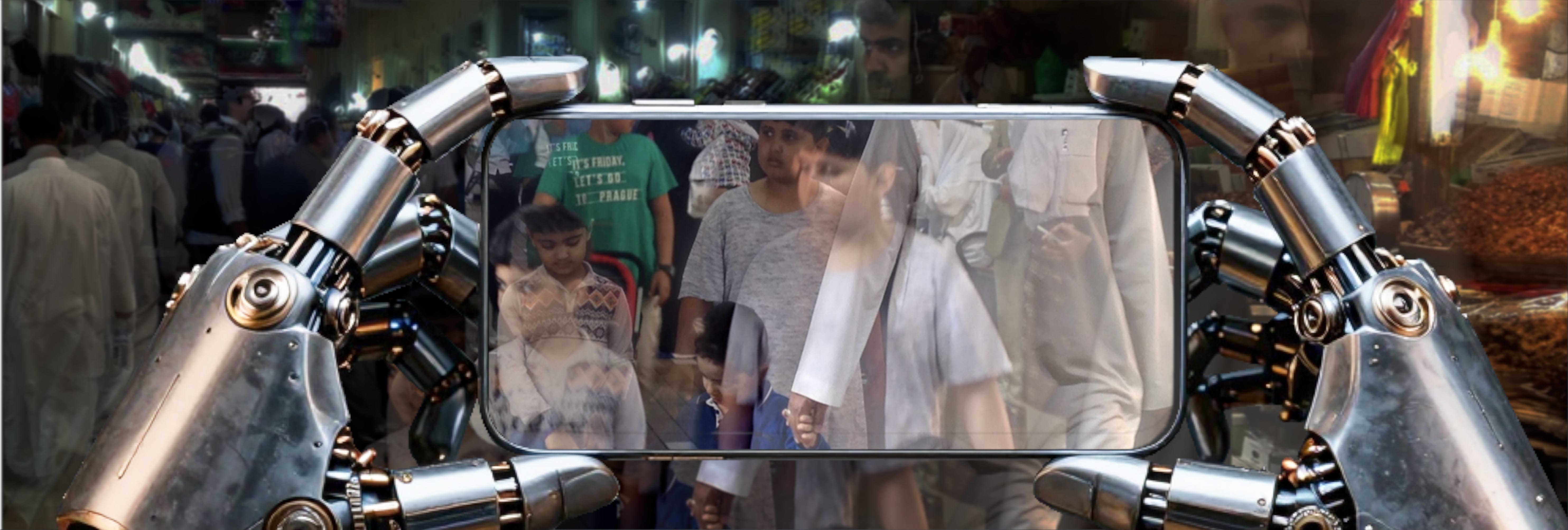
The robots are taking over. They can pick apples, sort boxes and deliver packages faster than the deftest, most energetic worker. They can analyze X-rays better than any radiologist. They can write a hundred cantatas in less time than it would have taken Bach to compose just one. They can render legal opinions, interview candidates, and fire employees with speed, precision and ersatz empathy. They can pinpoint an individual in a very large crowd. They can dance like Astaire, sing like Beyoncé, act like Brando, and paint like Rothko, Rockwell or Rembrandt.
They can do that, and so much more, without eating, sleeping, weekends or vacations. Without complaining or unionizing. Without overtime, raises or bonuses, indeed, with no salary at all. They are the apotheosis of the ancient Greek dream: a world served by automatons, artificial slaves. Robot, after all, is short for “robota,” the Czech word for forced labor.
Sooner or later, we may have to face the prospect of a world where all cognitive and manual labor is performed by artificial beings, with humans supported by some form of Universal Basic Income (UBI). So it could be instructive to look at a place where a version of this experiment has already been run on a small scale.
I’m talking about Kuwait, that tiny, Muslim, democratic emirate located at the head of the Persian Gulf, on the fault line between Sunni and Shia spheres of influence. Ringed by six US military bases, Kuwait is America’s unsinkable aircraft carrier for projecting power into the Persian Gulf. As the policy analyst Selma Khalil has written: “Kuwait resembles an automated society which runs on UBI, in that the average Kuwaiti national lives well independently of how they work.”
Over 36 million robots are already deployed worldwide, from Roomba vacuum cleaners to Amazon warehouse bots to Ukrainian autonomous military drones. Boston Dynamics aims to deploy thousands of its Atlas and Stretch humanoid robots in the next five to 10 years. Elon Musk predicts, perhaps optimistically, that he will deploy a “massive army” of his Optimus humanoid robots, starting at a million annually and topping out at 10 billion by 2040, replacing all human manual labor. Japan, Korea and China, xenophobic countries with crashing populations, are also big investors in robots.
In his 2025 book The Last Economy, Emad Mostaque—founder of the artificial intelligence company Stability AI—predicted that we have a thousand days left before Artificial Intelligence, AI, replaces all human cognitive labor and implodes our economy. By November 21 of last year, he had dropped his deadline to only 900 days. That puts The End at May 9, 2028. The AI safety expert Roman Yampolskiy (he coined the term AI safety), is even more pessimistic, predicting in an interview with the British entrepreneur Steven Bartlett that the AI-induced collapse will take place in 2027. The technology ethicist Tristan Harris, speaking to the comedian Jon Stewart, agreed. We have two years.
Or perhaps not.
Brian Merchant’s Substack journal, Blood in the Machine, has a recurring series: “AI killed my job.” He invites people in different fields—illustrators, artists, copywriters, content moderators and tech workers thus far—to write in with their own stories of job loss. They all agree that beginning in 2022, the jobs began to disappear. First slowly, then all at once. The war on work seems to have begun.
Humbug, says The Economist. AI is creating all sorts of new jobs: data annotators, forward-deployed engineers, risk-governance specialists, chief AI officers. One satirical advertisement circulating at OpenAI—developer of ChatGPT—calls for a killswitch engineer whose job is to “throw a bucket of water on the servers. Just in case.”
The cognitive scientist Gary Marcus agrees. This is the End Times not of work but the AI financial bubble. Large Language Models hallucinate (i.e. lie). AI companies have tried to solve this problem through scaling, hoovering up more and more data, making the LLMs bigger and bigger. But the LLM hallucination problem has proven to be insoluble no matter how much they scale. The LLM approach to AI appears to be fundamentally flawed.
Mirroring Marcus, the AI critic Ed Zitron has pointed out that, economically, LLM AI is a failure. Because of the massive amounts of electricity Nvidia chip data centers gobble up every time people ask ChatGPT to do their homework, OpenAI loses money. The same is true of Claude, Gemini, Copilot, Stable Diffusion, Midjourney, Sora and all other AI assistants. The more we use, the more our wannabe AI masters lose. The investment is unrecoupable at any scale. This reality is finally starting to undermine the enthusiasm of tech investors, whose AI billions have kept the wobbling US economy from sliding into recession.
As the AI scholar Kate Crawford argues, another more fundamental challenge remains: slop. AI companies have harvested all available human knowledge. To keep their LLM AI models up to date, they need to harvest more, but an ever-increasing amount of what’s now out there is AI generated, including the vast sewer of hallucinatory, error-filled nonsense (like Shrimp Jesus, the most popular image of 2025). When LLM models are trained on slop, they go MAD, an acronym for Model Autophagy Disorder. After about five generations of consuming slop (and its corollary, slopaganda), they collapse.
Still, the dream of a future where all cognitive and manual work is performed by artificial slaves remains. The race to create Artificial General Intelligence, AGI (i.e. sentience), and ASI (artificial super-intelligence) will undoubtedly continue. Many alternatives to LLMs remain relatively unexplored, including Liquid Neural Networks, Active Inference and Gary Marcus’s favorite, Hybrid Neurosymbolism.
Eventually, AI and humanoid robots may replace most, if not all, human cognitive work and manual labor. If so, we will have to face the reality of billions of unemployed people, either left to fend for themselves as feral humans outside the walls of Robotopia, or inside, as deskilled pets supported by a Universal Basic Income. That assumes we will be indefinitely tolerated, not simply extinguished.
Let us turn now to Kuwait to see how a future world without work might play out. The country’s name is derived from Al-Qut (“the little fort”) and, starting in the 18th century, the place was just that: a walled, mud-brick merchant town, busy with the trade in natural pearls. Modern Kuwait is bigger, an anomaly of history: carved out of the Ottoman Empire by British gunboats in the 19th century, quartered to its current New Jersey-ish size by the Saudis in the 20th, preserved as an independent nation-state by the Americans in the 21st. At various times, both the Saudis and Iraqis have tried to annex Kuwait. But as one wag put it to me, “the British gave us Kuwait and the Americans are making us keep it.” Today, it’s one of the world’s wealthiest countries, now in the 79th year of demonstrating what happens when nearly all cogitative and manual labor is done by the human equivalent of robots—migrants—while Kuwaiti citizens are supported by state subsidies.
Once upon a time, Kuwaitis were renowned as master shipbuilders and pearl divers. They were tough, skilled, resilient and poor. That changed with the discovery of oil in 1938 and the beginning of petroleum exploitation in 1946. Boats and pearls were abandoned. Nearly all work in oil-rich Kuwait was handed over to Palestinians who, conveniently for the emirate, were expelled from Palestine in 1948, during the Nakba. Ultimately, 400,000 Palestinians settled in Kuwait, including Yasser Arafat, who founded the Fatah Party there in 1957.
As Kuwaitis became increasingly deskilled, Palestinians built the nation. But when Iraq invaded Kuwait in 1990, some Palestinians supported Sadam Hussein, who promised to liberate Palestine next. Kuwaitis were understandably offended. Immediately after the war, in a mere two weeks, the emir expelled all Palestinians from Kuwait. They were replaced with more politically reliable South and Southeast Asians, North Africans and other Arabs, mostly Syrians and Lebanese. The Kuwait press is rife with lurid stories of their mistreatment.
Today, three migrants toil for every Kuwaiti. Migrants are nannies, cooks, gardeners and drivers. They sweep streets, work in construction, retail, teaching, consulting and management. Without them, the country wouldn’t function. Kuwaitis receive their share of the country’s immense oil wealth through generous allowances, subsidies, free education, free health care and housing grants. Now and then—periods of social instability, for instance—the emir forgives all their debts or provides a year of free groceries.
Kuwaitis are not unemployed, per se: Government jobs are guaranteed. But for the most part, they are sinecures whose main purpose is not to accomplish meaningful work but transfer money from the state to citizens. Barring exceptional circumstances, the risk of being fired is almost nil. Quoting Selma Khalil again, “production or innovation is often not celebrated, and inefficiency is not reprimanded.” Unlike the typical Universal Basic Income proposal of $6,000 to $10,000 per year, Kuwaiti GDP per capita is $33,000 to $58,000 depending on how you measure. The income is tax-free. Some Kuwaitis make far more on rents they collect as silent partners in migrant-run businesses.
I taught art in an international high school in Kuwait for five years, mostly to Kuwaitis. I had previously taught in the United States and later in Korea and Singapore. Kuwaitis were some of my most creative and adventurous students but also some of my least dexterous. Many had little hand-eye coordination or fine motor skills. Some couldn’t tie their own shoes or organize their school backpacks, the result of having been raised by Filipino and Ethiopian maids who did that work for them. International teachers who tutored on the side made a tidy income doing Kuwaiti homework and term papers. When teachers assigned the kind of work that required craftsmanship (build a model of a volcano; recreate the pyramid of Giza), many students would visit the Project Souq, a warren of fabrication shops in Kuwait City, where the work was accomplished—again, by migrants—to a very high standard.
In 2023, four Education Ministry employees were sanctioned for having sold test questions and answers to at least 400 Kuwaiti students. Despite millions of dollars spent on consultants and improvement plans, international tests of writing, science and math learning all rank Kuwait near the bottom. Annually, hundreds of Kuwaitis who are granted generous government scholarships to study overseas return after the first year, sometimes the first semester. Having outsourced their education to migrants, they simply can’t do the work.
The same kind of fraud, malfeasance, corruption and incompetence often continues when Kuwaitis enter government service, where absenteeism is a chronic problem. One investigation discovered a government employee who had been collecting a salary, without showing up, for over a decade. Numerous reform efforts have come to nothing.
What do Kuwaitis do with all their free time? Shop and dine out mostly. The country is awash in high-end malls and excellent restaurants. At weekly get-togethers (the male diwaniya and female istiqbal) in their walled mansions, Kuwaitis eat, drink, smoke shisha, gossip, arrange marriages and politick (in this democracy, elections are frequent and hard fought). On weekends, they retreat to their desert farms, where servants raise crops with desalinated water from the Gulf, and their seaside chalets, where they party, Jet Ski, parasail, scuba dive, pull wheelies on their motorbikes, do doughnuts and brake stands on their four-wheelers, and race their Ferraris and Lamborghinis. On holidays, they vacation in the Seychelles or take shopping trips to London, Paris and Florence. Kuwaitis also like to give to charity. Many have supported the Islamic State, ironic given the country’s role as an ally in America’s War on Terror.
Are they happy with this existence? The 2025 World Happiness Report rates Kuwait 30th out of 100 countries (Finland is number 1; Congo 100). So, pretty content. On the other hand, Kuwait is rated by InterNations, year in, year out, as the world’s unfriendliest country, 53rd out of 53 countries surveyed: last in quality of life, last in work culture and satisfaction, last in friendliness. So, not a great place to be a migrant worker.
Outsiders tend to judge Kuwaitis closed, secretive and paranoid that someone may try to part them from their wealth. Given historical events (see Saudi Arabia and Iraq above), a not unreasonable fear.
The Kuwaiti lifestyle creates additional challenges. The air, heavy with desert dust and petrochemical fumes, is lethal. So is the diet, heavy on American fast food. Kuwait is one of the most obese nations on earth. To keep family money in the family, consanguine (i.e. first-cousin) marriage is encouraged, leading to all sorts of hereditary illnesses: macular degeneration, color blindness, cataracts, glaucoma, keratoconus, night blindness, high blood pressure, gall bladder disease and strokes. Kuwait has the third-highest prevalence of Type 2 diabetes on Earth. I’ve never taught in a country where so many of my students and parents died from cancer.
In a world without work, are we destined to be fat, happy, incompetent, sick and short-lived thumb-twiddlers? Not necessarily.
Many Kuwaitis have used their government subsidies as springboards to creative excellence, the kinds of lives promoters of AI and a Universal Basic Income imagine for all of us. Kuwait is famed in the Arab World as “The Hollywood of the Gulf” for its thriving movie and television industry. Kuwaiti Musasalat—soap operas—are especially popular at Ramadan. The Kuwaiti sculptor Sami Mohamed is regionally famous for his contorted, agonized, bound-and-gagged figures, political allegories in bronze. The painter and poet Shurooq Amin has built an international art career exposing the country’s political and religious dirty laundry. Although her exhibitions within Kuwait are regularly shut down as “pornographic,” outside the country, she’s its most famous artist, feted in Dubai, Lebanon, London and at the Venice Biennale.
Sans subsidies, Kuwaitis have also been perfectly able to reskill and compete in the real world. Fahed “Freddy” Al-Habib won a Kuwait government scholarship to study film and cinematography at the Academy of Art University in San Francisco, completing his education in 2005. Instead of returning to Kuwait, Fahed turned his back on government support and moved to Hollywood, where he got a job as an editorial assistant at Disney, then Icon, where he worked on Mel Gibson’s “Apocalypto.” He moved up to visual effects assistant on Lilly and Lana Wachowski’s “Speed Racer” and Ben Stiller’s “Tropic Thunder.” At Universal, he advanced to lead visual effects coordinator on Angelina Jolie’s “Unbroken.” Studio by studio, movie by movie, he moved up the ladder to production manager, then associate producer and finally, at Marvel Studios, visual effects producer on the “Ms. Marvel” mini-series and Daredevil: “Born Again.” On a visit home, he gave one of my students some advice: “If you ever want to amount to anything, leave Kuwait and never look back.” Or words to that effect.
It’s an unpleasant irony that in a world without work, no one would have that option.
Bryn Barnard is an artist, teacher and former ICWA fellow. He has worked with Far Eastern Economic Review, Asiaweek, National Geographic and NASA, and also with schools and universities in Kuwait, Korea, Singapore, the US, Europe, the Middle East and Asia. His books include Dangerous Planet: Natural Disasters That Changed History, Outbreak: Plagues That Changed History, The Genius of Islam: How Muslims Made the Modern World and The New Ocean: The Fate of Life in a Changing Sea.

This identifies the danger in treating “no work” as merely an economic condition rather than a cognitive one.
A society can survive material abundance without labor only if it replaces the neurobiological functions of work: salience, agency, temporal structure, and earned meaning. Without those, UBI risks becoming a sedative rather than a foundation.
The question is do we truly understand what work was doing to the human nervous system before we started removing it? If not, the subsequent failure may be attentional drift, identity collapse, and susceptibility to capture by whatever new system or tech offers as a “synthetic” purpose next.
Thank you