


In 1953, the US Atomic Energy Commission opened an inquiry against the atomic scientist J. Robert Oppenheimer, accusing him of being a Communist sympathizer and probably an agent of the Soviet Union.
One of the allegations laid out against the father of the bomb in a December 23, 1953, commission letter was that he had “attended a house-warming party at the home of Kenneth and Ruth May on September 20, 1941, for which there was an admission charge for the benefit of The People’s World,” the pro-Communist newspaper.
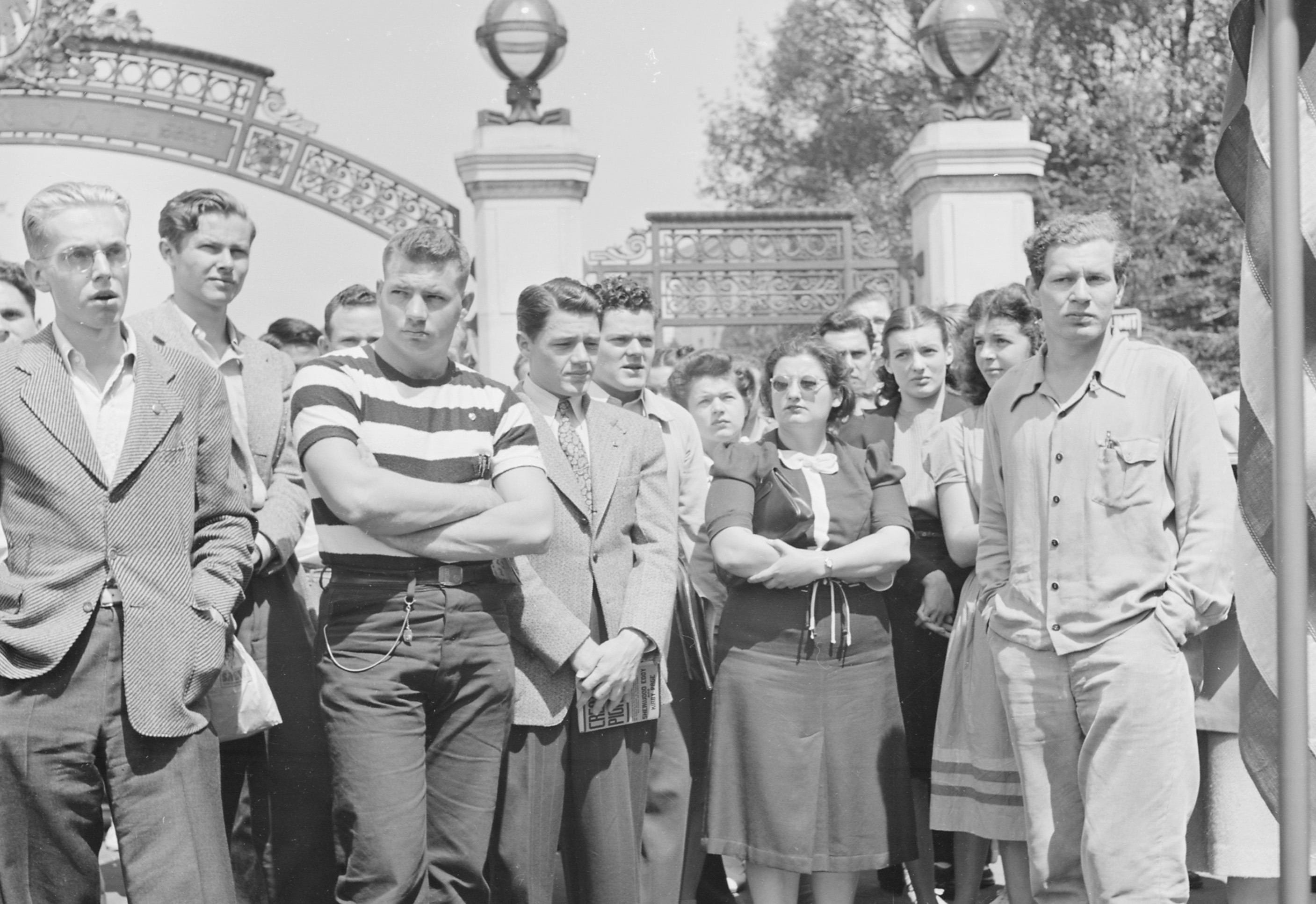
Kenneth May was a gifted mathematician who had been a teaching assistant at the University of California, Berkeley while finishing work on his doctorate, until he was fired in October 1940 because of his ties to the local branch of the Communist Party.
He was also in the orbit of the New York-based Institute of Current World Affairs (ICWA), which tried in the late 1930s to arrange a long-term fellowship to study centralized economic planning in Josef Stalin’s Soviet Union. Instead, he was pulverized between the millstones of mounting geopolitical tension, the US Red Scare and a bitter personal conflict with his father, Samuel May, a prominent Berkeley political scientist, that made national headlines.
Although Kenneth May’s time in the Soviet Union was cut short, his relationship with the institute’s director, Walter Rogers, helped him navigate a period of American history in which, like today, civil liberties were being squeezed by a nativist movement that saw spreading fear as a path to political dominance.
While he was awaiting permission to go to Moscow, the institute funded May to study in London, where his research led him away from the Soviet economy and back to math. He would go on to become a celebrated mathematician, best known for his work establishing the study of mathematics history and for devising May’s Theorem.

‘A time of crisis and tension’
Rogers, ICWA’s founding executive director and a champion of press freedom, first spotted the promising young Berkeley math student in 1936. Letters of recommendation characterized May as “one of the ablest young men in the country,” “very much alive to political and social questions” and “an exceptional young man.” May was also concerned about the inequalities of capitalism. Many English people, he noted in December 1937 from London, “avoided indigestion by simply not having the money to spend on Christmas dinner.”
Then as now, ICWA sent promising young fellows abroad for research, writing and deep cultural immersion with the aim of producing leading experts on global societies. Fascist and communist dictatorships across the continent were offering alternatives to the crisis-ridden capitalist economies mired in the Great Depression, and Rogers and May discussed an ambitious four-year fellowship in the Soviet Union to examine the centralized economy that had emerged in the 20 years since the 1917 Bolshevik Revolution.
May was not entirely unaware of Stalin’s crimes, noting about a lecture at Berkeley he attended in August 1937 that the speaker described the Soviet Union as “a largely disorganized country for the time being” as a “result of the recent executions.” He was almost certainly referring to the results of show trials of top Communist Party leaders and not the imprisonment and execution of millions of Soviet citizens. Of the forced starvation in large swaths of the USSR, especially Ukraine, much of it during the collectivization of agriculture, little was reported by the Western press; what information did get through was often treated with skepticism by left-leaning intellectuals.
The institute’s interest in the Soviet Union had grown out of its founder Charles Crane’s extensive involvement with pre-Revolutionary Russia. The diplomat and philanthropist was a sponsor of leading liberal figures including the historian Pavel Miliukov, who became foreign minister in the provisional government overthrown by the Bolsheviks in 1917. Crane had earlier established the first academic Russian area studies in the United States at the University of Chicago, sponsoring its first scholar Samuel Harper, a longtime institute associate.
Harper had helped ICWA send fellows to the Soviet Union since shortly after the institute’s founding in 1925, including a young political scientist named Bruce Hopper, who would later become a Harvard professor. Shortly after, a Harvard Law School graduate named John Hazard spent six years in the USSR as an ICWA fellow in the 1930s studying Soviet law at Moscow State University. He would go on to become one of the leading Western experts on the subject and help found Columbia University’s preeminent Russian Institute, later the Harriman Institute.
But by the late 1930s, Rogers was unable to secure permission for May to live in Stalin’s USSR. His diplomatic contacts advised that all requests had to go through the Soviet Interior Ministry, where suspicions about foreigners ran especially high.
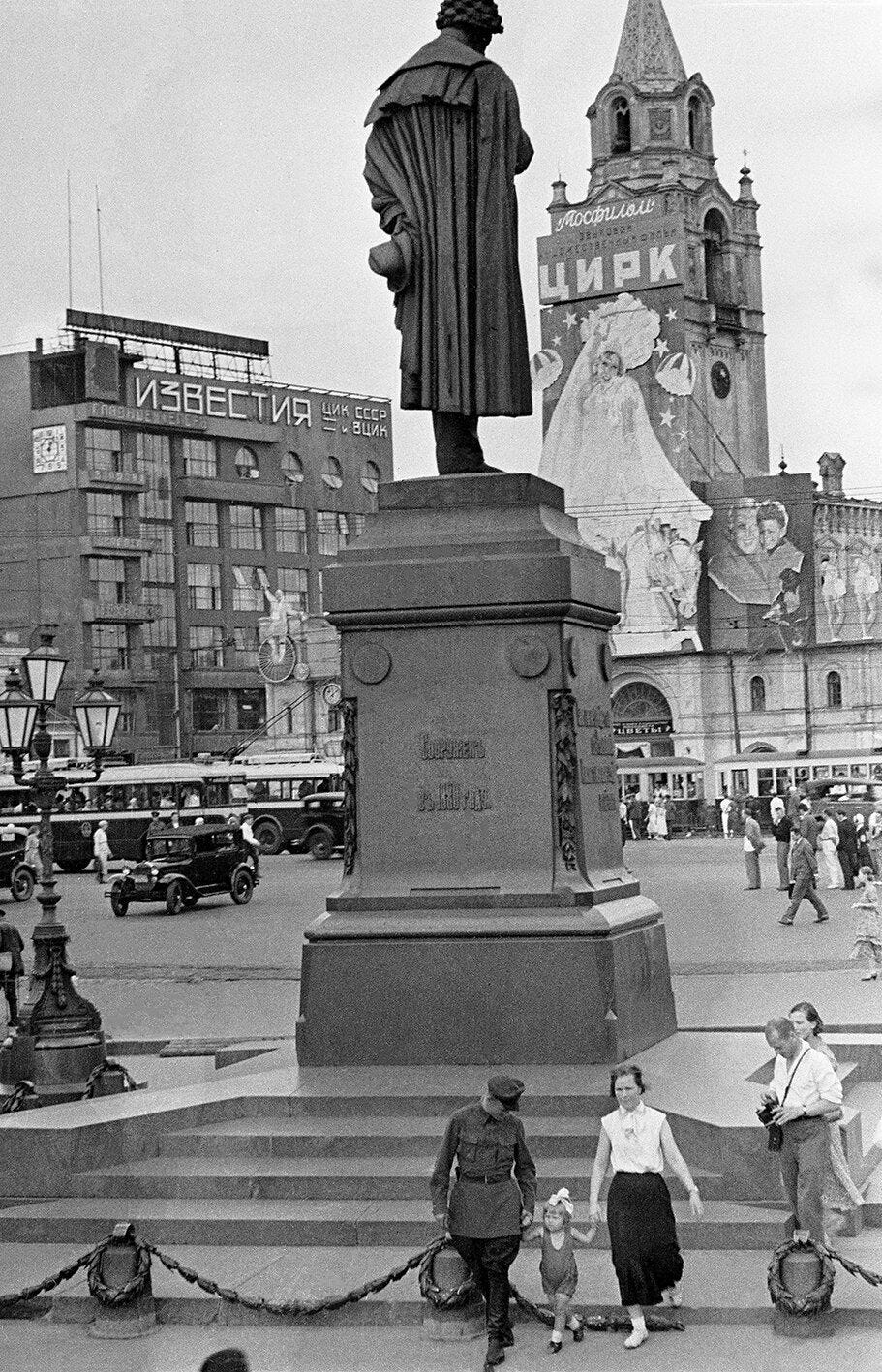
May was able to spend a few weeks in Leningrad and Moscow in October and November 1937—the height of the Great Terror—capped by attending the celebration of the 20th anniversary of the Revolution on Red Square. In his letters, he waxed enthusiastic about the energy of the Soviets, describing “a tremendous mass of people struggling fiercely but without haste to improve their standard of living.”
“Everywhere they seem to be tearing down the old or building the new,” he wrote from Moscow. But he was soon back in London, writing to Rogers that “all foreign students had left [the Soviet Union] or had little hope of staying long.”
Aside from a brief trip to the Ukrainian city of Kharkov in August 1939, days before the signing of the infamous Nazi-Soviet Molotov-Ribbentrop Pact, it was May’s only direct experience in the USSR.
‘Outside the range of the institute’s interests’
May continued his studies in London, attending lectures at the London School of Economics and elsewhere. But later that spring, he announced to Rogers his plans to finish his PhD in mathematics by studying in Paris. He also wrote that he intended to marry, and expressed hope ICWA would continue funding his research.
But in August, Rogers asked May to submit his resignation. “You have placed yourself outside the range of the Institute’s interests,” he wrote. He did not elaborate.
May concluded, almost certainly incorrectly, that his marriage had prompted his dismissal. Rogers had written that his decision came after a “lengthy conversation” with May’s father, who, he later wrote, didn’t approve of his son’s union with “an American school teacher eight years his senior.”
Writing to the US ambassador in Britain, Joseph P. Kennedy, however, Rogers blamed May’s intellectual attention wandering from the fellowship’s aims.
Despite the formal break, May continued corresponding with Rogers, who maintained his interest in him. The former fellow wrote a detailed report about his visit to Kharkov that autumn, after which he returned to Berkeley.
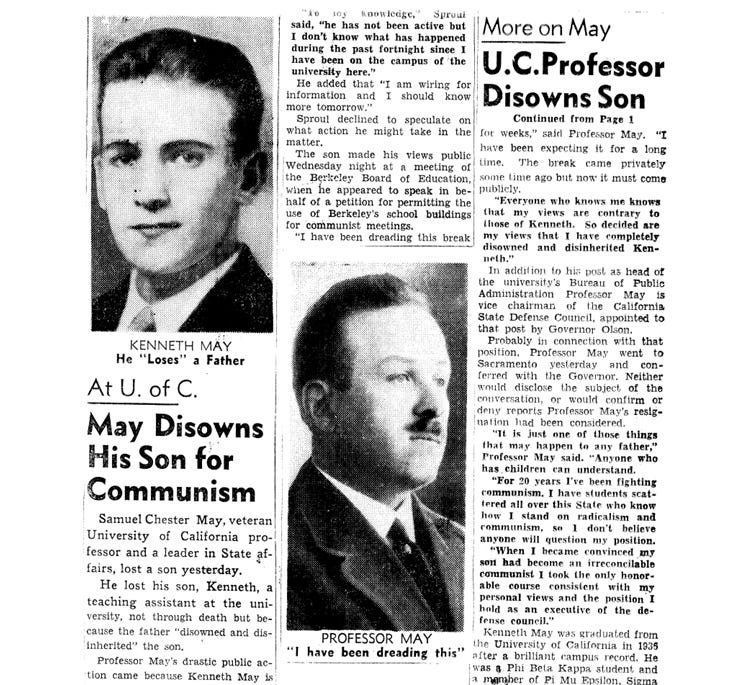
It was then that May began his activism with the Communist Party, prompting his father to publicly disown his “Communist son” in September 1940. In response, Kenneth May said his experience in Europe “convinced me that the Communist Party is the greatest force for good in the world and that only through Socialism can the people of the United States solve the problem of unemployment, poverty, oppression and war.”
Not everyone disapproved. ICWA Trustee Victor Clarke, economic adviser to the Library of Congress at the time, expressed admiration for May’s “independence and courage.”
“It at least separates him from the political herd of emasculate rabbits that constitutes so much of our electorate,” he said.
The scandal made a splash nationally, with editorials calling for May’s dismissal from his teaching post and one asking, “How many other university and State college instructors have similar records? What are we going to do about it?”
Berkeley fired May in October 1940.
‘I hope to be in the first wave’
A week after the Pearl Harbor attack on December 7, 1941, and the US entry into World War II, May asked Rogers for help finding “a place where I can be most effective in the war effort.”
Rogers wrote Hazard, the USSR fellow, who went on to help negotiate the Lend-Lease Administration’s agreement with the Soviet Union. If he could “without the slightest embarrassment” ask his superiors if they had anything to offer May, would he forward a memo on May’s behalf?
In his note, Rogers characterized May’s father as “the scheming, wire-pulling type of academic official” who was upset by his son’s marriage to “the daughter of a fellow professor with whom Sam May had a feud.”
“The generally held opinion,” Rogers concluded, “is that the father made an ass of himself” because of the perceived threat to “his own ambitions.”
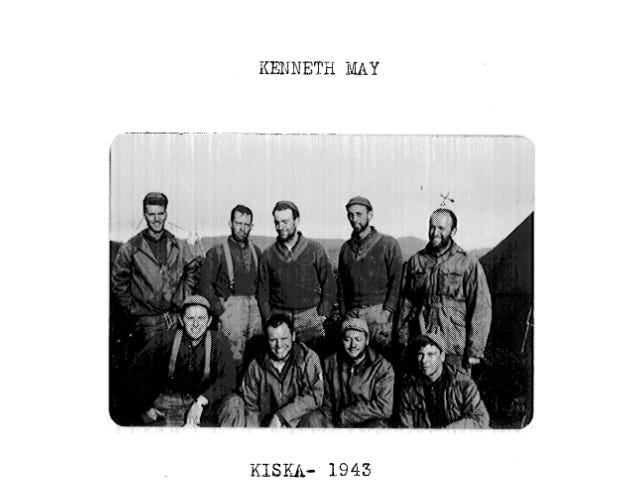
May was finally accepted into the US Army alpine troops only in January 1943. “[I] hope to be in the first wave of our combat team when we land on some now unknown beach,” he wrote Rogers in June.
Instead, he was assigned menial work in his company’s map room until a visiting general spotted his organizational work and promoted him, although only to corporal. He was promoted again the same month to communications sergeant.
Nevertheless, May reveled in his wartime experience. “I have got better acquainted with a section of America to which I was entirely a stranger—workers of farm and wood,” the communist champion wrote. “The experience convinces me that for the (near) time we are a great nation.”
He soon took part in the Allied forces’ landings in the Aleutian Islands, an experience that led him to examine frontline Army morale, his writing catching the attention of leading psychiatrists in the War Department and helping prompt his social rehabilitation. He later landed in Italy, where he was reported to have distinguished himself with bravery.
Sam and Kenneth May reconciled in 1944, and Kenneth reestablished his connections at Berkeley at the same time, completing his doctorate in 1946 and going on to become a distinguished mathematician and historian of mathematics.
He secured a position at Charlton College, where ICWA Trustee Laurence Gould was president, teaching there until 1964. In 1952, he published May’s theorem, which proved that majority voting is the only reasonable system possible for choosing between two candidates. And he continued his leftist political activity. In 1966, he signed a public vow of tax resistance over his opposition to the Vietnam War and moved to Canada. He died in Toronto in 1977.
May is best remembered for his work helping to found the International Commission on the History of Mathematics (ICHM). He served as its first chair and oversaw the publication of the first World Directory of Historians of Mathematics in 1972. Two years later, he edited the first volume of the international research journal Historia Mathematica. After his death, the ICHM established the Kenneth O. May Prize for outstanding contributions to the history of mathematics.

Robert Coalson is a retired journalist who spent more than 20 years reporting on Russia, the former Soviet Union, and the former Soviet bloc for Radio Free Europe/Radio Liberty.
