


I had two reactions on seeing the results of last year’s USA Today award for best fast-food fried chicken. First, suspicion. When I saw Popeyes—the bona fide, bone-in crispy gold standard—languishing at the bottom, I wondered if someone had fallen asleep at the wheel. Rankings are subjective, sure, but this one seemed like a clerical error.
My second reaction was respect. The underdog, Jollibee, claiming the No. 1 spot is genuinely impressive—two years in a row, no less. The Philippines-based chain has a tiny presence in the United States compared to the fast-food juggernauts on the list. Its cheerful ethos and odd food pairings would seem to destine it to an uphill battle for the hearts of a culinary-conservative American crowd, myself included.
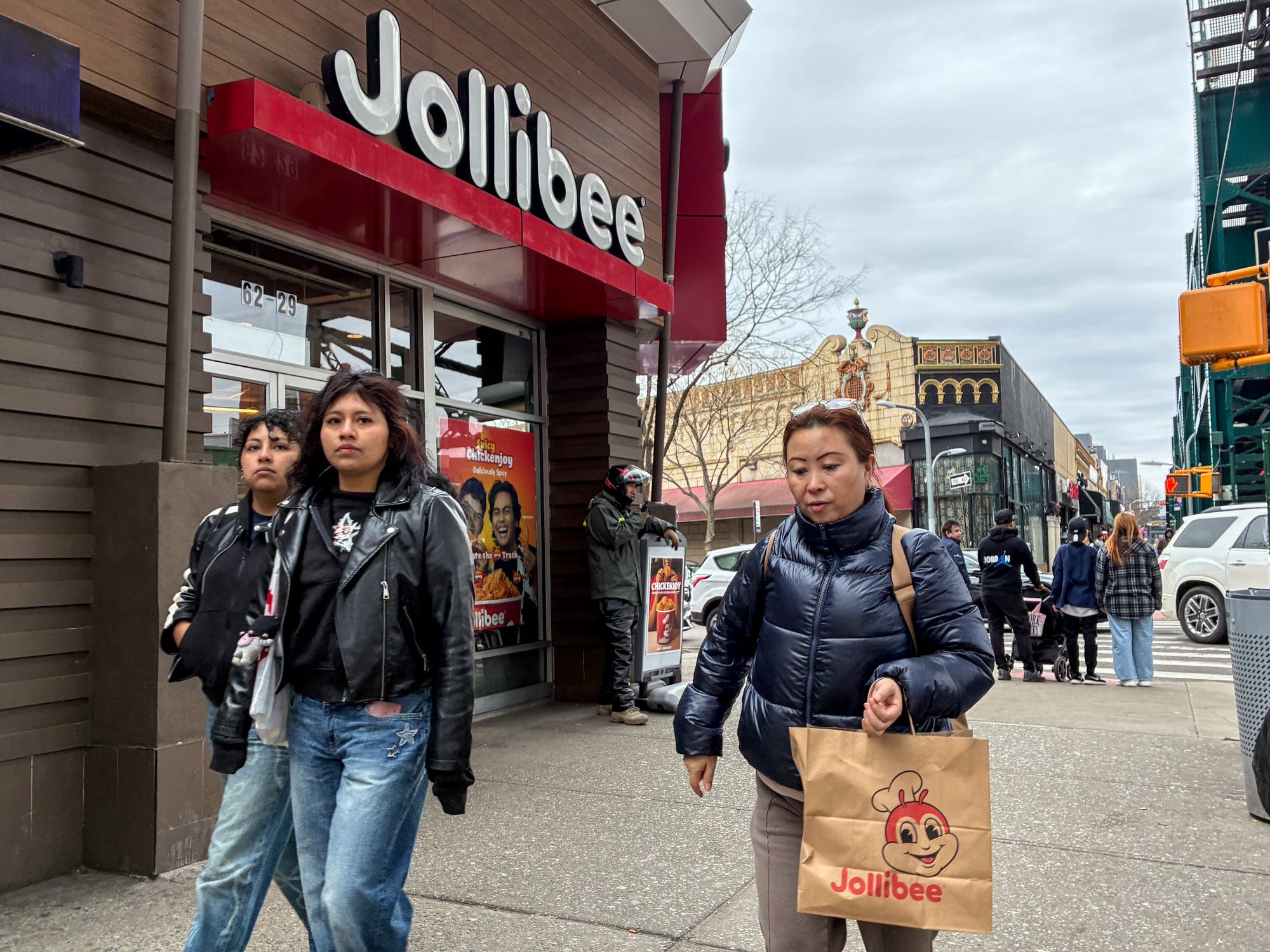
So I took the 7 train out to Woodside, Queens to Jollibee’s first New York location on a cold gloomy day. Listening to the loud metallic racket of the elevated track, I knew I’d made it to the Little Manila neighborhood. A gaggle of smiling Filipinos stood on the street, snacking on butter mamóns, Filipino sponge cakes. Pinoy (the catch-all term for Filipino cuisine) bistros, remittance centers and mom-and-pop groceries selling soy sauce and Filipino-style chicharon—crispy fried pork—line Roosevelt Avenue, also recognized as José Rizal Way, after the country’s national hero who worked to end Spanish colonial rule. I spotted a large, cheerful cartoon bee with a wide smile and white chef’s hat: Jollibee’s mascot, part-comic strip, part-icon.
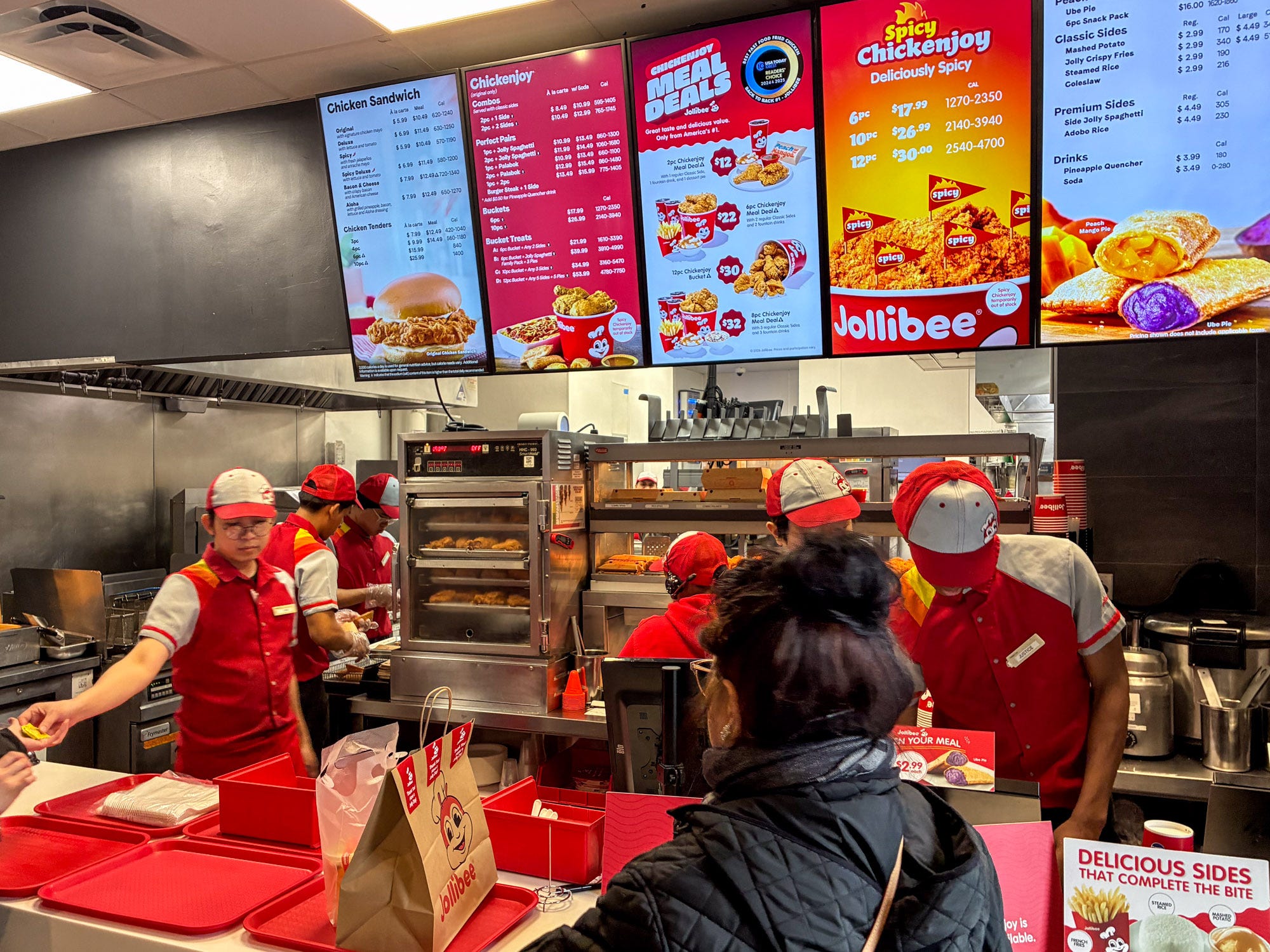
Inside, Filipinos in matching Bass Pro Shop trucker hats were wrapping spaghetti around their forks as teens collected large brown take-out bags. A cheerful employee took my order: Chickenjoy fried chicken and gravy, Jolly Spaghetti, a side of adobo rice and a mango coconut quencher. I sat at a communal table with stools, next to a family whose dad—chicken in one hand, phone in the other—didn’t seem to notice, or mind, his daughter’s face smothered in red sauce.
A lady named May, with deep jowls and short wispy hair, sat across from me with a nearly identical order. “It’s nice to feel at home,” she said as she dipped a drumstick into a brown cup of gravy. A registered nurse in her 50s originally from Ilocos Norte in northwest Philippines, she has lived in New York for the last 20 years. She described her Sunday routine: calling her family back home, going to Zumba class and then coming to Jollibee. She likes meeting people and speaking in her native Ilocano or the national language, Tagalog, she told me. One Sunday here, she ran into a classmate she hadn’t seen since childhood.
I cracked open my box of Jolly Spaghetti, bemused by the bright red tomato sauce with coarse slices of hot dogs and bits of ground meat inside, topped with cheddar cheese. The dish looked like mid-century childhood comfort food from the Midwest, not what you might expect to find in a Southeast Asian archipelago. But as I slurped up sweet bits of the Bolognese adaptation, the provenance made sense.
Processed American staples such as burgers and Spam were popularized under the US occupation of the Philippines. During World War II, a shortage of tomatoes prompted the local development of red-dyed banana ketchup, which gives the pasta its signature tangy flavor.
“We stick to our culture when we are far away,” May said. I nodded understanding, now biting into a crunchy chicken breast that certainly deserved praise. The brown gravy added an intense umami, peppery taste. Nevertheless, it didn’t hold a candle to my own fried chicken dream, spiced by deep-aged cayenne lathered in a vinegary hot sauce.
A map on the wall showed Jollibee locations around the world, with the adorable cartoon mascot trying to fit in—surfing in Guam, wearing a canonical sun hat, bamboo stick in hand in Vietnam, climbing the Empire State Building in New York. Just like many industrious Filipinos, the poster seemed to indicate, Jollibee personifies hard work that yields joy and sweet things. Last year, the company announced it would more than double the number of its American locations to 300 in the next five years.
May described McDonald’s first opening in Manila in the early 1980s. It was quite a sight, she said, with lines stretching around the block and people proudly wearing McDonald’s hats they’d received as gifts.
But the US chain, expecting an easy conquest, was outmaneuvered by a little fish that ate the whale. Although Jollibee was barely three years old, founder and CEO Tony Tan Caktiong fought back by doubling down on the Filipino palette. It was McDonald’s that had to tack instead, even launching “McSpaghetti” and serving up sides of white rice. Today, Jollibee is the fast-food leader in its home country.
A woman joined in from across the table. Alma—who coincidently works at the Filipino Trade Commission—and her friend Karol were sharing a Palabok Fiesta, rice noodles covered in garlic shrimp sauce and pork rinds. Jollibee’s brand identity centered around family and celebration, she said. “Every kid will remember celebrating their birthday here.”
America’s Filipino diaspora makes up the third-largest Asian demographic in America today, nearly 5 million, half US-born. Jollibee’s incredibly loyal base serves as a springboard to reach American taste buds. Although the fried chicken is commendable, the real edge is sweet foods and wholesome social marketing.
Alma’s friend Karol shared her Peach Mango pie, a cult favorite. A painter, she explained that she was visiting New York to exhibit her artwork. She showed me a photo of a picture titled “Mabuhay Times Square,” or “Hello Times Square,” proudly pointing to a smiling red-and-white bee in the center of the action.
Joshua Levkowitz was an ICWA fellow from 2021-2023 in Turkey, where he wrote about issues related to migration and identity.