

Editor’s note: This passage about events in June 2019 is an excerpt from Suzy Hansen’s new book From Life Itself: Turkey, Istanbul, and a Neighborhood in the Age of Erdoğan (published today by Farrar, Straus and Giroux).
Hüseyin said it was like a movie—that they came out of nowhere. A mob of thugs, all limbs and swinging arms, assumed battle formation, taking up the whole width of the street and moving swiftly, trying to get to their target without interruption. They came from the direction of Sulukule, the Roma enclave inside [the working-class Istanbul neighborhood] Karagümrük that [President Recep Tayyip] Erdoğan had mostly torn down and replaced with fancy-looking, shoddily built, expensive town houses, which had mysteriously filled up with Arabs. They passed the real estate agent Ebru’s office and then turned down the top of Professor Naci Şensoy Avenue.
As they marched by, all of the shopkeepers came to their doors to watch, and pedestrians clutching plastic bags stumbled to the side to hug the walls. The men were carrying baseball bats—for what they had baseball bats, I do not know, since baseball is not a popular sport in Turkey, though later someone said, “For this”—and they had clubs, or sopa, as they called them, rough pieces of wood. One man even had a döner kebab knife, which is long and has a serrated edge, intended for cutting the upside-down pyramid of meat that hangs in so many restaurant windows. These döner kebab knives appeared in fights often in Istanbul; I saw one for the first time in a brawl on my street when I first moved to the city 12 years earlier. At the time, I thought it was a sword. I still wondered whether these fighters with the döner kebab knives worked at a döner place, had family who owned a döner place, or had stolen the knife from a döner place, though later a man in the neighborhood would tell me that in Turkey many people have döner kebab knives and it was normal to see them wielded in neighborhood fights.
By then I knew it was likely that only descendants of Turks who came from Anatolia would say such a thing about döner kebab knives, whereas those whose families liked to think of themselves as the “real” Istanbul people might grumble that before 1950, they didn’t even have the popular döner kebab wraps in Istanbul, one of those “Arab things.” One of the many things I would learn from Karagümrük in those years was that what created and divided Istanbul was not Erdoğan or Islam or secularism or left or right—as I had long thought—but this endless story of the countryside and the city, and all that they hated and envied of one another.
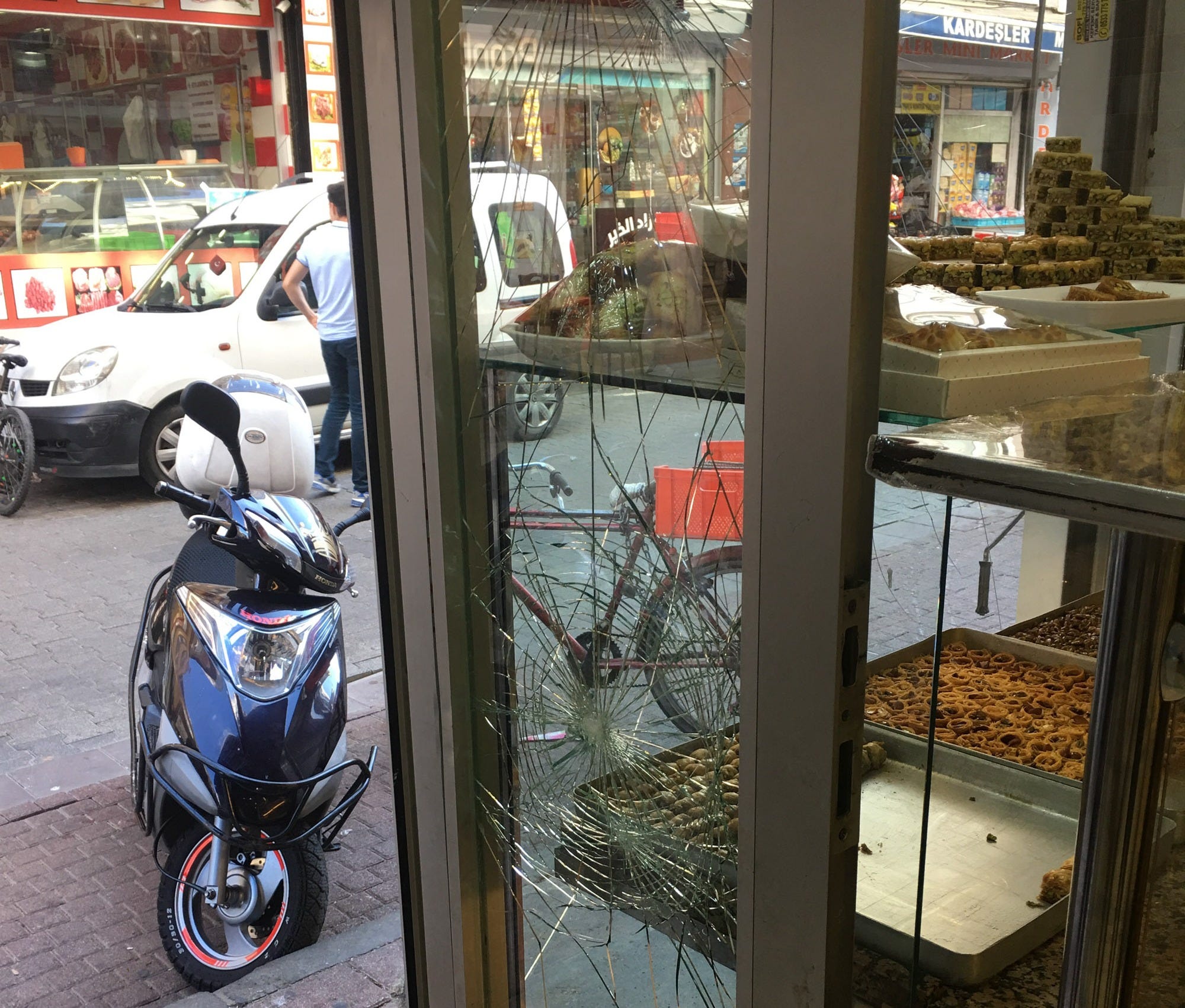
That evening, at some point, with a jog and a hop, one man with a bat—who sounded like the leader—smashed Al Nour’s window, as if their charge down the street resulted in this release of energy, all of it hurtling at the proud window with its stenciled glass. The first strike had an effect on the activity of the street, a momentary freeze. Some people backed out of the way. Others hurried past. The man at the butchery kept smoking and watching. It all happened so fast.
The other men followed their leader, galloping at the window to shatter it and then leaping back again, afraid of the glass, amazed by themselves. Get the fuck out of here! Fuck you! They didn’t say, Fuck you, Syrians, but they looked at the Syrians as they cursed. Siz geldiniz buraya, bizim huzurumuzu kaçırdınız. You came here and disturbed our peace.
The first strike supposedly brought the Syrians out, almost immediately, and with chairs, which they hurled at the men wildly. Later, they would proudly show security videos of their bravery, the adrenaline taking weeks to drain from their bodies. The young men had been left to their own devices; Majed, the owner, who, his sons casually noted, once killed a man in Syria in self-defense, had been out making a delivery.
His employees defended his sweets shop, as did his second-youngest son, Tarik, who, after all, was the one the toughs were really after. Hüseyin was at his Girit Market. He immediately exploded out of his shop, too, and into the crowd. Stop, stop, stop! What do you want? I don’t understand! He did understand; it would turn out he knew much more than he told me at first. Canan, one of Hüseyin’s sisters, a stout, unmarried woman in her 50s who sat at the counter of the Girit Market all day, threw herself into the street and at the chest of the main attacker, the leader, and wrestled with him; she ended up with a bloody scalp, probably from a flying chair. Someone slapped Hüseyin. Another woman ran outside in her nightclothes, and men yelled at her for running outside in her nightclothes. A man named Ibrahim yelled at Hüseyin, Why are you protecting these people? The tüpçü from next door tried to calm everyone down, but he was just a tüpçü, the lowest on the totem pole, the guy who sold the natural gas cans, sometimes driving through the streets playing a jingle like an ice cream truck. Otherwise, no one helped the Syrians, Hüseyin said. The butcher watched, the electronics shop watched, the bakers stayed inside, but some women came by and spat on the Syrians—a rumor I heard once and never heard again in any subsequent retelling.

Just down the street, five shops away, at Muhtar Ismail’s kahve, his all-male coffeehouse, the men were playing cards and okey, a tile-based game like Rummikub, on their raggedy felt tablecloths. As he did many nights, the muhtar—the neighborhood councilman, “one of Karagümrük’s most prominent men,” as Hüseyin once said—sat with his cane and his Marlboro Reds, talking to customers, some of whom he liked and some of whom he did not. The muhtar had heard the shattering of glass outside. The clacking crash of the okey tiles fell silent. What’s that? The other men playing cards looked up too, all turned toward the window, toward the street. Someone walked outside. It’s a fight, they said. They attacked the sweets shop. The men crowded onto the porch.
Ismail watched them from his seat. He had lived in Karagümrük almost all his life, and been its muhtar for almost three decades. He had watched since the 1950s as Karagümrük declined from an elegant, cosmopolitan wonderland of notable elites into this deteriorating labyrinth of roughnecks and Roma mafia, and he had watched Istanbul morph from a genteel imperial capital to a dusty, impoverished backwater to now, most terribly, Erdoğan’s glitzy, corrupt megalopolis, and so when the men in the kahve said they attacked the sweets shop, the muhtar grimaced, kept playing cards, kept smoking, because he knew this was a movie it was better he didn’t see.
Suzy Hansen is a former ICWA fellow (Turkey, 2007-2009) who lived in Istanbul for more than a decade, where she was a contributing writer for The New York Times Magazine and many other publications. Her first book, Notes on a Foreign Country, was a finalist for the Pulitzer Prize in Nonfiction and the winner of the Overseas Press Club of America’s Cornelius Ryan Award. She has taught writing at Princeton University, New York University and Bard College.