


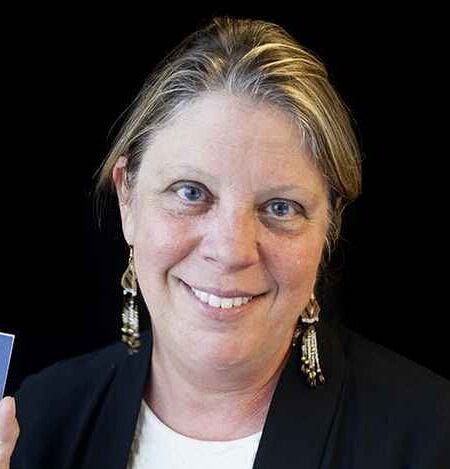
Carol Rose is a leading advocate for human rights and social justice. She has been executive director of the Massachusetts ACLU since 2003, expanding the organization and tackling many issues and legal cases of national importance. She began her career as a reporter, working for United Press International, The Des Moines Register and The New York Times, with stints in Washington, DC, Israel, the West Bank and Gaza, Northern Ireland and Japan. Carol was an ICWA fellow from 1989 to 1993 based in Pakistan, Nepal and Bangladesh. She went on to attend Harvard Law School—where she was co-editor of the Harvard Human Rights Journal—clerked for Federal District Court Judge Patti Saris, and worked as a First Amendment, intellectual property and civil rights lawyer at the Boston law firm Hill & Barlow. She earned her undergraduate degree at Stanford University and master’s at the London School of Economics.
In this July 1992 dispatch, Carol describes refugee camps emptying in the Pakistani border town of Torkham as Afghans return home in droves following the collapse of the Communist government in Kabul that year. Soon after, a second Afghan civil war broke out, and the Islamist Taliban eventually seized control of the country until its ouster in 2001 by American forces following the attacks of September 11. With the Taliban now back in power after four decades of conflict and instability, the UNHCR estimates that 6.4 million Afghan refugees remain outside the country.
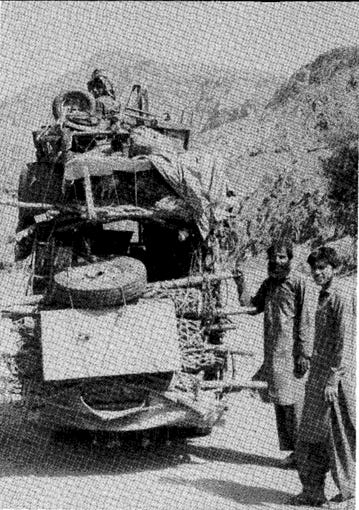
Pakistan (July 1992) — An endless caravan of heavily laden buses, lorries and donkeys moves past the black iron gates that divide Afghanistan and Pakistan in the border town of Torkham.
Bearded moneychangers sit alongside the road, haggling with turban-clad men over fluctuations in the value of the Afghan currency. Veiled women and children wait in crowded minivans as their fathers, husbands and brothers make last-minute financial transactions before crossing the border. Nearby, garishly painted Bedford trucks are piled 20 feet high with the remnants of life in the Afghan refugee camps: beds, blankets, pots, window frames, doors, bricks, wooden roof beams, chickens and the occasional water buffalo.
After 13 years of war, the Afghans are going home.
Since the collapse of the Communist government in Kabul last April, the trickle of people crossing the border has become a human tidal wave. As many as 15,000 people return each day to Afghanistan—more than 600,000 since the beginning of the year. At the present rate, more than 1 million Afghans will go home by the end of August—making this the largest voluntary repatriation movement since World War II.
Amid the rubble of abandoned houses of the Surkhaps refugee camp stands a single mud-wall compound. I have come to this distant camp in the middle of the Balochistan desert to see what has become of my friend, Somargul, the eldest sister in an Afghan family with whom I lived in purdah—seclusion—one year ago.
As before, I have come here in disguise: wearing an all-encompassing body veil (burqa) to avoid detection by Pakistani police. Because of frequent tribal clashes, foreigners are not allowed into this camp.
As a taxi ferries me through the five-mile-long central bazaar of the camp, I peer through the lace eye-covering of my burqa at the deserted shops and homes. It appears that the refugees left in waves: Some stretches of the camp are completely abandoned while others remain full of people. As we near Somargul’s house, I see that her family compound is the only one still standing in the neighborhood.
When I enter the inner courtyard, Somargul and her sisters embrace me and usher me to the central salon. As before, children gather around to see my face as I lift my veil. I distribute gifts—coloring books, scarves, chocolates—while Somargul tells me of her life since the fall of Kabul.
“Everyone has left the camp,” she says. “Our neighbors were all from the same village, so they left together. We are the only people left in this area so we must travel [three hours] to Quetta to buy meat or vegetables. It’s a big problem because it is almost impossible to find taxis to come here anymore, so the men have to walk a long way just to get transportation.”
“It also has become dangerous for us to stay here,” she continues. “But we went back to see our home in Kandahar [Afghanistan] and it is completely destroyed and our fields are mined. There is no place for us to live if we return there. We also looked for a house in Quetta, but it is too expensive for us to move there.”
Somargul says her family has two ration cards but that when they tried to cash them, they were turned away because of the crowds. Since it costs money to go to the encashment center in the nearest town, they gave up trying.
Instead, Somargul asks if I can help one of her brothers find a job with a Western aid agency. With cutbacks in international assistance programs, however, jobs for Afghans are becoming more scarce even as the need increases.
“Please, won’t you help us?” she says. “It is not safe for us to stay here, but we cannot afford to leave.”
The same plea is made by a refugee family with whom I meet in the Khorasan refugee camp, north of Peshawar. As I tour the nearly empty camp, a man invites me inside to have tea with the women in his family. Inside the purdah compound, beds and blankets are stacked in preparation for imminent departure.
“The water has gone bad here so we will have to leave soon,” says one of the women as she offers me a cup of sweetened green tea. “What are we to do? Our house in Afghanistan has been bombed and we haven’t enough money to transport roof beams on a truck to Afghanistan. But it is too dangerous for us to stay here. There are only five or six families left, and the thieves come in the night.”
When Taliban took over five years ago, how long were the lines of people returning?