


Originally published in the Claremont Review of Books
Reviewed in this article:
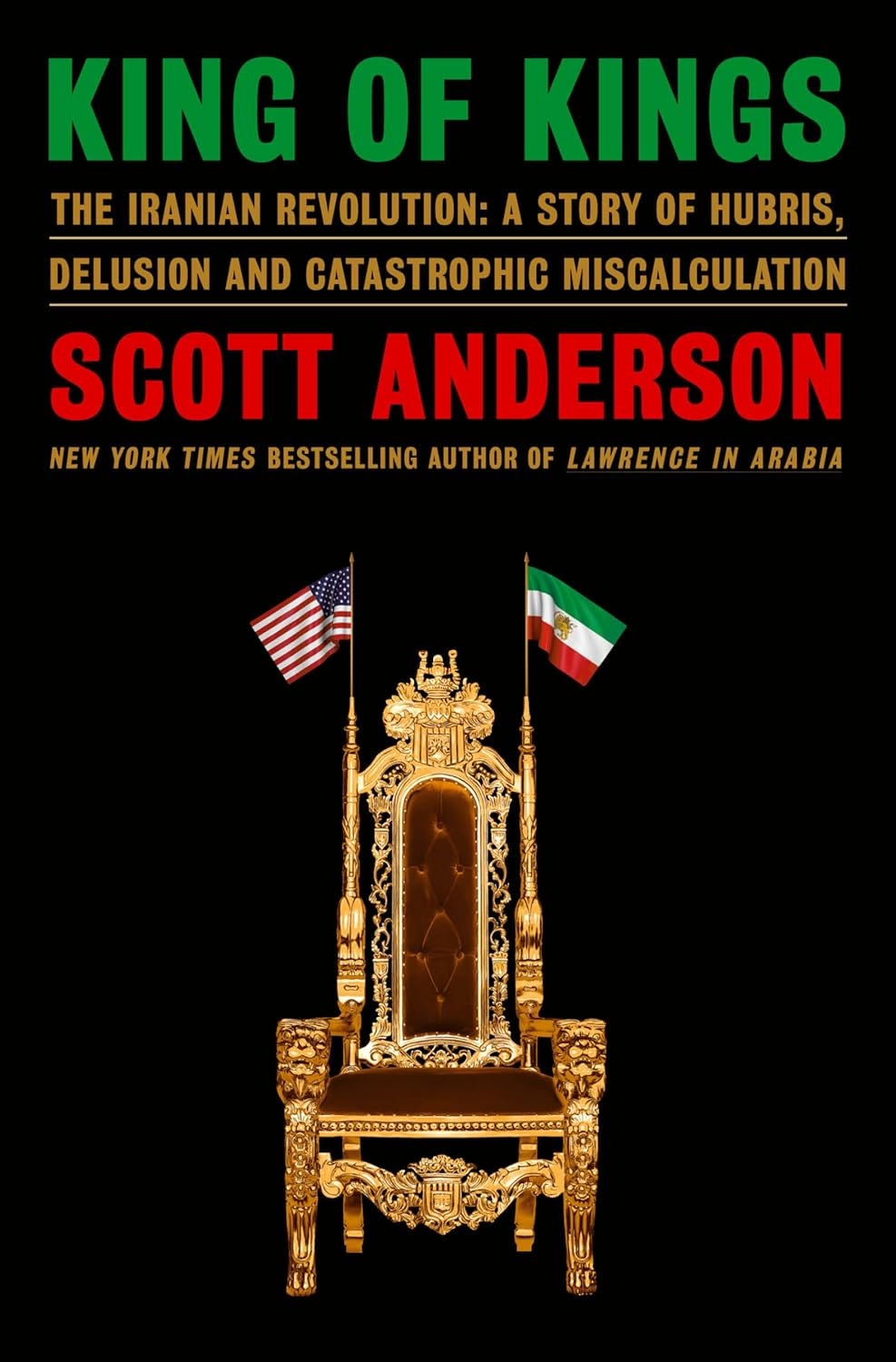
King of Kings: The Iranian Revolution:
A Story of Hubris, Delusion and Catastrophic Miscalculation
Doubleday, August 2025
by Scott Anderson
In 2002 I asked an Iranian journalist whether recent spontaneous, pro-American demonstrations at Iranian soccer matches meant Iran was on the verge of a counter-revolution. “No,” he said.
The people who run Iran were graduate students in Eastern Europe during the Communist period. They know how to control a population. What they don’t know how to do is to control their own children. There will be a counter-revolution but not for quite a while.
I have often reflected on that conversation. What happened in Iran in 1979 was a genuine revolution—an upheaval as profound as those which took place in France in and after 1789, in Russia in and after 1917, and in China in and after 1947. In Iran, revolutionary fervor waned quite some time ago (as it did at a similar stage in France, Russia, and China). But the regime established by the Ayatollah Ruhollah Khomeini and his followers in 1979 is not apt to collapse until the generation that made the revolution 46 years ago (or came of age not long thereafter) passes from the scene. Mikhael Gorbachev was the first Soviet leader who had no direct personal connection with the Russian Revolution, and he did not come to power until 1985—nearly 70 years after the event. The fact that the Islamic revivalist regime weathered the recent defeats inflicted by Israel and America shows that it retains staying power.
For this reason, if for no other, it is important that we come to understand what happened in Iran in 1978 and 1979. The best books on the subject are Abbas Milani’s The Persian Sphinx: Amir Abbas Hoveyda and the Riddle of the Iranian Revolution (2000) and The Shah (2011). Milani had a series of advantages that set him apart from everyone else who has analyzed the upheaval: he was born in Tehran, attended college and studied for his doctorate in the United States, and lived in his native country for 30 of his first 38 years. Politically engaged, he joined an underground Maoist cell and spent two years as a political prisoner in the time of the shah, taught at the National University of Iran, and witnessed the revolution and remained in the capital until the outbreak of the Iran-Iraq War in 1986. Needless to say, Milani knows Farsi and possesses an intimate familiarity with his homeland and knowledge of its history and political culture that almost no outsider can hope to equal. Moreover, while working on his books, he had unexcelled access to the memoirs and diaries of those who were involved, and ample opportunity to conduct interviews. Equally important, Milani long ago shook off the Marxism-Leninism of his youth, and has no partisan axes to grind. He simply wanted to get to the bottom of the mystery.
This, too, sets him apart from the journalists who have written on the subject, as does one other inestimable virtue. Westerners, especially Americans, have a propensity for denying genuine agency to the people who live in countries such as Iran. When they write on events, they nearly always trace their cause back to the United States, and they nearly always have a partisan point to make. Milani has no time for either practice. He is a genuine historian.
Compare his work to All the Shah’s Men: An American Coup and the Roots of Middle East Terror (2003) by Stephen Kinzer, a former New York Times journalist. Milani’s treatment of the prime minister Mohammad Mossadegh’s overthrow in 1953 is strikingly different. The first thing to notice is Kinzer’s extremely misleading subtitle: the Americans were minor players in the drama of 1953. Secondly, Milani’s Mossadegh is no more a hero than Mohammad Reza Shah who succeeded him. Further, by the time of the coup the leading Shiite mullahs of Iran and many of the secular nationalists were as hostile to Mossadegh as was the shah. “It is not far-fetched,” Kinzer claims, “to draw a line from Operation Ajax through the shah’s repressive regime and the Islamic Revolution to the fireballs that engulfed the World Trade Center in New York.” He’s right: it is not far-fetched; it’s ludicrous. Teddy Roosevelt’s grandson, intelligence officer Kermit Roosevelt, may have boasted that it was the CIA’s Operation Ajax that brought down Mossadegh. But it is not at all clear that this was the case.
For Kinzer, Mossadegh was a virtual saint—a democratically elected politician brought down by an American administration idiotically obsessed with the Soviet threat at a time when the Tudeh—Iran’s Communist party—was a spent force. As Milani shows in detail, the Tudeh remained potent in 1953, and Mossadegh was a power-hungry demagogue who had—contrary to the constitution of Iran—been voted dictatorial powers by the Majlis, Iran’s national assembly. He was intent on concentrating authority in his own hands, on stripping from the shah his constitutional prerogatives, and on overthrowing the monarchy. This caused many of those who had once supported his quest to nationalize oil production in Iran to shy away and turn on him. In response, Mossadegh was more than willing to turn to the Tudeh for support. Remember that the Soviet Union occupied northern Iran during World War II, that the Truman Administration exerted considerable pressure to get Stalin to honor his treaty commitments and withdraw his troops, that the Russians subsequently sponsored a secessionist movement in Iranian Azerbaijan, and that they pressed Iran very hard for oil concessions. The Soviet threat was real. There were troops aplenty within easy reach of the Iranian border. All it would take to bring them into Iran was an invitation from a beleaguered and unscrupulous Iranian prime minister.
I belabor Stephen Kinzer’s myopia for a reason. Scott Anderson, a war correspondent and frequent contributor to The New York Times Magazine, shares Kinzer’s prejudices. In some ways, to be sure, Anderson’s book is a decided improvement on Kinzer’s fairy tale. In dealing with the shah, he restates Milani’s account in abbreviated form. As he points out, by Middle Eastern standards the regime governed by Reza Shah’s son, Mohammad Reza Shah Pahlavi, whom Khomeini pushed out, was not all that repressive. The man was a modernizer—an exponent of land reform; a friend to the emancipation of women; a builder of clinics, hospitals, and schools; and a supporter of higher education. At the time of the revolution, there were 50,000 Iranians studying in American universities with support from the shah, and Iran was a far more open society than most in the region, including Iraq, Syria, and Libya.
Moreover, Anderson’s depiction of American conduct in the late 1960s and the 1970s is more or less accurate. Our presence in Iran in the late ’70s was immense. There were 50,000 Americans living in Tehran on the eve of the revolution. Most were businessmen hawking weapons and other items. But the embassy had a staff of 300 Americans, the CIA station was exceedingly large, and military advisers were scattered across the country. All this notwithstanding, Washington knew next to nothing about Iranian society. Almost no one at the embassy, in the CIA, or in the military spoke or read Farsi. Our people knew the English-speakers at the top. They did not know the country—and the individuals assigned to the Iran desk at the State Department in D.C. and the staffers assigned Iran at the National Security Council were even less well-informed. No one listened to and translated the sermons of the Ayatollah Khomeini, which were circulated in Iran via tape cassettes. No one bothered to read the firebrand’s books. Journalists were no better. Khomeini, who had been a force in Iranian affairs since before 1963, was not mentioned in The New York Times until quite late in the game.
Anderson shares the attitude, voiced by Kinzer and articulated by Jimmy Carter early in his presidency, that America’s foreign policy was distorted by its focus on the Communist threat, and he has no use for Eisenhower, Nixon, or any other Republican. Carter learned the hard way that his foreign policy stance was wrong. To his credit, when the Soviets invaded Afghanistan, he responded by initiating covert aid to the Afghan rebels and a military build-up. Anderson never learned the requisite lesson. In consequence, he showers contempt on Henry Kissinger, is severely critical of Carter’s national security adviser, Zbigniew Brzezinski, and has nary a word of criticism to say about his hapless secretary of state, Cyrus Vance. It is strange, then, that the story told by Anderson contradicts his obiter dicta and suggests that Brzezinski had a far better understanding of the stakes. What’s more, Anderson’s positive depiction of Carter is belied by the fact that in the midst of the crisis—when he ordered Vance, Brzezinski, and the CIA Director Stansfield Turner to work together and come up with an assessment of the situation and a plan for dealing with it—each of the three cut the other two off from the cable traffic generated by their various bureaucracies.
There is this to be said for Scott Anderson’s book: like Stephen Kinzer, he can write, is a skilled storyteller, and, in preparing to compose this book, did a great deal of homework. Readers will find it a treat to follow the irrepressible Michael Metrinko from his Peace Corps days in rural, then suburban Iran in the early 1970s through his service as a Foreign Service officer in Iran from 1977 to 1980. Metrinko, one of the few embassy staffers fluent in Farsi, tried time and again to alert his superiors to what was happening on the ground. Time and again they admonished him to stop talking nonsense. At one point, when he attempted to alert the embassy and Washington to an emerging mutiny within the Iranian Air Force, the ambassador William Sullivan, a career Foreign Service officer who knew absolutely nothing about Iran, threatened that, if Metrinko ever again wrote such a report, he would personally ruin his career. We also get to see events through the eyes of the shah’s long-time right-hand man, Asadollah Alam, who kept a detailed diary (eventually published in English) right up to the time of his death a year before the final crisis began. We also learn a great deal from the testimony of the shah’s consort Farah Diba, whom Anderson interviewed at her home in Washington, D.C.
Anderson also took the time to learn about the Iranian expatriates who formed Khomeini’s entourage when he was pushed out of Iraq by Saddam Hussein and ended up in a suburb of Paris. Ebrahim Yazdi, the chief figure in this group, was largely responsible for packaging Khomeini as a moderate interested only in bringing democracy and a respect for Islam to his native land, and he came to believe his own baloney. He did a brief stint in the transitional government as foreign minister before resigning in response to the hostage crisis. He eventually ended up in prison. Abolhassan Bani-Sadr served time as the Islamic Republic’s president before fleeing back to his former refuge in France and denouncing the ayatollah. Sadegh Ghotzbadegh succeeded Yazdi as Foreign Minister but did not last long, ultimately suffering torture and execution. These figures—whom Lenin would have called “useful idiots”—paid a heavy price for misreading the Ayatollah Khomeini, and all lived to regret what they had done.
As all this suggests, there are things to learn from King of Kings, but why the revolution took place is not one of them. To get closer to that goal, one would have to turn to Abbas Milani’s splendid biography of the shah. But something more is needed. To get a proper perspective, one needs to back away: set aside the United States, the Soviet Union, and the day-to-day decision-making that took place in Tehran, and think about the difficulty of the task that Mohammad Reza Shah Pahlavi and his father set for themselves. Both were unabashed admirers of Mustafa Kemal, who took the name Atatürk. Both sought to bring to Iran the modernization program that he had introduced in Turkey in the 1920s. Neither, however, possessed the advantages that belonged to the towering figure they so admired.
The Ottoman Empire in the first two decades of the 20th century was a much more modern state than Qajar Iran. It was a great power, not a plaything of Russia, England, or anyone else. It had engaged the great powers of Europe as an equal, if not a superior, for hundreds of years. Its army officers and leading officials were highly educated, sophisticated men. Moreover, in World War I it had suffered a defeat so catastrophic that, in the aftermath, it came apart at the seams and there was a good chance that its Anatolian heartland would be cut into districts for distribution to the British, French, Italians, and Greeks. The man who saved the Turks of Anatolia from this fate was the victor at the battle of Gallipoli, Mustafa Kemal. In consequence of the War for Independence that he staged, he came to possess a measure of moral authority that neither of the Pahlavi Shahs could come anywhere close to equaling. The fact that he was the man who had prevented the partitioning of Anatolia enabled him to abolish the sultanate and then the caliphate—the latter an event from which Sunni Islam has never recovered. It was his achievement on the battlefield that enabled him to disestablish the Islamic religion, establish a secular republic, and bring women into the public sphere. In 1950, there were more female university professors in Turkey than in the United States.
To do all this required ruthlessness. Atatürk crushed religious uprisings in the Kurdish region without mercy. When, in a little town north of Izmir near the Anatolian coast, one Nakşibendi Derviş denounced his government, demanded a restoration of the caliphate and of sharia, then staged a riot in which the rioters beheaded a teacher doing his military service, Atatürk sent his minions to conduct trials and execute or imprison those involved.
What can be said is that it all worked. Some might argue that the victory of the party headed by the Islamic revivalist Recep Tayyip Erdoğan in 2003 and his subsequent domination of Turkey is proof that Atatürk failed. But I think not. In Istanbul a year ago I was struck by two things. Atatürk’s image was everywhere. There had been a nationwide celebration of the Turkish republic’s centenary the year before. Moreover, the secular women on the street in Istanbul were more scantily clad than their counterparts in Athens, and many of the young religious women wearing the çarşaf were elegantly decked out. The fact that Erdoğan has jailed the man slated to be his opponent in the next presidential election is a sign of profound weakness, not strength. There has not been and will not be an Islamic counter-revolution in Turkey.
Reza Khan Pahlavi had the moxie necessary to duplicate Atatürk’s great effort, which is what he intended. He was cunning and ruthless. He knew what needed to be done. But he did not have the moral authority to effect such a transformation. Iran in the 1920s and ’30s, caught between the British and the Russians, was not a great power. The first Pahlavi Shah was eager but unable to free his nation from interference by outside powers. Moreover, Shiite Islam was not as closely bound up with and submissive to earthly rulers as Sunni Islam had been. The Turkish sultan was the caliph, the commander of the faithful. The Iranian monarch was just a monarch. The mullahs of Iran were a much better organized and much more powerful force than the prayer-leaders of Anatolia. That Reza Khan Pahlavi made considerable progress is clear, but he also made one crucial mistake—attempting to play the Germans off against the British and the Russians early in World War II, as a way to wrest his country from the grasp of the latter two powers. Instead, they joined forces and intervened to deprive him of his throne and substitute in his place his adolescent son.
Like his father, Muhammad Reza Pahlavi was intent on conducting his native land into the modern world, on freeing its people from the oppression of the mullahs, and on liberating it from foreign domination. To a considerable degree, he succeeded. Under his stewardship, Iran became more or less fully independent, and he managed to enrich it. But his success virtually guaranteed his failure. For he lacked the stature that Atatürk had gained through his war of liberation, and the thousands of bright young Iranians he sent abroad to study came back wanting for their country a degree of modernization that left no room for a traditional, absolute monarchy. Mohammed Mossadegh may not have been regarded as a hero by those who knew him at the height of his power in 1953. But legend made him a hero to those who entered the political arena a quarter-century after his defeat. Atatürk had the support of his country’s elite, increasingly large and educated. The shah did not—and lacked the resolve that Atatürk and the first Pahlavi shah had possessed in spades. In 1953, when faced with Mossadegh; in 1963, when Khomeini first appeared on the scene; and in the late 1970s, when the younger members of Tehran’s educated elite made common cause with the followers of the Ayatollah Khomeini, the shah was paralyzed. In 1953 and 1963, others did what was necessary on his behalf. In 1978-79, no one with the requisite spine had the authority to act.
Had the shah been a man of courage and decision, he might well have survived the crisis. Had the State Department and the CIA had any idea what was happening, the Americans might have rallied the Iranian officer corps against the revolutionaries. Had Jimmy Carter had an administration that was not at loggerheads, something might have been done. But well-informed, resolute leadership was not to be found. Carter was nearly as indecisive as the shah.
Even, however, had the shah managed to get past the crisis of 1978-79, the monarchy would not have lasted much longer. The shah and his father—with their modernization campaign—had unleashed forces in Iran they could not stop. The educated elite was profoundly disaffected. So were the devout, and that was not likely to change. Moreover, when things came to a head, these two groups were bound to collide, and the odds were good that the devout—more numerous and with a clearer idea of what they wanted—would prevail. Those within the educated elite were leaderless and at odds with one another ideologically. What’s more, many of them were sympathetic to Khomeini (or thought that they were).
It was not, however, inevitable for someone like the Ayatollah Khomeini to be the victor and impose a regime characterized by the so-called “Guardianship of the Jurists [velayat-e faqih].” Many a mullah regarded this concept as heretical: it had been bandied about, but never before been put into practice. Clerical rule was contrary to Shiite tradition. If Khomeini came out on top, it was because he was a paragon of cunning, determination, and ruthlessness, and because over the years, as an opponent of the shah, he had acquired for himself every bit as much moral authority as Mustafa Kemal had garnered for himself in the course of Turkey’s War for Independence.
Paul A. Rahe is a professor of history at Hillsdale College and Charles O. Lee and Louise K. Lee Chair in the Western Heritage. He lived in Istanbul from mid-summer 1984 to mid-summer 1986 as an Eastern Mediterranean fellow of the Institute of Current World Affairs.
