



Reviewed in this article:
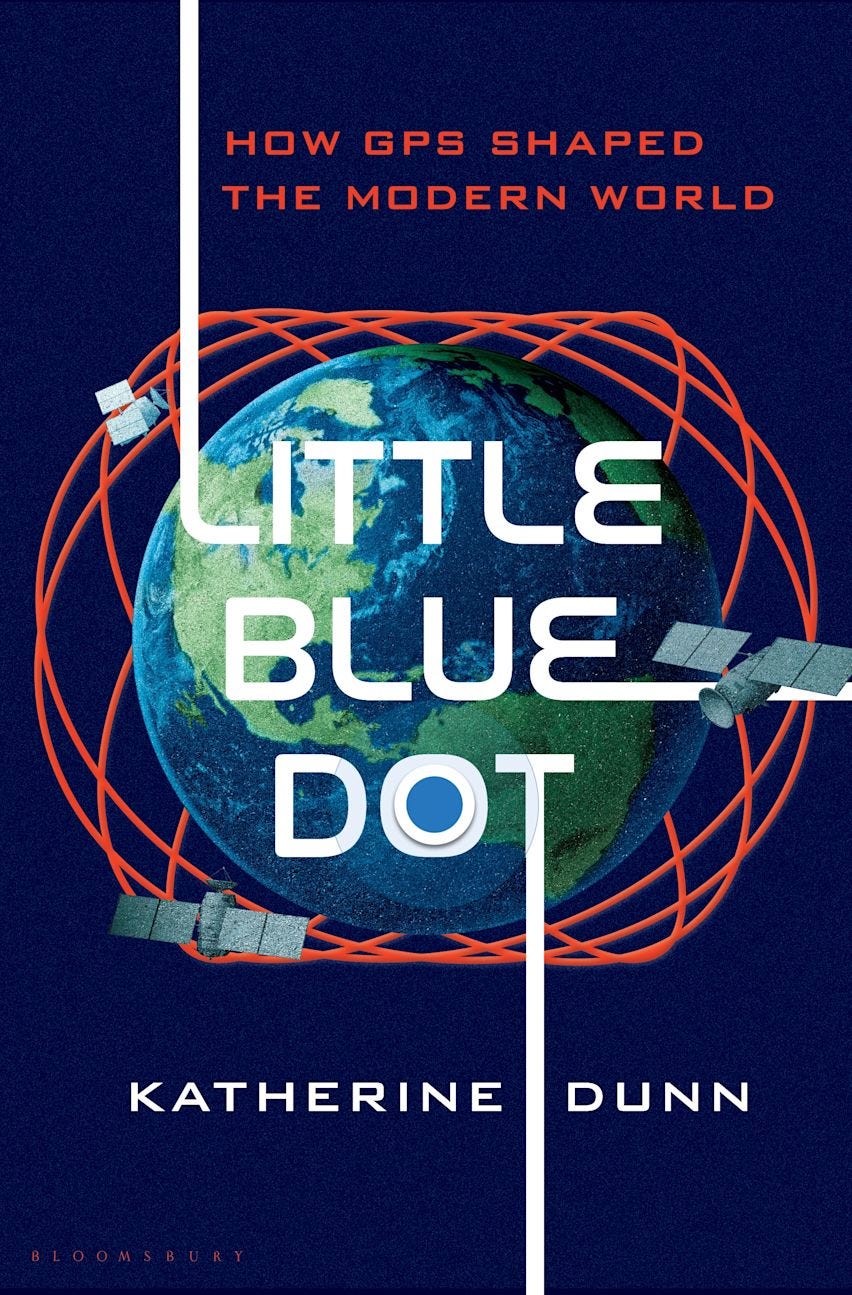
Little Blue Dot: How the Global Positioning System Shaped the Modern World
Bloomsbury, June 2026
by Katherine Dunn
On a clear day in 2019, an A320 Airbus plane was making a final approach to Larnaca airport in Cyprus when its cockpit warned that the ground was dangerously close. The warning was wrong. The Global Positioning System (GPS) data feeding the aircraft placed it far lower than it really was. But the pilot didn’t know.
Taking the plane up to 8,000 feet, he undertook another landing attempt. The second approach progressed without incident—luck held. But the problem of faulty GPS data has since spread. Some 1,500 flights a day experience GPS interference, a 2024 aviation industry report estimated. Most incidents aren’t the result of direct attacks on individual planes but collateral effects of military electronic warfare near conflict zones such as Ukraine and the Eastern Mediterranean.
That is the unsettling reality Katherine Dunn describes in her new book Little Blue Dot, in which the London-based journalist examines GPS, the indispensable but chronically overlooked technology. Air traffic, power grids, stock exchanges, traffic lights, card payments: All depend on GPS signals sent down by satellites from 12,500 miles overhead.
“We have come to rely almost blindly on a tool so useful that we now treat it like a free utility, one cheaper and more available than water,” she writes. Her book tells a riveting story in three acts: how GPS was developed, how it conquered the world and how it now may be becoming a liability. The final part, “Distort,” is where this important book earns its keep.
For most of us, GPS primarily means the little blue dot on a phone screen, pulsing at the center of a map. But the satellites on which the system relies aren’t actually sending locations. Each orbiting satellite carries atomic clocks, and because a receiver—your smartphone, for example—has to work out the exact time in order to work out the place, the system’s defining measurement is timing rather than mapping.
In 2000, GPS time became accurate to within 40 nanoseconds, or 40 billionths of a second. That ability has turned GPS into a metronome of modern life. So much so that the US Department of Homeland Security’s American National Risk Estimate declared the country’s critical infrastructure “increasingly at risk from a growing dependence” on the technology.
Dunn looks beyond America’s GPS to the wider family of Global Navigation Satellite Systems (GNSS), the umbrella term for different countries’ satellite-based “blue dot” services. She has a practical reason: GPS isn’t as dominant as it used to be and “investment in the system is falling behind its major rivals,” the author writes.
The rivals include Europe’s Galileo and China’s BeiDou. The latter’s capability “should be considered an element of China’s ‘soft power and an element of great power competition,’” Dunn quotes from the US government’s GPS Advisory Board.
She introduces readers to different ways of attacking GPS signals, including “jamming” and “spoofing.” Jamming denies, spoofing deceives. More specifically, jamming prevents a receiver—say, a power grid—from receiving necessary information from a satellite. Spoofing provides information that appears genuine but is actually false.
Russia appears to have been the origin of the most intense jamming and spoofing campaigns to date. Some experts believe both Moscow and Beijing may even be using satellites to jam and spoof rival signals from above.
Dunn documents incidents around the globe in which GPS signals have been either jammed or spoofed, like the A320 incident in Cyprus. Because civilian signals are unencrypted, anyone with sufficient know-how–state and non-state actors alike–can counterfeit them in a spoofing attack. All a motivated person needs is a laptop and “$50 of equipment,” a Stanford researcher tells Dunn.
Jamming can be even cheaper. In 2009, drivers on the New Jersey Turnpike began experiencing mysterious GPS disruptions. It took the authorities two years to find the cause: The culprit turned out to be a driver who kept a small jammer in his work vehicle so his employer couldn’t track his location. He had unintentionally interfered with the navigational system of everyone driving nearby.
A real attack could be far more dire. Brief jamming is usually manageable because backup clocks take over. But after only 30 or 40 minutes without satellite timing, telecommunications stations would begin shutting down services, starting with the fastest 5G connections.
The real danger, Dunn says, is jamming that can last for days, or subtle spoofing that goes unnoticed by humans and machines so that backup systems never switch on. No one is sure how long networks and grids would hold under such attacks.
Most of us tend to imagine that the technology is able to compensate for human fallibility. But Dunn shows that sophisticated systems have their own fallibilities—and we forget to protect ourselves against them all too easily.
The risk of malfunction is greater today because safety nets have been quietly removed. Before GPS, ships and planes relied on a patchwork of alternatives for navigation, including star-sighting with a sextant and the radio-navigation system LORAN. When cheap GPS receivers were able to take over their functions, maintaining the older methods as backups seemed outdated and costly.
Experts have urged reviving the old alternatives but as Dunn shows, with the cost high, public awareness low and responsibility scattered across various agencies, little has happened.
Dunn discusses ways to safeguard critical infrastructure. They include a combination of land-based clocks and fiber-optic cables that would transfer time readings with the same precision as GPS. But none of the measures provides a universally feasible substitute. The author suggests redundancy as another solution: several imperfect systems overseen by people who would know what to do if one of the systems were to go wrong.
Dunn’s book has notable gaps. Attending overwhelmingly to Russian electronic warfare, it provides only thin coverage of other threats, including China’s. Risks associated with space weather interference get only a passing mention, and there is no sustained discussion of anti-satellite weapons and attacks on satellite ground control.
Alternatives such as eLoran, a long-range radio system using land-based towers, get only a brief survey. Signal authentication is barely examined, although it offers a direct defense against spoofing because it lets a receiver verify that a signal comes from a trusted source.
Even so, this is an important book. It leaves readers with an unnerving question that lingers long after the last page: What happens when the little blue dot stops telling the truth?
Anna Gielas is a research associate at Oxford University’s Emerging Threats Group. She earned her PhD in the History of Science from the University of St. Andrews, has published more than a dozen peer-reviewed academic articles on special operations forces and the integration of emerging technologies into the armed forces, and held fellowships at Harvard University and the University of Cambridge.