


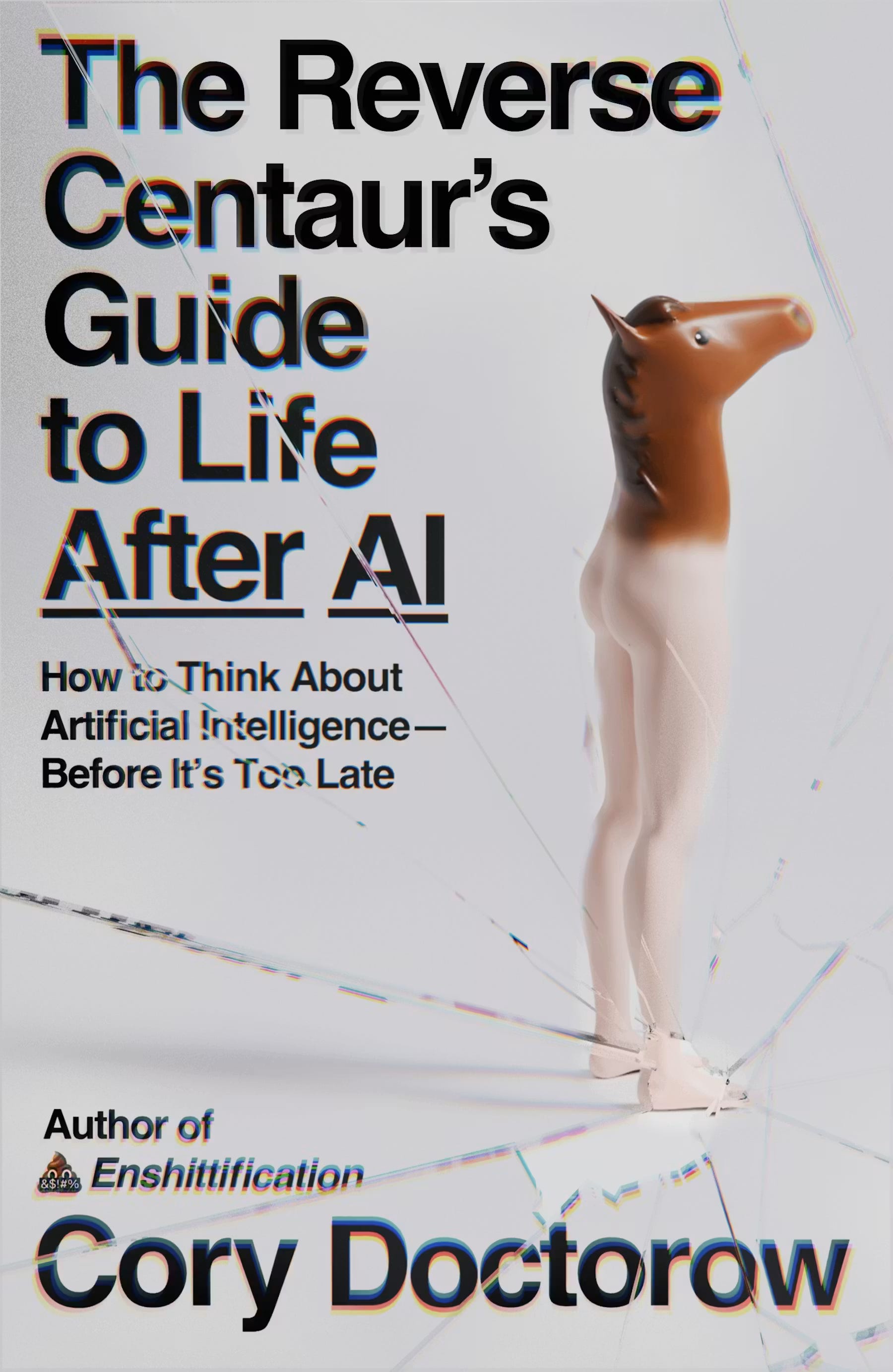
Reviewed in this article:
The Reverse Centaur’s Guide to Life After AI: How to Think About Artificial Intelligence—Before It’s Too Late
MCD, Farrar, Straus and Giroux, June 2026
by Cory Doctorow
Long before artificial intelligence became technology, it was part of the cultural imagination. Greek myths described Hephaestus forging golden automatons that could think and move. Chinese tradition told of the artificer Yan Shi, who presented a mechanical man to his king. Only in the mid-20th century did that ancient vision become a scientific field. From the 1950s through 2022, researchers pursued AI along different paths. Then ChatGPT arrived.
The chatbot attracted a million users within just five days of its release in November of that year. ChatGPT’s sudden popularity made AI’s rich intellectual history appear to collapse into a single proposition—that large language models (LLMs), as such deep-learning systems are called, would keep improving as long as three factors continue to grow: model size, training data and ability to compute, supported by an ever-expanding infrastructure. Today, frontier laboratories such as OpenAI and Anthropic—and the companies supplying their computational resources, most notably the chip designer Nvidia—don’t merely overshadow all rival approaches to AI. They’re increasingly shaping the global economy.
Nowhere does AI dominate investment markets as heavily as in the United States. American private capital flooded AI with roughly $286 billion in 2025 alone. This year, the Chinese government has pledged a near-identical $295 billion but as a five-year program—not a single year’s private bet.
It’s no secret that despite the record investment, the US companies continue to post losses rather than profits while their infrastructure becomes increasingly debt-financed. The result is an industry built on extraordinary expectations—and exposed to extraordinary risks. Financial watchdogs such as the Bank for International Settlements are warning that soaring valuations, heavy debt and uncertain returns could turn the AI boom into a source of instability for the world’s financial systems, one of the central economic issues of the day.
Whether the current AI boom reflects a genuine technological revolution or a speculative bubble poised to burst—as countless opinion columns debate—is increasingly dividing economists and scientists as well as commentators. The author Cory Doctorow leaves little doubt as to where he stands: His new book is the latest to cast AI as a bubbling—and deeply troubling—sector. Beyond the financial hype, Doctorow is concerned with the burden that integrating AI into corporate workflows places on workers.
To illustrate the problem, he reaches for two metaphors: the centaur and the reverse centaur. A “centaur” is a person whose abilities are amplified by technology, whether through tools as simple as glasses or as familiar as cars. A reverse centaur describes a human compelled to serve machines’ needs. Consider Amazon warehouse workers managed by algorithms or delivery drivers denied bathroom breaks by AI that dictates their tempo and tracks their every move. “The important part isn’t the technical characteristics of the device, it’s the power relationships of the people who use the device,” Doctorow says.
A prolific Canadian science-fiction and non-fiction writer, Doctorow works with the Electronic Frontier Foundation, a digital rights non-profit based in San Francisco. His new book is a sharp, timely contribution to the AI debate particularly for anyone who hasn’t followed the discussion and wants an accessible, well-informed entry point on the side of AI skeptics. The book may also prove a valuable read for AI enthusiasts willing to engage with counterarguments to prevailing narratives about AI’s inevitable, world-remaking ascent.
The trillion-dollar valuations attached to AI, Doctorow argues, require investors to believe not merely that AI will improve but that it will elementally transform the economy. That belief depends on compelling narratives that OpenAI, Anthropic and other companies have been eager to provide: Every breakthrough is just around the corner, every product launch is globally significant and every objection becomes merely a failure of vision.
Even apocalyptic warnings, Doctorow notes with a raised eyebrow, conveniently flatter the products by framing them as powerful enough to end the world. Eliezer Yudkowsky and Nate Soares’s recent bestseller, If Anyone Builds It, Everyone Dies, is a prime example, lending potentially troubling credibility to the technology’s alleged omnipotence. Ultimately, Doctorow argues, the hype and the doom are two sides of the same sales pitch.
The real threat, he says, is not that new machines are acquiring superpowers or wicked intentions. It’s that corporate executives harbor old motives: slashing costs, weakening organized labor, inflating valuations and dodging accountability for their human and environmental impacts. AI gives them a new vocabulary to present those corporate goals as inevitable technological destiny.
Doctorow urges readers to stop mistaking the development of AI and automation for fate. Tools should be designed to answer to people, he says, people should not have to accommodate tools. That stance will comfort those who, like the majority of Americans surveyed by Pew Research, “are much more concerned than excited about the increased use of AI in daily life.” While most “want more control over how AI is used in their lives,” however, they remain open to letting algorithms assist with day-to-day tasks. In short, they welcome the opportunity to become AI-enhanced centaurs but reject the idea of ending up as reverse centaurs.
Attitudes abroad are more critical. A Pew Research Center survey of 25 countries published in October 2025 found a median 53 percent of respondents trust the European Union to regulate the technology, against 37 percent who trust the United States and 27 percent who trust China—a tepid mandate for the US as the country currently supplying most of the world’s foundational models.
In Brussels, that skepticism has begun hardening into major legislation. The European Commission’s technological sovereignty package, unveiled in June, couples a proposed Cloud and AI Development Act with a successor to the original Chips Act, bound together by the explicit ambition to reduce Europe’s overdependence on foreign countries for chip design and cloud infrastructure.
In much of the Global South, developments in Silicon Valley’s AI race are read through a historical lens. Developing countries that can’t adapt or build their own AI models risk being trapped in a cycle of digital colonialism. Across Africa, Latin America and Asia, foreign tech contractors are assessing model responses and labeling images for AI training. Critics see the old extractive bargain in digital form: human labor and local knowledge drawn from poorer countries, converted into valuable technology and monetized by corporations headquartered thousands of miles away.
But Doctorow focuses his attention on the plight of workers in the United States—an understandable choice, given his familiarity with that terrain. His core claim is that the reverse centaur is a structural feature of how AI is deployed, not a quirk of any single labor market. That makes the lack of a robust international comparison a missed opportunity—one that could have sharpened both his diagnosis and recommendations.
Those prescriptions echo his earlier work: public-interest regulation, antitrust enforcement to break up entrenched corporate power and labor organizing to keep AI in the service of ordinary people. The world offers interesting models here: German works councils, Nordic sectoral bargaining and India’s remarkable Self-Employed Women’s Association all embody forms of worker power that could have lent Doctorow’s recommendations evidentiary force.
Still, no reasonable steps could take place in time to prevent the crash inevitably baked into the sector’s arithmetic, the author warns. Doctorow expects the AI bubble to burst, triggering a major recession that will “destroy a ton of innocent bystanders, including people whose retirement savings are invested in index funds.” But the market collapse will leave behind usable salvage, the author argues. He calls it AI residue: cheap, open models to run on our laptops, quietly doing unglamorous but genuinely helpful work such as transcription.
If there’s a fault in Doctorow’s work, it’s in the expectation his title sets up. As a diagnosis, his book is carefully argued and compelling. He explains how we got here, who profits, what the rhetoric conceals. As a guide, however, the book is thinner. The map for what a reader could actually do on Monday morning is sketched rather than drawn. Those hoping for a step-by-step manual may wonder what to do next.
Many structural critiques share similar gaps: Explicating an emergency isn’t the same as providing exit strategy. Still, this is a complaint about Doctorow’s final chapter, not the book. Read alongside the author’s recent work on platform decay and corporate power, this is the AI installment in his body of work, applying his signature framework: Look past the gadget, look past the hype, ask who benefits and who gets used up.
Few writers do that with as much clarity and—despite the topic’s seriousness—entertainment value. That’s no small achievement amid a larger discourse generally stuck between awe and panic. His refusal to be either dazzled or terrified is exactly why this book is worth your time.
Anna Gielas is a research associate at Oxford University’s Emerging Threats Group. She earned her PhD in the History of Science from the University of St. Andrews, has published more than a dozen peer-reviewed academic articles on special operations forces and the integration of emerging technologies into the armed forces, and held fellowships at Harvard University and the University of Cambridge.