


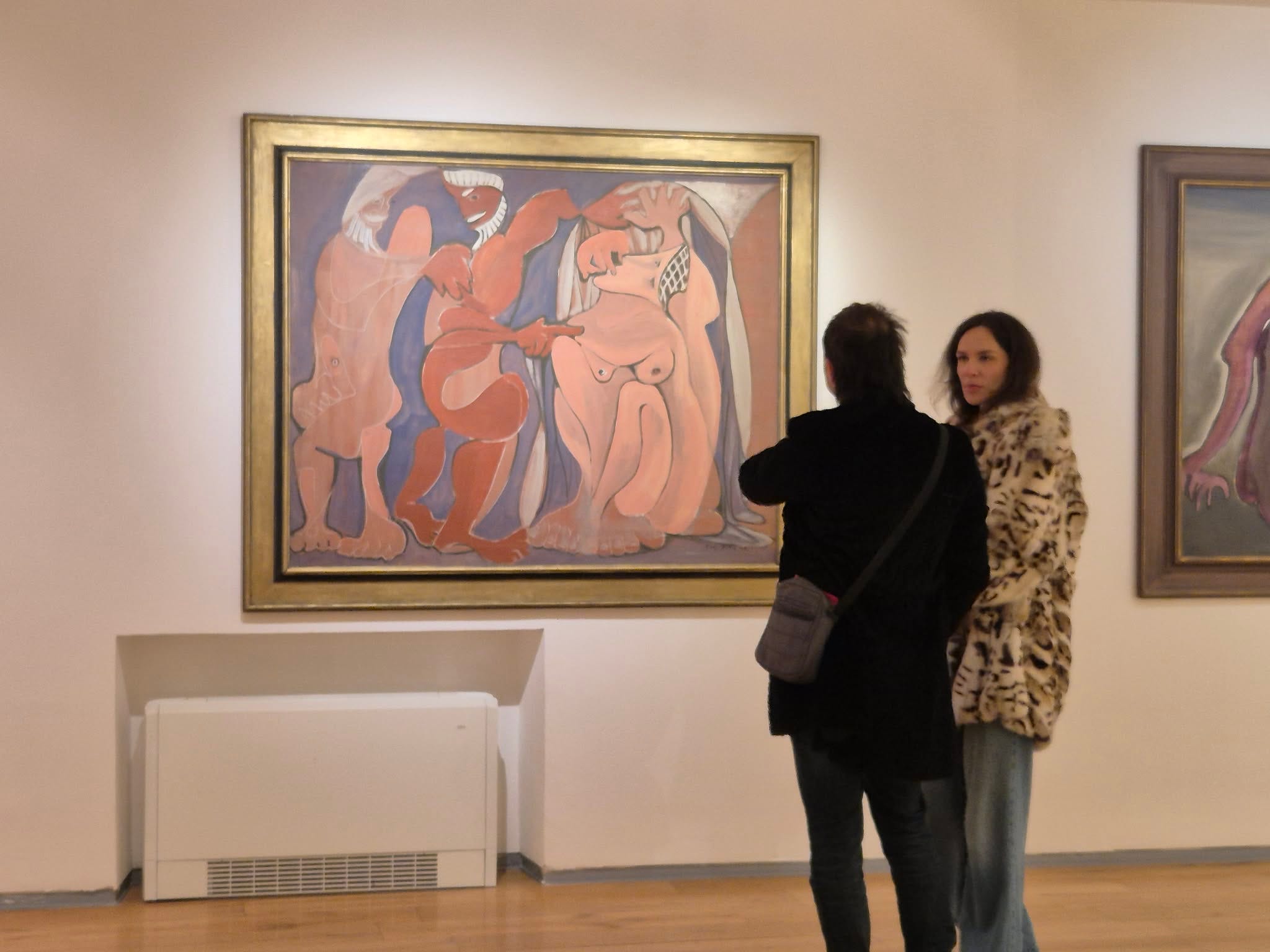
I recently found myself nearly in tears at a remarkable exhibition in Prague of Czech Cubism at the Museum Kampa. I was transfixed in front of a large 1935 canvas by Emil Filla called “Susanna,” wrestling with a torrent of emotions.
Filla’s painting is part of a rich tradition depicting Susanna and the Elders, an apocryphal biblical story of a beautiful, virtuous woman being ogled, assaulted and accused by two rich, lecherous old men. I’ve been drawn to these images for many years; it’s difficult to find a major gallery that doesn’t have at least one version in its collection. Usually, the two arrogant, drooling assailants are depicted groping the helpless Susanna as she desperately tries to hide her nakedness under a cloak of some sort. The Renaissance artist Artemisia Gentileschi, herself a rape survivor, was perhaps the first artist to focus her depiction on Susanna’s terror.
The images are often brutally powerful because they inexorably draw the viewer into the story—especially, I would imagine, the heterosexual male viewer—like a third, hideous letch violating the victim. In the past, such feelings were mitigated by a protective psychological layer that I believed kept me at a distance. When I felt myself becoming too entangled, I pulled back with rationalizations, reminding myself that I have never been a bully or felt like one.
Despite the inevitable missteps and sins I’ve committed during my six decades, I’ve never used a position of strength to take advantage of anyone or abuse or debase others. As far as I can recall, I’ve never really taken pleasure from another’s suffering.
I’ve always rooted for the underdog; patiently waiting for baseball’s Boston Red Sox to beat the powerful New York Yankees, or cheering the hapless Seattle Mariners of the late 1970s. I went on to make a career writing about brave Russians still trying to exorcise the horrors and crippling legacies of Stalinism. I often think about the journalist Larisa Yudina, the first person I ever knew who was murdered—found with multiple knife wounds and a fractured skull in 1998 in Kalmykia, the southern region where she lived. I wonder if the last words Yudina heard were similar to those spat at the dying Renee Good in Minneapolis on January 7.
This time at the museum was different. I’m a citizen of the United States, a country where the people supposedly elect their leaders; where the government supposedly derives its power from their consent; and where the state supposedly reflects their essence, will and desires. As I stood in front of Filla’s work, a frightening voice rang in my head: “We can do this the easy way, or we can do it the hard way.” “One of ours, all of yours.” “Human scum.” “When you’re a star, they let you do it.” “Quiet, piggy.”
Now I felt complicit in front of that painting. Was it me leering over the shoulders of the aggressive, phallic, bullying elders? Was it just my imagination that the Czechs surrounding me were standing aside, avoiding my gaze, holding me in contempt, judging me?
Filla’s 1935 painting was created at a time when Czechoslovakia faced the looming darkness of Adolf Hitler’s Germany. Just three years later in Munich, Europe’s mighty leaders would hand the newly independent country over to the mad dictator, to occupation and defilement. The 1938 Munich Agreement, bearing the signatures of Britain’s Neville Chamberlin and others alongside those of Hitler and Benito Mussolini, is on display just a couple kilometers from where I stood.
On the wall to my left hung paintings Filla completed between 1936 and 1939, a period that was growing increasingly blood-soaked and hopeless. The works, forming a series Filla called Fights and Struggles, “depict twisted and often deformed figures with bloody paws and mouths, symbolizing the struggle between good and evil, and the danger of totalitarian power,” the curators deftly wrote.
The Nazis arrested Filla in September 1939, and he was held in the Buchenwald concentration camp until the end of the war in May 1945. A 1946 canvas called “Buchenwald,” also part of the Museum Kampa show, depicts an emaciated, devolved humanoid figure wrestling over a bone with a sharp-toothed dog.
As powerful as those images are, however, the one that won’t quit my imagination is Susanna, tugging at her flimsy cloak, alone and terrified. I never felt like a bully before.
Robert Coalson is a retired journalist who spent more than 20 years reporting on Russia, the former Soviet Union, and the former Soviet bloc for Radio Free Europe/Radio Liberty.
Theperspective shift here is haunting. The progression from sympathetic observer to feeling implicated through citizenship captures something real about collective responsibility. I remember visiting a holocaust museum years ago and having a similiar moment of recognizing the distance between witnessing history and being part of it.
Powerful narrative. Thank you.