



Not long ago, a friend in Dakar sent me a video by the comedian Kyle Gordon, “Mr. Jambo.” It features one of Gordon’s musical personae, Barry Bergen, an aging singer-songwriter who travels the world appropriating the music of other cultures. “Mr. Jambo” is a parody of Paul Simon’s “Graceland,” his 1986 collaboration with the South African group Lady Smith Black Mambazo. “Mr. Jambo” went viral soon after its release in July.
It’s a catchy tune. In the video, Bergen wears an earnest expression along with his American nerd uniform: 80s-style wire-rimmed glasses, baseball cap, sports coat, tie, jeans and white Nikes. He bothers an exasperated African man played by Mandla Dlamini.
“Hey there Mr. Jambo,” Bergen sings, “Out there in the African sun; do you ever get tired? Hey there Mr. Jambo; will you share with me the jambalaya living in your soul?”
“Angikhulumi isingisi, Unaye umhumushi? Yeka ukuklabalasa,” Mr. Jambo replies, Zulu for “I don’t speak English; do you have an interpreter? Stop shouting.”
Bergen nods knowingly and in a series of jump-cuts and cross-dissolves, he dances among the giraffes, zebras and grasslands of South Africa and the kingdom of Eswatini and belts out his epiphany:
“I couldn’t speak his language, couldn’t even understand a word; but I knew his meaning was what I decided I had heard. He said, ‘the love you seek, it’s in the valley of the soul; the love you seek, it’s in the wisdom written on the African scrolls.’”
Jambo means “hello” in Zulu, thus Mr. Jambo is Mr. Hello. Bergen, who evokes a more benign version of the Quiet American, has mistaken a greeting for a name. There’s a lot more miscommunication in the song, but you get the idea.
The hilarious performance especially resonated because it took me back to my experience teaching high school students art as well as introductory philosophy in Kuwait from 2011 to 2016. It was for the International Baccalaureate program at the American International School, where students had been trained from kindergarten to call the female teachers “miss” and the male teachers “sir” or “mister.” Sometimes when they couldn’t remember my name, my students called me Mr… Mr… Shisma? Shisma is a kind of hedge that in Kuwaiti and Iraqi Arabic means “whatshisname.” It’s a way to buy time while you think of what to say next, like yani in Levantine or Maghribi Arabic, or “like” and “you know” in American English. Mr. Hello is my brother from a different mother.

The International Baccalaureate (IB) Diploma is marketed as the most successful and influential international educational certificate in the world. Of 15,075 international schools worldwide, 6,200 in 160 countries use the IB. IB Diploma holders include former Canadian Premier Justin Trudeau, Facebook co-founder Dustin Moskowitz, Oscar-winning actress Lupita Nyong’o, Jeopardy! host Ken Jennings, and American singer-songwriter and rapper Kesha. Kim Jong-Un, an IB drop out, has managed to do okay as dictator of North Korea. Despite, or because of this success, the program has come under increasing scrutiny and pressure: from within to be less American and Euro-centric, less white, more diverse, more sensitive to local mores, values and traditions; from without to renounce or modify its stated goal to “teach peace.”
Since its inception a half-century ago, the Geneva-based International Baccalaureate Organization has seen steady growth around the world. It counted nearly 2 million students enrolled in its programs in 2022, half in the US. That’s up from a million in 2019. The IB diploma is recognized by universities worldwide. For students with exceptionally high scores, college credit or advanced standing is granted.
Part of the IB mission statement reads, “other people, with their differences can also be right.” In Kuwait, however, mutual incomprehension was often the name of the game, as three different groups of people—Kuwaitis, other Arabs and North American whites (more about that later)—tried to navigate conflicting expectations for discourse, dress, timeliness, personal space, academic honesty and grades.
One of my colleagues once caught a student named Aisha, for example, plagiarizing her essay word for word from Wikipedia (this was pre-AI). Confronted, she protested that Wikipedia had stolen the essay from her. The student persisted in this defense until her mother was called to school, where she berated the principal.
“How dare you accuse my daughter of cheating!” she said. “Do you know who I am?”
“You’re Aisha’s mother,” the principal replied mildly.
“I’m a world-renowned doctor!” she shouted. “My family owns the Crown Plaza Hotel!”
“I’m sure your family is very proud.”
“You’re insulting my family’s honor!”
“No offense to your family, ma’am, but there is no doubt that your daughter plagiarized her assignment. She’ll be suspended and will have to rewrite the paper in a supervised Saturday detention. Fortunately for her, this was not a final exam or she would be expelled. Look for yourself. Here’s her paper and here’s the Wikipedia article.”
The mother read the screen. Now she turned her fury on her progeny, who had been sitting on a couch in the office observing the exchange with a smirk.
“When we get home,” the mom shouted, “I’m going to gouge out your left eye, cut off your right hand, and this summer, you are getting married!” The smirk vanished. The mother dragged her child out of the office by the ear.
The principal told us this story at a Friday brunch at Le Pain Quotidien, a weekly ritual for the older teachers. Ten of us sat at a long table outside under umbrellas warmed by an ultramarine sky.
As we sipped soup-bowl sized lattes and munched our eggs Benedict, French toast and oatmeal, the parent’s histrionics seemed ridiculous, along the lines of Saddam Hussein’s threatened “Mother of All Battles” ahead of Iraq’s crushing in the 1991 Gulf War. But mubalagha (exaggeration) is core to Arab communication, an expressive tool that adds weight, color and flair to conversation. Pre-Islamic poetry prized grandiose descriptions of nature, love and grief. In modern colloquial speech, volume, gesture and dramatic emphasis signal genuine feeling.
Some scholars divide mubalagha into three degrees. At-tabligh is unlikely (exaggeration). Al-igharaq is improbable (over-exaggeration). Al-gulu is impossible (extreme exaggeration). When Aisha said Wikipedia had copied her essay, that was at-tabligh. When Dr. Crown Plaza Hotel proclaimed her fame was global, that was al-igharaq. When she threatened amputation, enucleation and coerced matrimony, that was al-gulu.
I asked what happened to the student.
“She rewrote the paper and returned from suspension with both hands and both eyes intact,” the principal said. “I don’t know about the marriage plans.”
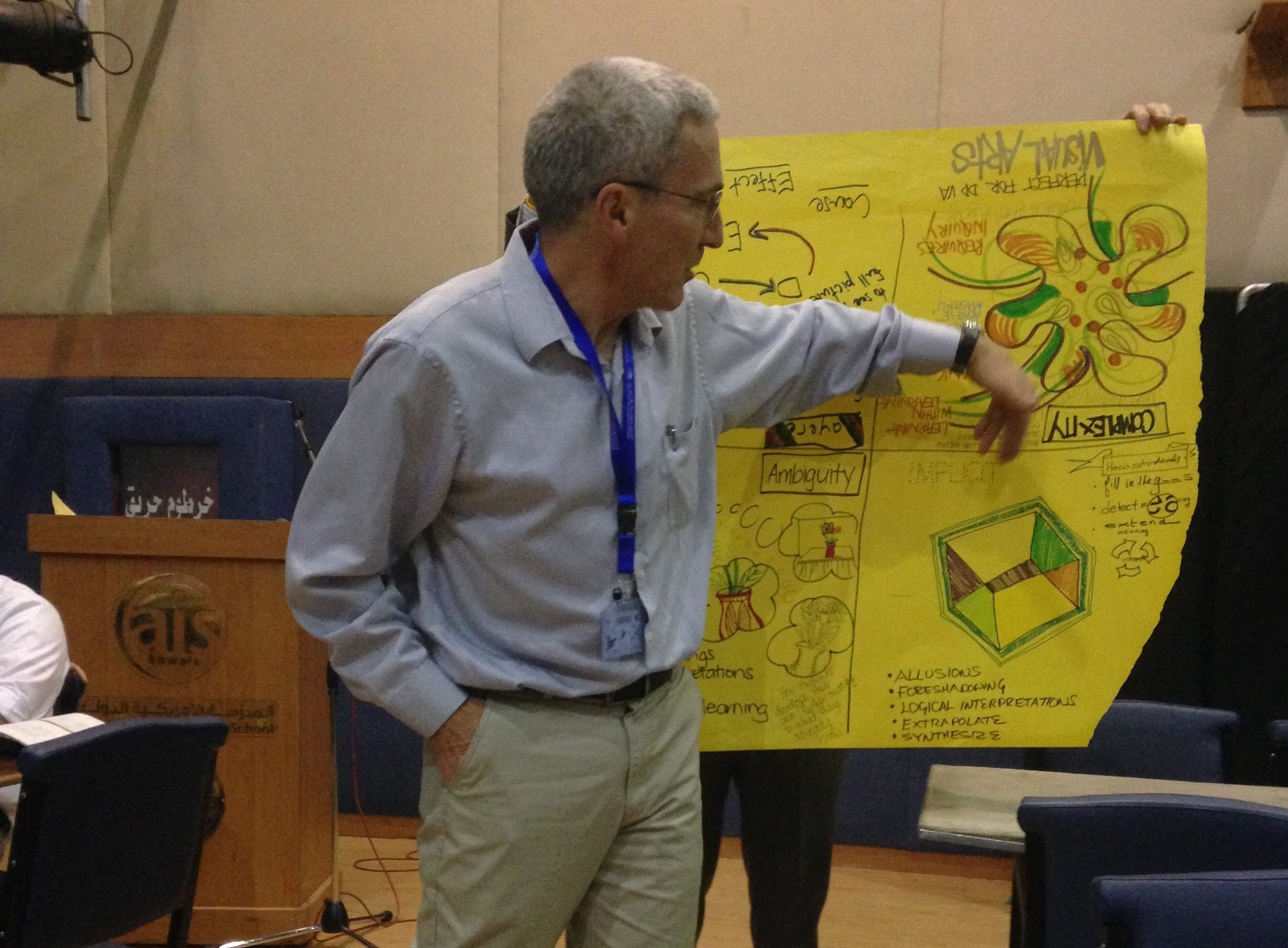
Incidents like this, of two cultures talking past one another, were weekly (sometimes daily) occurrences at the American International School as our faculty of Barry and Betty Bergens, in alignment with the IB Learner profile, tried to transform students into knowledgeable, caring, balanced, reflective, principled, open-minded, risk-taking and inquiring global citizens.
The concept for the International Baccalaureate started as a booklet written in 1948 by Marie-Thérèse Maurette, the director of the highly respected International School of Geneva, the oldest international school in the world, commonly known as Ecolint. Inspired by the many international peace organizations headquartered in Geneva after World War II, she called it Educational Techniques for Peace. Do They Exist?
Maurette’s pedagogy emphasized respect and openness to others. Her booklet became the foundation for what would become the International Baccalaureate: the IB. The term was coined in Geneva in 1962 at a meeting of international social studies educators. The IB developed with a focus on critical analysis and learning to learn. The first director general of the IB, Alec Peterson, described it as combining “the range of subjects taught in the French baccalaureate…with the depth of knowledge and specialism found in the British A-level system.”
The jewel in the IB crown is the philosophy course Theory of Knowledge, a two-year must-pass introduction to epistemology. I loved teaching the class, in which students learn critical thinking through lectures, games, performances, and written and oral assignments. One of my favorite activities was “Putting Brâncuşi on Trial,” a reenactment of the 1927 Supreme Court fight Brancusi v. United States, which determined our current anything-goes definition of art. Students divided themselves into offensive and defensive teams that developed arguments and presented them before a panel of student judges. They were allowed to put mubalagha to practical use, employing soaring rhetoric to make their cases. Sometimes Brâncuşi won, supporting the status quo. Sometimes America won, changing the course of art history. The winners got chocolate.
The International Baccalaureate Organization was founded in Geneva in 1968 under the auspices of UNESCO. Over the following years, the courses expanded from the two-year Diploma Program to a comprehensive K-12 education. More controversially, the IB also expanded its marketing focus from the children of the international diplomatic and business class, for whom a global perspective is more familiar, to the children of in-country elites such as my students in Kuwait, whose traditional values are typically challenged by an IB education. One could even say undermined. The term du jour is “colonized.”
Today, the IB’s biggest growth area is in American public schools, where the program is appreciated for its focus on academic rigor but also criticized for its connection with the United Nations and teaching of relativistic international mindedness instead of American exceptionalism. The IB’s American footprint is tiny compared to the US-based College Board’s Advanced Placement product: 1,900 American schools to the AP’s 23,000. In our current political climate, however, it’s viewed by some politicians and parents as a threat. It’s an open question whether the United States will continue to tolerate an educational business that ideally turns out critically thinking citizens instead of unthinking patriots. The evidence suggests no.
In 2023, two San Francisco-based educators named Tiago Bittencourt and Gabriel Bustamante Callejas published “International Education and the rise of paleoconservative thought,” an article examining rising resistance to the IB in MAGA country. A decade earlier, parents in a conservative suburb of Pittsburgh had denounced the IB as an “anti-Christian, un-American and Marxist approach to education.” The program was shut down. Also in 2012, in Coeur d’Alene, Idaho, the School Board, in a 5-0 vote, discontinued the IB Primary Years Program. The Board stated the cancellation was due to “mounting parental complaints that the program was underscored by ‘a social-political philosophy that has no place in public schools’ that promoted global citizenship and its embedded values to ‘impressionable young children.’”
Between 2024 and 2026, the Leander Independent School District and Houston Independent School District in Texas, Summit School District in Colorado, Richland School District Two in South Carolina, Morris Knolls High School in New Jersey and State College Area School District in Pennsylvania all scaled back or phased out the IB citing budget, low participation, ideological or other reasons, usually replacing the program with the AP.
Educators in the Global South are also unhappy with the IB but for different reasons. Many think the IB has been too Western. They are not wrong. The United States runs the IB at a scale unmatched anywhere else in the world. In May and November 2025, 225,000 students around the world took the IB Diploma final exams. 107,000 of these students were in the US. 90% of those American diploma candidates were in public schools. Most of the rest were in Canada and Europe with a fraction in Asia, the Middle East, Central and South America, Australia, New Zealand and Africa. In short, most IB students studied in the Global North and West with the fewest in the Global South and East. The imbalance is reflected in the seven-year IB review cycle where simply because of their numbers Western/Global North voices—especially American ones—are the loudest and have the most impact on how the program evolves.
Within the IB the dominance of the Global North in curriculum, subject matter and participation is increasingly seen as a bad thing. Since the global Black Lives Matter protests of 2020 and beyond, calls have grown from IB teachers and students to “decolonize” the IB universe.
“We have not been equipped, intellectually or emotionally, to understand this world and its current crises, and more importantly, our position in upholding global racial capitalism,” IB graduate Xoài David complained on Medium in 2020. “Our maps are distorted. Our education makes us complicit. If we want to use the platform of international schools to its full potential, to truly advance justice, equity and global-mindedness, our community needs to recast its long-outdated mold.”
Decolonization advocates have organized panels, workshops, speeches, TED Talks and a decolonization organization. Educational broker businesses that pair teachers with schools, such as International School Services (ISS) and Search Associates (SA), have come in for withering criticism for covert and sometimes overt racism. Historically, white candidates have received preference over Black and brown ones. Teachers with Christian-sounding names have been picked over those with “African” ones. Thus my colleagues and I in Kuwait.
The “this is what parents want” rationale no longer holds water. In 2021, Zuri Stevens, a West African student who grew up in Geneva, wrote an article on Medium titled “I Went to An International School and Didn’t Have a Single Black Teacher.” The Pulitzer Prize-winning Bloomberg journalist Natalie Obiko Pearson’s 2022 article “Elite International Schools Have a Racism Problem” has been widely read and shared. ISS and SA have pledged to do better. So has the Ecolint school in Geneva, the mothership of the IB, where it turns out racism was indeed widespread.
But it is precisely the IB’s Western aspects that have led to its growth and financial success: $271 million in revenue in 2025. As a non-profit, it reinvests this income into operations, program development and global education support. By comparison the Advanced Placement program generates $500 million for the College Board out of total revenues of 1.1 billion.
“The research suggests that it is not the promise of promoting local cultures while educating for international mindedness that makes the DP [Diploma Program] attractive in non-Western contexts,” the scholars Quentin Maire and Joel Windl wrote in Educational Review in 2021. “Rather, it is its inherent Westernness that draws students and their families to it… Studies of why students choose the DP over their local curricula or other non-national franchises, such as the British and American curricula, have found that access to the global market and Western universities are key factors in their decision making.”
Another expert, the University of Manchester’s Alexander Gardener McTaggart, writing in Globalisation, Societies and Education in 2021, points out that the IB Diploma “has been successfully used by socially dominant and academically powerful families to consolidate their academic capital and secure educational advantage, thus contributing to the reproduction of social inequality.”
Ironically, it is DEI, that MAGA bugbear, that has been adopted as the solution to the IB’s problems. Sort of. If you want to be au courant with your acronyms, wrap your tongue around DEIJ: diversity, equity, inclusion and justice. Part of a 2026 IB document, “Building practices for inclusivity within the IB community,” reads, “The IB has intentionally developed commitments to DEIJ at an organizational level…”
That makes sense. Most international schools are communities of teachers and students from many different countries and cultures with wide ranges of abilities, disabilities and genders. Students often live in dorms or boarding houses, far from their families and support networks. To survive, to thrive, everyone needs to feel included. As the Head of School of the American International School of Guangzhou wrote at the beginning of the 2026-27 school year, “Belonging starts on day one.”
DEIJ helps level the playing field, ferrets out bias and provides redress for injustice. Indeed, at some schools, DEIJ has been expanded to Justice, Equity, Diversity, Inclusion and Belonging: JEDI-B. At Ecolint, the acronym is Inclusion, Diversity, Equity and Anti-Racism: I-DEA.
In Kuwait, by contrast, uniformity (of Sunni religious belief), hierarchy (of class, race and gender) and exclusion (of Bedoons and other non-Kuwaitis) are explicit and implicit cultural values. Justice is of “the strong do what they will and the weak suffer what they must” variety. Belonging means to your family, your tribe, your clique. Those values bleed over into international schools. Students in my classrooms organized themselves by race and confession: Kuwaitis over here divided into Sunni and Shia. Levantines over there divided into Lebanese and Syrians, Sunni, Shia, Orthodox, Catholic and Druze. The occasional Indian or Filipino by themselves at the back. Queer students deep in the closet. Trans students deeper.
Kindness, one of the supreme values in the IB education, is perceived as weakness by Arab parents, who teach their children to be “lions” who fight for family, honor and tribe. When my students told me I was kind, it was not a compliment.
“Where’s Talal?” I asked one day in art class. Talal was a short, quiet, gentle, socially withdrawn Kuwaiti student who usually beavered away on an art project, rarely speaking.
“I think he went to Religion,” Abdullah said.
“But he’s supposed to be in Art,” I said.
“Mohamed has been giving him a hard time all year,” Abdullah said. “Yesterday, Mohamed insulted Talal’s mom. Talal brought some brass knuckles to school today.”
“And you’re telling me this now?”
“It’s not your business, sir.”
Despite school rules forbidding bullying, after-school fights were not uncommon. Someone, usually a boy, would say something to another boy, who would say something back. That had happened in my classroom more than once. Two boys began arguing, stood up and began bumping chests as they shouted into each other’s faces. I separated them.
Once a disagreement escalated to the point of no return, however, both sides called in their relatives. Older brothers and cousins would wait by one of the school gates in the messy throng of family cars and drivers and school buses. Relatives would accompany the two boys across the street to the alley behind the bakala convenience store. Most mornings, a crowd of boys gathered there to smoke their last cigarettes of the school day. Some afternoons, it served as the school’s Thunderdome.
Unlike fights in Kuwait public schools, which could involve weapons, wounds or worse, American International School conflicts rarely ended in serious injury. Like two novice sumo, the students would face off, huff and puff, scuffle, slap one another, possibly land a few blows, maybe tear a shirt or pop a few buttons. Since the altercations typically took place not on school property, administrators usually turned a blind eye.
But this fight was in-school. I had to act. I picked up the classroom phone to warn Reem, the Religion teacher.
“There!” Abdullah said, pointing out the window, “It’s Mohamed.”
I put down the phone. On the other side of the tennis courts, Mohamed, his head bloodied and bandaged like a character in “Les Miserables,” was being led by the assistant principal to the nurse’s office. He was grinning. What would Barry Bergen have made of that?
The next day, on our early morning run, the assistant principal told me what had happened. Talal had walked into Religion with his set of knuckle dusters and bashed Mohamed in the head. It had been a glancing blow that produced a lot of blood but no serious damage. Talal had admitted what he did and why he did it. He was suspended. That evening, Talal’s dad visited Mohamed’s dad. Dates and coffee were served. Bargaining commenced. They settled on 10,000 Kuwaiti dinar—about $30,000—as the price for Mohamed dropping his threat to call the police along with his demand that Talal not graduate. Talal’s dad wrote a check. A year of insulting, a little blood, a satisfying payday, another Kuwait life lesson learned.
Against this worldview, the IB kumbaya philosophy has its work cut out.
Bryn Barnard is an artist, teacher and former ICWA fellow. He has worked with Far Eastern Economic Review, Asiaweek, National Geographic and NASA, and also with schools and universities in Kuwait, Korea, Singapore, the US, Europe, the Middle East and Asia. His books include Dangerous Planet: Natural Disasters That Changed History, Outbreak: Plagues That Changed History, The Genius of Islam: How Muslims Made the Modern World and The New Ocean: The Fate of Life in a Changing Sea.