


In recent decades, American foreign policy rested on the assumption that the United States possessed a broad, flexible toolkit for influencing global developments. Military power was part of it. It also included economic reconstruction, political alliances and sustained engagement with civil society, which were treated—at least in principle—as serious strategic assets despite their limitations. Together, they formed a three-legged stool of diplomacy, defense and development that underpinned American power.
The stool was never balanced. The legs were unequal in size and political weight. But it existed, however imperfectly.
Today, it does not. Instead, it has joined a growing pile of discarded tools of American influence as Washington pursues a policy of conflict and coercion leaning heavily on tariffs, sanctions and episodic intervention while dismantling the capacities that once enabled earlier, cheaper and more flexible engagement. The near-overnight dismantling of USAID by the Trump Administration was not the inevitable endpoint of long-term bureaucratic decline but a deliberate rupture. But the need for foreign assistance—and its importance to US national security—has not disappeared. The question is whether in the future the United States can learn from how it was built, weakened and ultimately dismantled.
After World War II, the United States confronted a devastated Europe, collapsing empires and an emerging strategic competition with the Soviet Union. The response now feels almost radical: a recognition that American security depended not only on defending borders but rebuilding other societies. That logic informed three initiatives that defined US power for nearly 80 years—the Marshall Plan, NATO and later USAID—each addressing a different dimension of global competition.
The Marshall Plan was the clearest expression of the strategy. Grounded in a hard lesson from 1930s Europe—that economic collapse breeds authoritarianism—it committed the equivalent of roughly 2 percent of US GDP between 1948 and 1951 to stabilize Western Europe. Aid was tied to cooperation, reform and Western integration. The payoff was extraordinary. Economies recovered, democratic institutions gained legitimacy and Western Europe’s political future tilted decisively to the transatlantic alliance.
NATO institutionalized the military side of the alliance. It deterred Soviet aggression, anchored Europe’s security and outlived the Cold War that gave birth to it. Russia’s invasion of Ukraine has underscored that NATO’s original mission remains essential. But it was designed to deter tanks, not counter political subversion, economic coercion or democratic erosion.
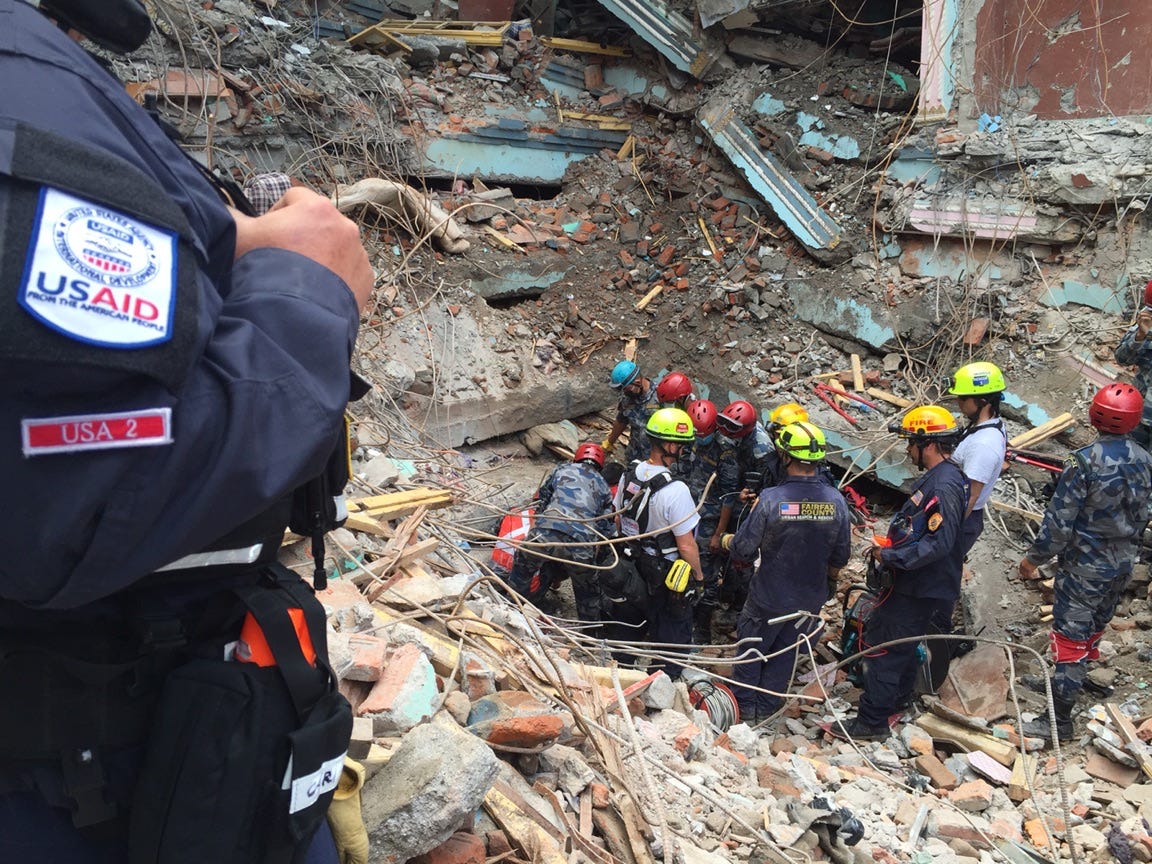
That gap was meant to be filled by USAID. Created in 1961, the agency became Washington’s primary vehicle for shaping political and institutional environments without resorting to military force. I spent much of my career there, working in contexts where elections, courts, media and civil society mattered more than troop deployments. In post-Cold War Europe and Eurasia, those efforts were rarely glamorous or well-known but they helped sustain pluralism during periods of extreme volatility and bought time where coercion would surely have backfired.
In the aftermath of the communist collapse, former Warsaw Pact countries faced the task of building the basic institutions that governed the Western order. Through sustained foreign assistance, the United States helped Central and Eastern European societies lay the foundations over two decades. The results were uneven and imperfect but tangible: judicial reforms that enabled EU accession, independent election commissions that facilitated peaceful transfers of power and investigative media that exposed corruption when domestic accountability mechanisms were still fragile. Without those interventions, democratic backsliding would likely have come sooner and more decisively.
Unlike NATO or the Marshall Plan, however, USAID never enjoyed durable bipartisan support. Even as its mission expanded after the fall of communism in the 1990s and again during the post-9/11 engagements in Iraq and Afghanistan, its institutional standing eroded. Development and governance assistance came to be treated as discretionary spending—useful in good times, expendable in bad ones. According to the Congressional Research Service, all US foreign assistance has typically amounted to roughly one to 1.5 percent of the federal budget, with democracy and governance programs comprising only a small fraction of that total. But they were among the first accounts traditionally targeted for cuts—and, in 2025, among the first to be dismantled almost entirely.
Inside Washington, the consequences were visible well before the collapse. USAID officers increasingly spent more time defending the legitimacy of civilian engagement than designing it. During the early years of Russia’s war against Ukraine, proposals to sustain support for independent Russian media and anti-war civil society groups—crucial partners for opposing the Kremlin’s aggression—stalled for months amid political review even as the strategic costs of disengagement were widely acknowledged. Over time, a quiet but fateful choice took shape: Military power would remain sacrosanct while civilian capacity would be allowed to hollow out.
What happened next was an intentional act of demolition. The Trump Administration did not seek to reform US foreign assistance but ended its role in building independent expertise, international engagement and values-based policy. The question now is whether future leaders will be prepared to act decisively to rebuild it.
The stakes could not be higher. The unraveling of the American-led post-war order has been marked by confusion about US purpose and a shrinking political tolerance for sustained engagement. Although the war in Ukraine temporarily revived transatlantic unity, it also exposed the limits of an alliance-centered strategy. As the conflict drags on and European governments struggle to align rhetoric with long-term defense production and spending, NATO increasingly resembles a holding action rather than a solution.
Meanwhile, great-power competition has assumed different forms with new technologies. It plays out through institutions, markets, information spaces and legal systems as much as on battlefields. China’s use of development finance to shape regulatory standards and political incentives across the Global South is one example; Russia’s export of legal repression—through “foreign agent” laws and managed civil society—offers another.
The United States will face this environment with a narrowing set of tools and alliances if not a lack of power. Any serious effort to restore balance will require early, visible action. A future administration should move quickly to reconstitute USAID as an independent agency, rebuild its professional cadre and protect it from politicized dismantling through statutory safeguards. It should reinvest in State Department civilian expertise, clarify the national security rationale for democracy and governance assistance, and prioritize early engagement in politically contested environments before crises metastasize. Congress should be drawing up a clear day-one blueprint now, insulating it from political sabotage and reintegrating development and governance into US strategy as instruments of national security—rebuilding institutional capacity will be far harder than tearing it down.
Eighty years ago, American policymakers built an ecosystem of institutions that reinforced one another in service of US interests and values. Under a future administration, neglecting civilian engagement will heighten risk by deferring foreign intervention to later stages, when options are fewer, costs higher and outcomes harder to shape. The question isn’t whether America will be able to afford to rebuild its civilian capacity, it’s whether it will be able to do it quickly enough to help restore US national security and a rules-based international order based on the common good.
Suren Avanesyan is a professorial lecturer at The George Washington University’s Elliott School of International Affairs and a distinguished senior fellow at the university’s Institute for European, Russian and Eurasian Studies, focusing on Russian law, governance, civil society, and Track II diplomacy. He is also a visiting scholar at the University of Wisconsin Law School.