


Mornings, before dawn, I lubed my nipples, waist and groin with Vaseline, put on my running togs, downed a cup of French press and an Ibuprofen and took the elevator to my apartment lobby to meet my running buddies, the other teachers who didn’t mind rising at 5 or 4 or sometimes 3 a.m. before school for long distance marathon training. We ran out of habit, for health, discipline, camaraderie, endorphins: John, David, Jamie and me. As we loosened up, jogging down Haroun al-Rashid Boulevard, we passed flocks of pigeons and feral cats feasting on food scraps deposited by kindly garbage collectors: piles of rice, leftover lamb korma and fetid pools of chana masala.
We picked up the pace and crossed the Gulf Road, turned north at McDonalds and KFC. We passed seaside lawns strewn with garbage from the previous night’s Arab partying and picnicking, passed the jump-suited South Asian workers cleaning it up, passed strolling couples in abayas and dishdashas furtively holding hands in the predawn darkness. Increasing our pace, we arrived at the Corniche, the long, broad sidewalk that borders the Gulf. We dodged loose paving stones, coverless sewer ports, rusted post bolts, loops of wire and the obese fast-food rats that waddled between and under our feet, squeaking in the darkness. Beside us, on Arabian Gulf Road, helmetless young Arab men in jeans, flip-flops and t-shirts roared past on their motorbikes and ATVs, popping long high wheelies on the flat straightaways. We called them “the organ donors.”
Most mornings, we ran past the Saudi embassy and three identical mansions a Kuwaiti grandee had built for his three wives, past Green Island and the flagpole, turning back at the Ali Baba Beach parking lot, a 6-mile loop. Twice a week we ran further, past Wimpy, Costa Coffee, the Army Officers Club and TGI Fridays to the Kuwait Towers, a 10-mile loop. On weekends, we ran even further, past Dasman Diabetes Institute, Souq Sharq, the Fish Market, the Grand Mosque, the Sief Palace with its high walls and imposing machine gun emplacements, the National Assembly, the National Library and the long stretch of beach to the Kuwait Free Trade Zone, a 20-mile loop that left my heels aching and toes numb. At some point during those runs, the first blush of dawn would kiss the horizon, and the muezineen would awaken and bray the azan, the morning call to prayer, into their loudspeakers, into the darkness, first a single one, then two, then 10, then 100, each with a slightly different cadence, pitch and melody. This overwhelming atonal cacophony is my strongest aural memory of Kuwait.
Most mornings, we encountered two balding Arab men in polo shirts and shorts, one tall and clean shaven, the other short and bearded, walking together on the Corniche. Usually, they were deep in animated conversation. Sometimes they walked in silence. Occasionally, they walked separately, a hundred yards apart, causing us to speculate about a rift in their relationship. Then, after a day or week or a month, they were back together again. Always we waved and they waved, greeting each other with a jolly “Good morning!” Sometimes one of us added a comment about the weather, the heat or the wind. “Enjoy your running!” they would say. Individually, we called them Little Guy and Big Guy. Together, they were the Odd Couple.
Running was a habit I had developed in high school. For a variety of reasons—quiet temperament, fear of failure, poor coordination—I did not excel at team sports. In after-school street football pick-up games, I was invariably chosen to be center, my only job to hike the ball. No one ever asked me to go long and catch a Hail Mary in the end zone. Solo sports like skiing, rock climbing, hiking and running were less embarrassing. Although I was a slow runner, usually the slowest on the team, cross country fit my introverted teenaged personality. By the time I got to Kuwait at age 55 to teach art at the American International School, however, I’d evolved into a chatty extrovert. I loved talking with my running buddies about global affairs, philosophy, our families, school politics. I was still the slowest and now, by a decade, the oldest. We all tripped on the road hazards in the pre-dawn darkness but I was the champion, pancaking onto the pavers over and over again. To save my palms from yet more bloody contusions, I began wearing gloves. To deal with the aches and pains from the repeated falls, I took up yoga.
Late during my first year in the country, we saw an announcement for the inaugural Kuwait Desert Marathon, planned for the following November. We began training, following a weekly schedule of increasingly lengthy runs, interspersed with sprints and rest days. By September 2012, when we regrouped after our summer break, our longest runs were approaching marathon distances.
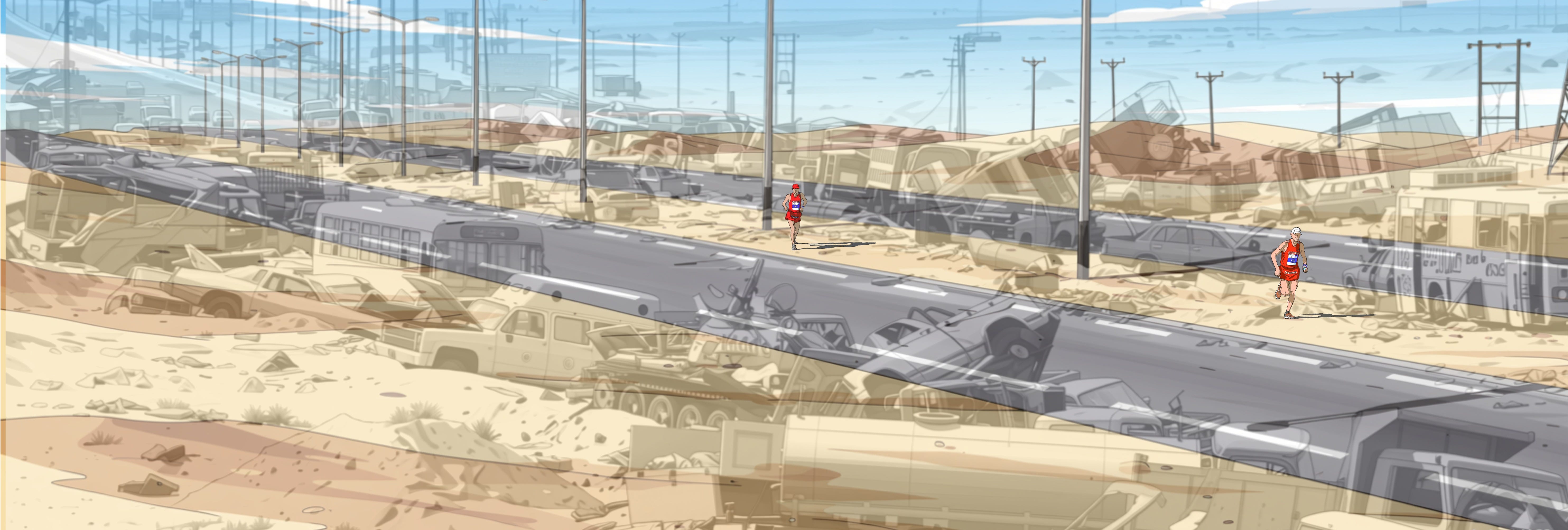
The marathon fee was 60 dinar, about $200. Late in October, a few weeks before the race, we drove over Mutla Ridge (at 460 feet above sea level, Kuwait’s Everest) into the northern desert to get a sense of what we were in for. One of the organizers met us there and explained the planned route, a loop that paralleled Kuwait Highway 80, the wide asphalt road that connects Kuwait City with Iraq. On February 26-27, 1991, during the brief American-led invasion that ended the Iraqi occupation of Kuwait, the Iraqi army had used Highway 80 to make a panicked, disorganized retreat. Over 1,500 jeeps, water tankers, fuel tankers, tractor trailers, passenger cars and armored personnel carriers had clogged the six-lane road. Allied attack aircraft disabled the front and rear of the convoy, then spent the next several hours converting the traffic jam into a blackened graveyard of burnt corpses, exploded tanks and charred vehicles. American pilots called it “the Turkey Shoot.” Kuwaitis called it Tariq al-Mawt, “The Highway of Death.” Two decades later, the dead had been buried and the wreckage cleared. But there were still traces of the former carnage. The starting line for our race was next to a mound of shattered concrete, a former gas station.
Novembers in Kuwait can be quite cool: sweater weather. Race day, however, dawned warm. We all wore nylon singlets and running shorts. To prevent sunburn, we had coated our exposed areas with SPF 50. To prevent chafing, we had lubed up. To stave off exhaustion, we had stuffed our pockets with espresso energy gels. Everyone carried water bottles. We wore hats. John and Jamie wore long-billed running caps. I wore a cap with a Foreign-Legion style neck guard. David was bald and hatless.
“Sure you don’t want a hat?” Jamie asked.
“I never wear a hat.”
“It’s pretty sunny.”
“I’ll be fine.”
By 8 a.m., when the race was scheduled to start, the sky was clear and the temperature 80 degrees Fahrenheit. Some 400 runners milled around the starting line, a mixed group of Arabs, Asians, Europeans and Americans who were running the full and half marathons, the 10K run (which included US Ambassador Matthew Tueller) and the 3K fun run. Of this group, only 16 were running the full marathon. At the front were two wiry Jordanian runners—Salamah Al-Aqra’a and Mohamed Al-Suwaiti—red-shirted professionals who had been lured by the organizer to the event to give it some respectability and elan.
By 9 a.m., the mercury as registered on my friends’ Garmin running watches (I made do with a Timex) had climbed to 85. Blessedly, the humidity was low and I could feel a light breeze. Race officials fussed with race banners. I fussed with my race number: a piece of A4 copy paper attached to my jersey with safety pins. Next to an SUV marked “ambulance” with a magnetic sign and beneath a striped canvas tent, attendants arranged tables with a snack buffet and bottles of desalinated Abraaj water, Kuwait’s Evian. By the time the event sponsor, an elegant man in white dishdasha and idling Ferrari, concluded his speech about how the race would support diabetes funding, it was nearly 9:30.
“Diabetes is probably what he calls his car,” John muttered.
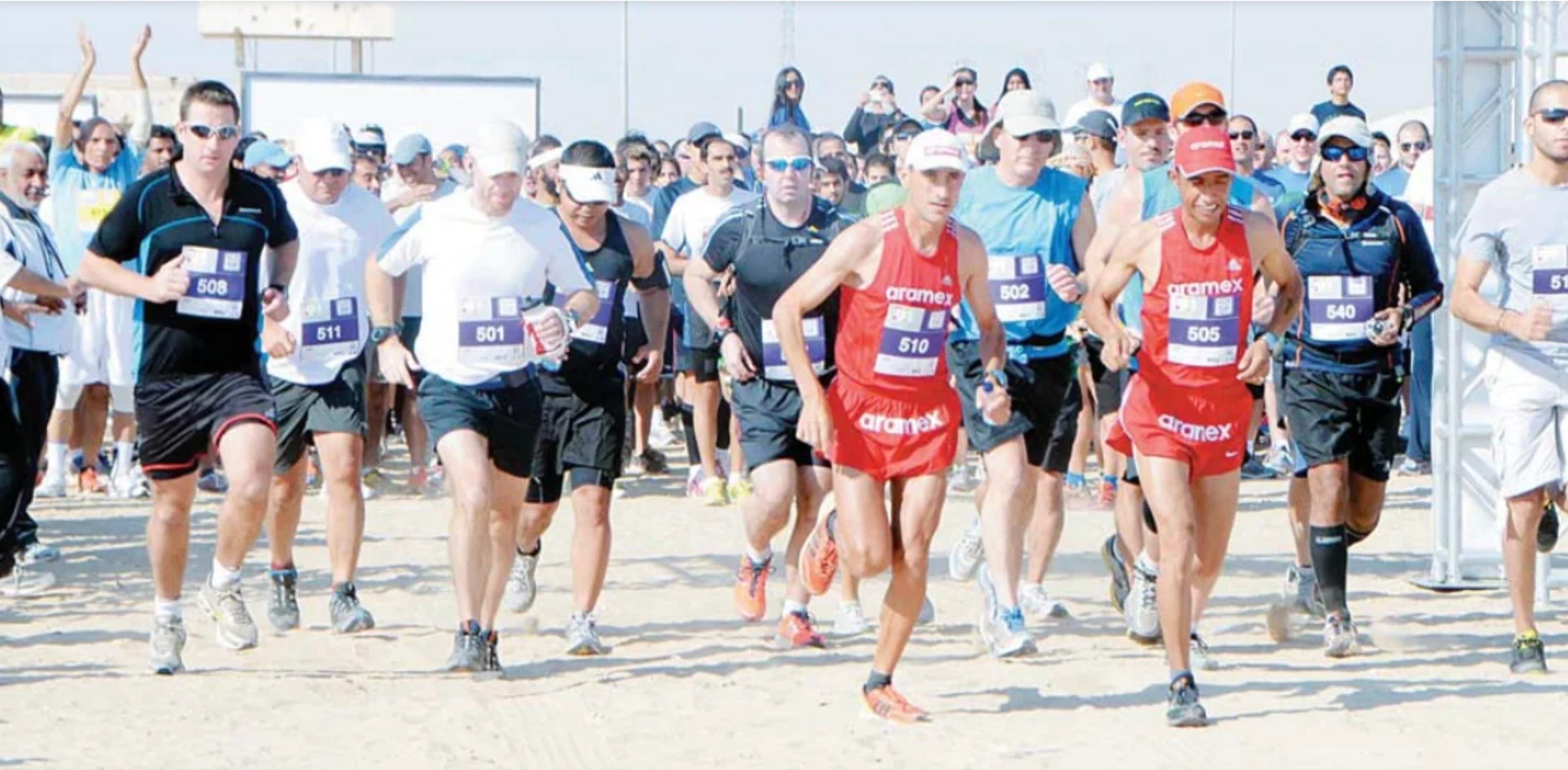
The sponsor fired the starting gun and we were off.
The pack quickly thinned. Jamie and David raced ahead, behind the Jordanians. John, knowing my slow pace and wary of the body-contorting cramps he had suffered in his previous marathon attempt, suggested we run together. This race he would finish.
The Kuwait desert is nothing like the majestic dunes of Saudi Arabia’s Empty Quarter, the Rub al-Khali. In Kuwait, it is hardpan, a flat expanse of dirt, sand, pebbles, rocks, scattered scrub bushes festooned with decaying plastic bags, rusting wire, broken concrete and, we had been told, unexploded depleted uranium munitions. Along the course, this cheerless landscape was punctuated by dust-covered solar arrays placed flat on the sand. Power cords lay across our route like trip wires stretched from the panels to low black Bedouin tents. To stay upright, we had to remain alert and keep our attention focused on the ground. As runners approached, Bedouin kids revved up their four-wheelers and carved doughnuts around us, created billowing clouds of choking dust, laughing as they shouted questions:
“Wain?”
“Kilo chem?”
“Enti may?”
Where are you going?
How far?
Want some water?
The continual exertion in the heat and aridity instantly evaporated our perspiration, caking us with white salt stains. The organizers had placed water stations at roughly 5-kilometer intervals, consisting of a plastic card table, several bricks of bottles, an Arab race official in jeans and t-shirt and a Filipino guy in scrubs and stethoscope, all baking in the sun. We would pause, the official would loop a colored elastic band around our wrists to indicate we had passed that waypoint, the medic would hand us two hot waters and we would trot on. By mile 10, my race number had disintegrated into ragged tendrils of paper pulp.
A regulation marathon is 26.2 miles. This race was a loop: 13-plus miles out and back along the same track. Long before John and I approached the halfway mark, the Jordanians passed us in the other direction. Ten minutes later, Jamie passed us, running strong. Five minutes after him, David followed, clearly struggling, his bald pate red and gleaming.
Not long after we had made the halfway turn, we caught up with him.
“You okay?” I asked.
David smiled weakly.
“You don’t look so good,” John said.
“Let’s get you the ambulance,” I added.
David looked up sharply, his eyes unfocused.
“No!” he muttered. “I’m finishing this thing.”
“You sure?” I asked.
“Absolutely!” He swayed a little and picked up his pace from a stumble to a stumble-trot.
At the next station, we pantomimed that our friend might be in trouble. We pointed. The officials nodded and gave us our water bottles and colored bands. We ran on. No ambulance appeared. The next station, and the next and the next were abandoned: a table, bands, bottles of stove-hot water but no personnel. And still no ambulance. I looked behind us. David was still running. For some reason, none of us were carrying our cellphones. David’s wife Christina was waiting at the finish. She could have easily driven up the Highway of Death and picked up her husband.
Suddenly, a black SUV with tinted windows swerved off the highway and roared up toward us, braking in a cloud of dust. A window rolled down. A male Arab face in baseball cap and mirrored shades smiled at us.
“Hot!” he said, gesturing at the sun.
“Yes,” I replied, bewildered.
“Ice!”
“Huh?”
“You like ice?”
“Yes!”
The stranger opened a cooler and handed me a steaming, football-sized chunk of ice. I thanked him and pointed behind us to the distant figure of David, shimmering in the heat haze.
“He likes ice,” I said.
The man gave me a thumbs up, closed the window, revved the engine and peeled away, spraying us with desert talcum.
John and I looked at each other. Looked at the ice. I scanned the ground and noticed a nearby concrete shard jutting from the sand. Wrapping the ice in my kepi, I smashed it against the cement a few times, breaking it into smaller and smaller pieces. I poured half into John’s hat, kept half for myself. We replaced our headgear and resumed running, ice water dribbling down our steaming heads. It felt glorious.
The final miles of the racecourse paralleled the Highway of Death. John and I began to walk-run-walk-run-walk. The sky was a brilliant blue, the sun an unblinking Sauron’s eye. Except for our breathing, the clump of our feet on the sand and the occasional blast of furnace air as vehicles shot by, the desert was quiet. It was nearly 2:30 in the afternoon when John and I sprinted across the finish line together, hands clasped high. Except for Jamie, Christina and a race official who handed us faux-bronze participation medals, the place was deserted. The sponsor and his Ferrari were gone, the buffet was gone, the ambulance was gone. All that remained were the stripped tent and several bricks of Abraaj water. Jamie handed us water bottles. Christina looked anxious.
“Where’s Dave?” she asked.
I sat down, pointed vaguely in the direction of Iraq, put my head between my knees and vomited.
“He’s coming,” John said.
Twenty minutes later, David staggered into view, crossed the finish line and collapsed, face first, onto the ground in front of the striped tent.
“We need to cool him off,” Christina said. “Get some water.”
“Water,” David repeated.
The only water around was in the bricks of sun-cooked Abraaj. Christina opened one and poured it over her husband’s head. Then another and another. Soon we were all opening and pouring, opening and pouring. Fortunately for David, he revived before we drowned him. Shakily, with Christina’s help, he managed to stand.
“That’s the hardest thing I’ve ever done,” he whispered.
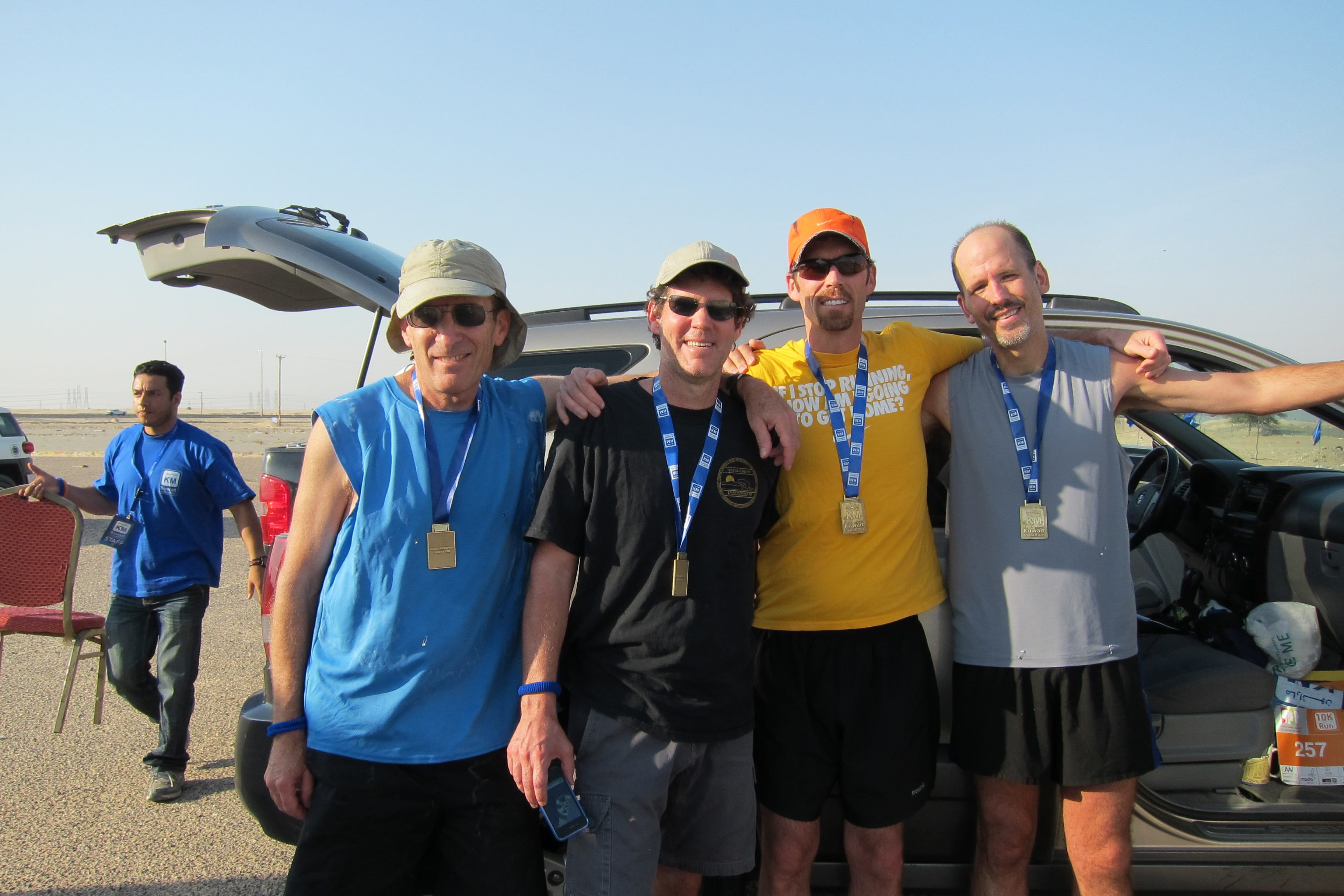
Like frail men on an outing from their assisted living home, we doddered to the car, our medals around our salt-caked necks. Gathered, arms on shoulders. Smiled. Christina snapped a few photos with her iPhone before we piled into the SUV. As she drove us up Tariq al-Mawt across Mutla Ridge and back to Kuwait City, I looked out the window, marinating in the phenethylamine, endocannabinoids and β-endorphins that make long-distance running such an addictive sport. I tried to imagine what this quiet desolation must have been like in 1991, with US fighter jets raining death from the sky on the retreating Iraqi army, or in 2003 when American Shock and Awe rolled down this same highway for an unhappy tryst with Baghdad destiny. What I could not imagine in 2012 was that 14 years later, another American president would start another war of choice in the region, this time against Iran, inflicting more needless suffering and destruction on more innocent people. A new generation of Kuwaitis would endure, as the military euphemism goes, collateral damage. More hubris. More nemesis.
John opened a metal water bottle he had stashed beneath the seats. It was dripping with condensation. He took a long swig. Closed his eyes. Smiled.
“Ahhhhh,” he sighed and offered me the bottle. “Try some.”
“What is it?” I asked.
“Kuwait Sunrise. Date rum and orange juice. I left it in the freezer last night.”
I made a face.
“You don’t know what you’re missing,” he said, taking another pull.
I took the bottle. Tried a tentative swallow.
It tasted surprisingly good: syrupy, sweet, cold, with a kick that made my eyes water.
“You know,” John said, “according to my Garmin, we ran more than 26.2 miles.”
“How far?”
“27.”
“27?” David whispered.
“Guess the organizers don’t count so good,” Jamie said.
“Technically,” John said, taking another sip from the water bottle, “this was an ultra-marathon.”
The Jordanian runners had finished first and second, of course. Later I heard they complained that it had been the worst-organized race they had ever experienced. Of the 16 runners who started, only nine finished. Jamie was third. John and I were fifth and sixth. David was eighth. A Filipino runner, Rodel Argo, was last, crossing the finish line seven hours after we started.
The following year, we ran in the very well-organized Dubai marathon: race numbers on vinyl-coated paper; GPS chips in our shoes; bananas, gels and ambulances at every water station; mile markers and big digital clocks counting off elapsed time; porta potties, photographs of every runner crossing the finish line, cheering onlookers. This time, once I passed the 10-mile mark, the ache and numbness in my feet had escalated from intermittent to constant. Each step felt like someone was plunging a knife into my arch. Dubai was my last marathon.
We took a month off before returning to our early morning runs by the familiar cast of Corniche characters: the organ donors, the cats, the rats, the furtive lovers, the Odd Couple. The following year, John announced he was moving to a new school in China. Jamie and I put together a farewell video. We wanted to record goodbyes from everyone. Even the Odd Couple happily complied.
“Goodbye John! Goodbye!” They waved and smiled in front of Jamie’s phone, the ultramarine of the Gulf and a hazy azure sky gleaming behind them.
Afterward, we introduced ourselves and shook hands. Little Guy told us his name was Magid. Big Guy told us his name was Kasim. In our four years of greeting one another, it was our first actual conversation. Kasim asked us why we were in Kuwait and what we did for a living. We hesitated. But Magid and Kasim didn’t look like ISIS informers.
“You’re teachers?” said Magid, his smile widening. “Like us! We knew you were civilized people!”
Bryn Barnard is an artist, teacher and former ICWA fellow. He has worked with Far Eastern Economic Review, Asiaweek, National Geographic and NASA, and also with schools and universities in Kuwait, Korea, Singapore, the US, Europe, the Middle East and Asia. His books include Dangerous Planet: Natural Disasters That Changed History, Outbreak: Plagues That Changed History, The Genius of Islam: How Muslims Made the Modern World and The New Ocean: The Fate of Life in a Changing Sea.