


The soil in Malaysia is full of high concentrations of iron oxide. Leached by tropical rain, the earth is a brilliant red. It made a striking contrast with the white shroud around Raja Haji Abdul Aziz as his body was lowered into a grave and placed on its side, facing Mecca last month. Workers from the local mosque carefully placed rocks around the body, then a piece of plywood, to separate it from the backfill. A backhoe moved in, filling the grave, mounding the soil on top.
Aside from a few sniffles, there was no outward emotion from the onlookers, standard practice at a Malay funeral. I was watching on Facebook Messenger from my home in the San Juan Islands of Washington State. My wife Shelley and I had sent a fruit basket and a card with ritual language used in times of mourning.
In the Malay language, animals die but people meninggal dunia—they “leave the earth.” Raja Aziz, known as Wan, was the final member of his family to leave the earth. Wan’s family was also my host family when I lived in Malaysia in the early 1970s. He was 74, preceded by his parents Raja Ibrahim and Raja Hawa, his elder sister, Raja Zahara, known to the family as Kak Hanim, his elder brother Raja Abdul Rahman, known to the family as Haris, and his younger brother Raja Mohamed, known to the family as Mohai and Azahar, a year older than I.
That leaves me. I am the last of us.
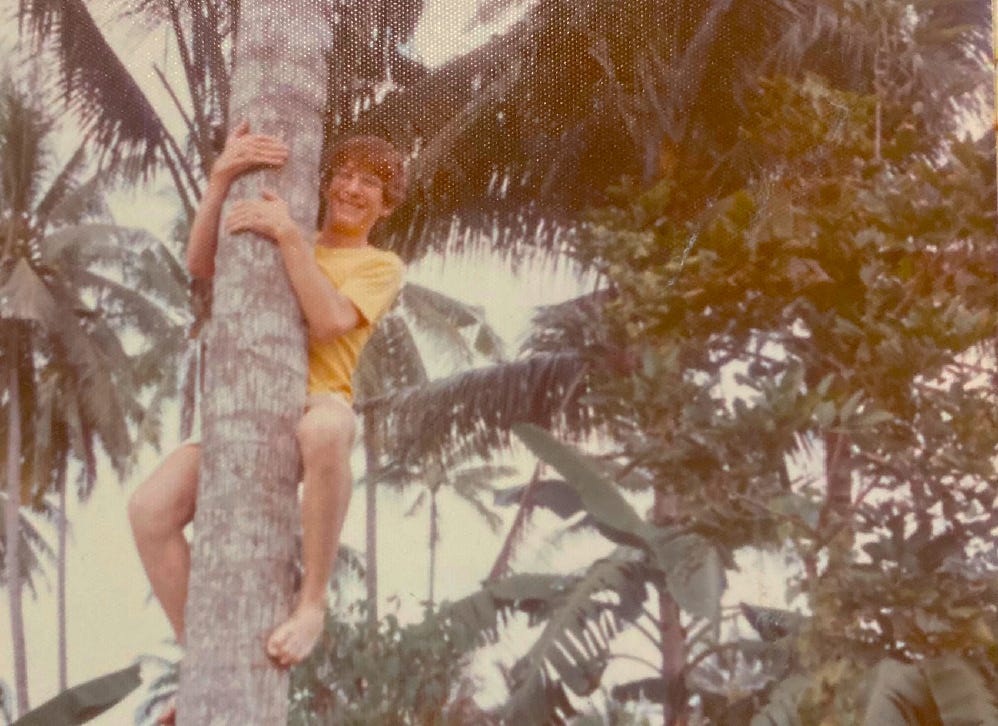
Raja Ibrahim and Raja Hawa invited me to live with them for a year in 1973 under the auspices of AFS Intercultural Programs, the international high school student exchange program, an experience that upended my parochial Southern Californian life. AFS is the oldest high school exchange program in the world, founded by volunteer ambulance drivers during World War I as the American Field Service.
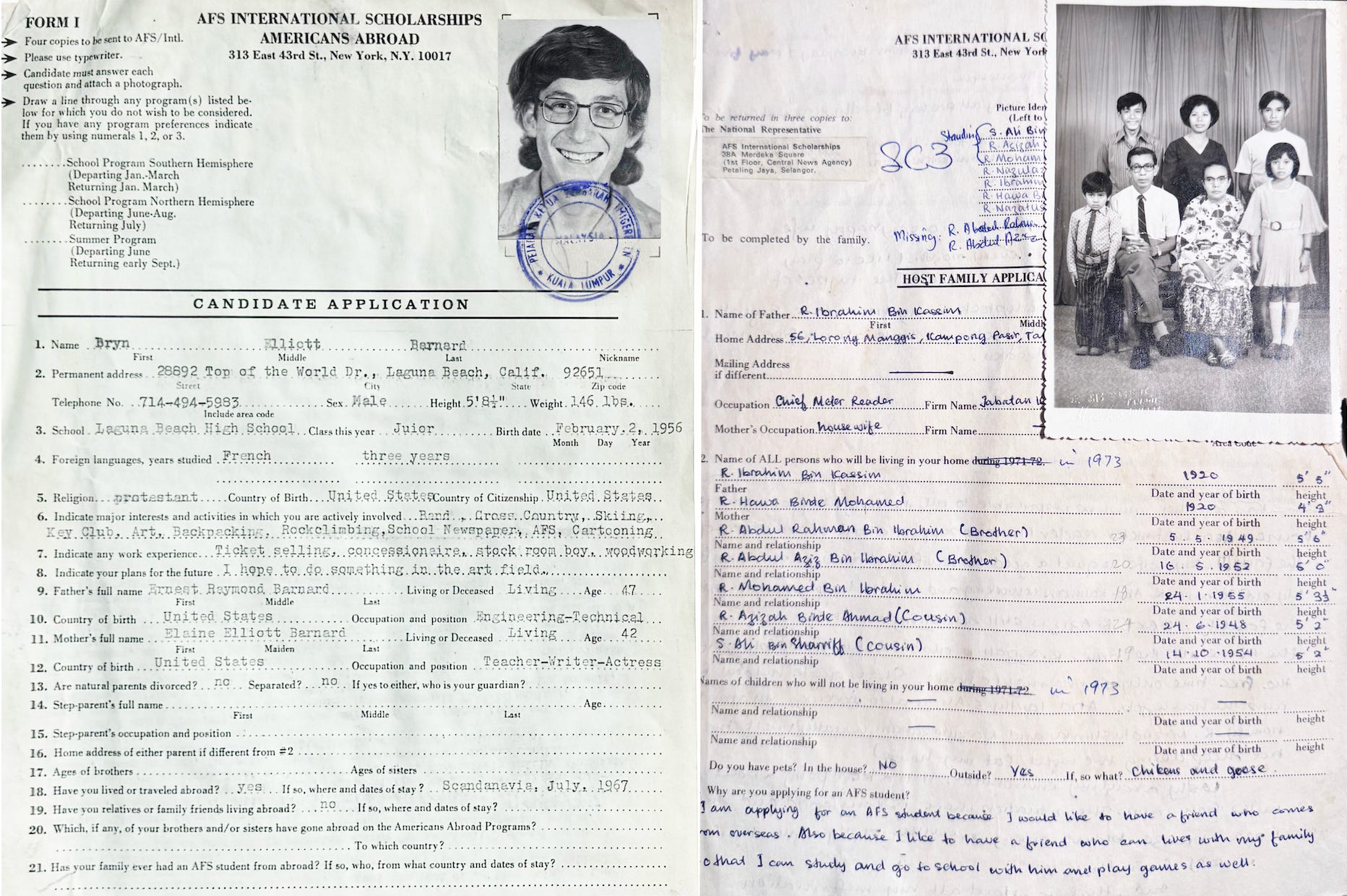
In World War II, the service’s ambulances carried more than 700,000 wounded. They also helped evacuate the Bergen-Belsen concentration camp. In the war’s aftermath, starting in 1946, the organization transitioned to student exchanges from France, Czechoslovakia, the Netherlands, Norway and Syria to the United States. In 1950, the Americans Abroad program began sending US students to Europe and in 1970, AFS became multinational with country-to-country exchanges that did not include America. In every country, families volunteer to host students, for which they receive no remuneration.
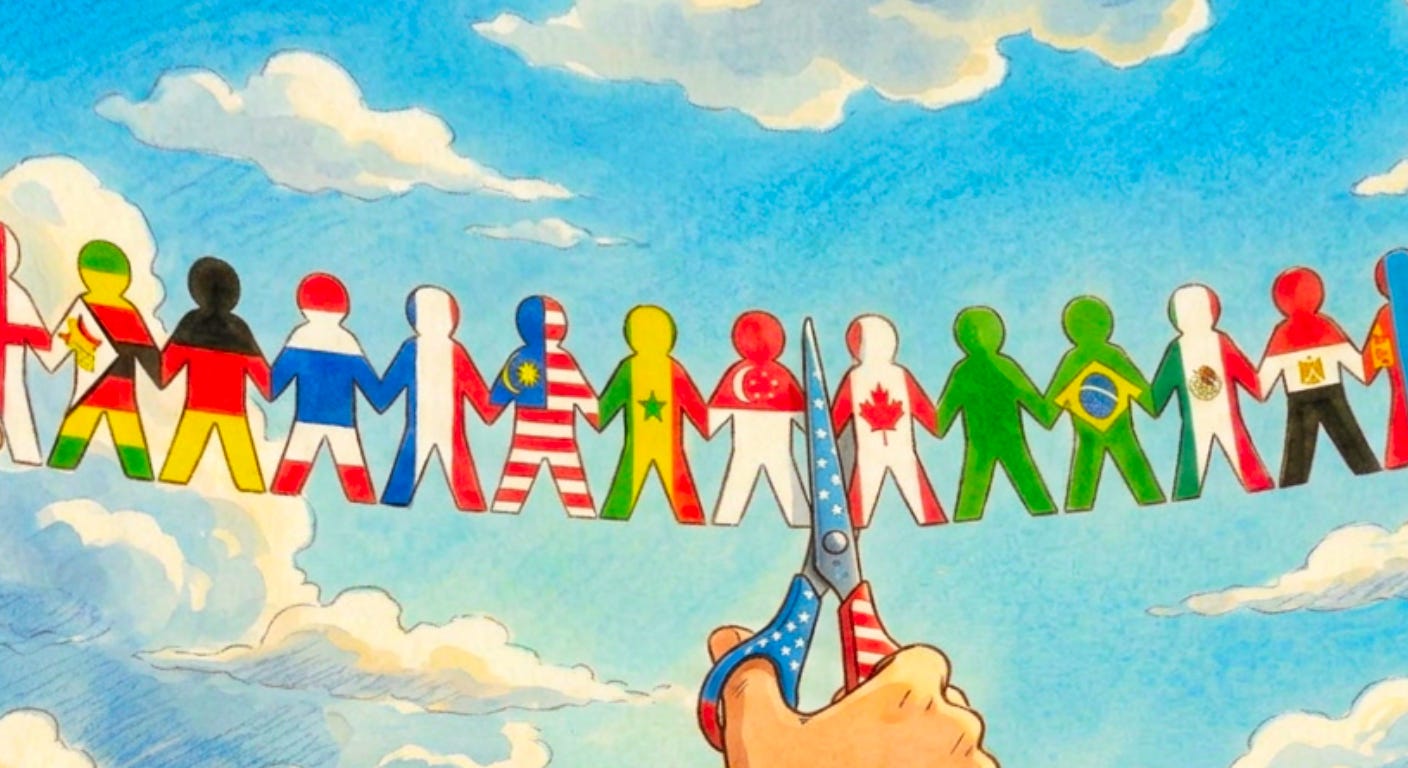
The original ambulance drivers hoped we could avoid another world war if teenagers—those who would do most of the fighting and dying—got to know one another face to face, personally, intimately. Friends are less likely to kill one another. The goal was to create a more peaceful and just world by promoting cross-cultural exchange. As the Trump Administration defunds programs, deports migrants and makes it harder for foreigners to enter the United States, that world is now in danger.
My host family lived in a small house in a small village called Kampung Pasir in Johor, a state in the south of the Malay Peninsula. My parents and siblings were called Raja in recognition of their connection to Johor’s ruling family, one of many honorifics Malays use to establish rank, status, experience and birth order.
Their home at Number 56 Mangosteen Lane was 5 miles outside Johor Bahru, the regional capital and Malaysia’s second-largest city, on the border with Singapore. The village was squeezed between a river noted for its crocodiles, a factory, the Singapore-Kuala Lumpur trunk road and a mangrove swamp. Our home, with overlapping plank walls and a corrugated iron roof, was raised on stilts for protection from floods and wild animals. We had a single outlet to supply the family electrical needs: lights, fan, television. We had a single indoor tap for water and an outhouse in the back. Some other families, less fortunate, ran their homes on car batteries and hoses strung like telephone wires from the public tap. Everyone in the village was Malay and Muslim.
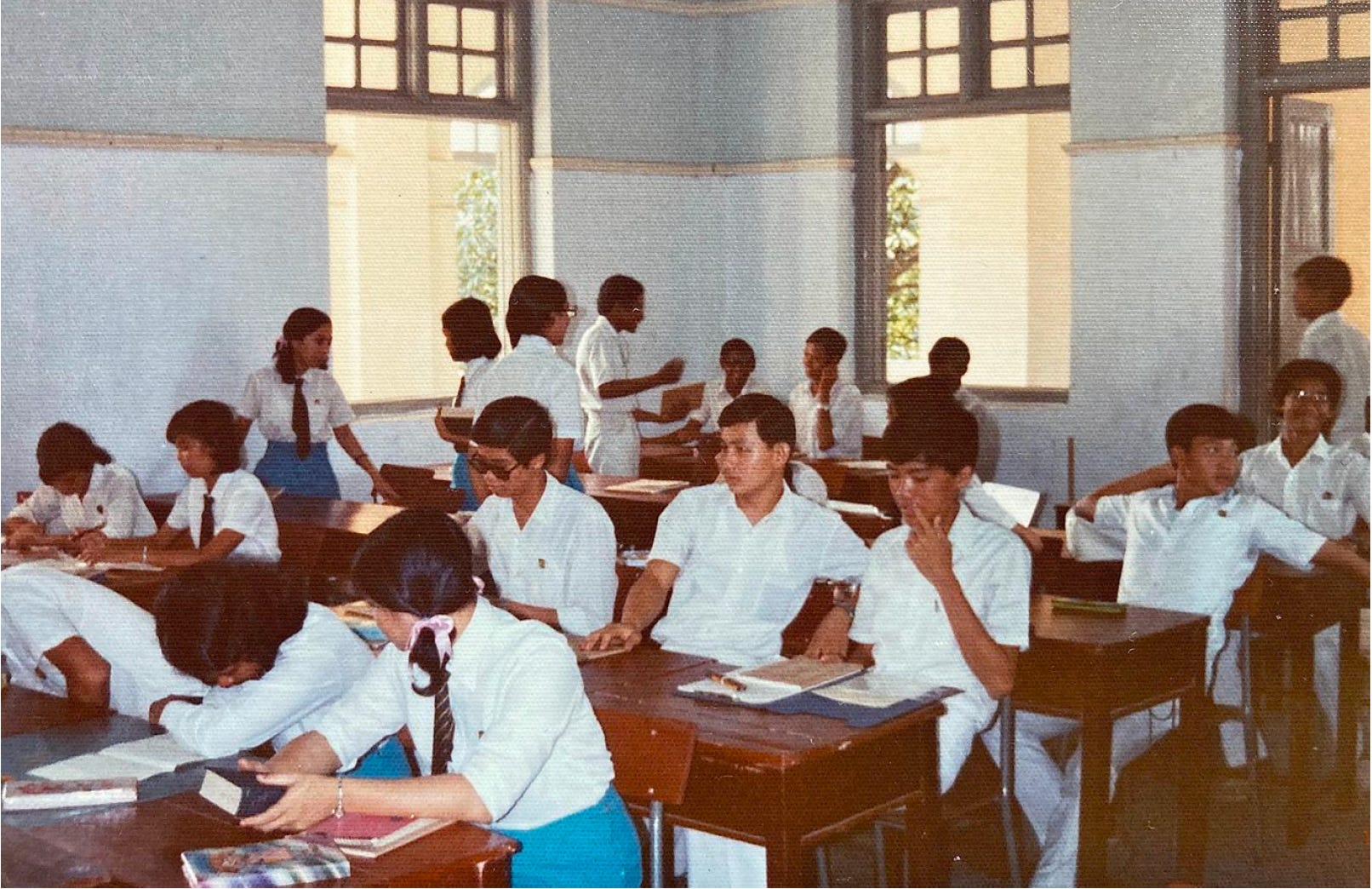
On the other side of the trunk road was a Chinese town, Tampoi, which we visited to mail letters, buy food and see movies. Nearby was a rubber plantation staffed by Tamil laborers. School was English College, five miles away, where I made Chinese, Malay, Indian and Eurasian friends, relationships that have endured to this day. I wore a school badge, white shirt, white pants, white socks and white shoes that I whitened weekly with whitener.
EC was a tropical Eton with a syllabus not much different from the days of British rule. Exams were set and graded in London. English, spoken with Received Pronunciation, was the language of instruction. In history class, Mr. Mohan Singh Penu taught us about Lord William Bentinck (first governor-general of India), Lord Dalhousie (second governor-general of India), the first Anglo-Afghan War, the Second-Anglo Afghan War, the Third Anglo-Afghan War and so on. Mr. Bakshi taught us “King Lear” and Wordsworth’s “Peter Bell.” Teachers would open a textbook to the appropriate page and copy a passage word for word onto the blackboard. We would then copy the copy into our copybooks. Successful students would regurgitate the text on the exam. That was learning.
In time, after navigating a crushing bout of homesickness, I learned to speak Malay and adapted to the rhythms and rituals of village life: the hot season, the wet season, births, weddings, funerals, prayer five times a day, the Prophet’s birthday, the Sultan’s birthday, Independence Day, Hari Raya (Eid). I ran 5 miles a day trying to stay in shape for my senior year of track and field back in the US. At the English College Sports Day, I won the 5,000-meter. At the state finals held at the big stadium in Johor Bahru, I ran my one and only steeple chase, coming in dead last.
Raja Hawa, Raja Mohamed and one of my aunts were practicing bomohs, or shamans, curing everything from possession to adultery to cracked metatarsals to congestive heart failure, giving me a front row seat to their belief—a combination of animism, Buddhism, Hinduism and Islam. That syncretic layer cake was already under assault by Saudi missionaries trying to transform Malaysia into an outpost of ultra-conservative Wahabism. They were successful.
Once a week, I took chloroquine to prevent malaria. I got ringworm, something neither the shamans nor allopathic salves, ointments and creams from the general hospital were able to cure. The Chinese doctors blamed the unhygienic conditions in my Malay village. One physician refused to treat me until I gave him some American coins, including a Kennedy half-dollar, for his collection, the one and only time I resorted to bribery in Malaysia. He told me to boil my clothes. The gentian violet antiseptic dye he recommended turned my underwear pink.
One of five AFSers change families or return home early. I nearly left mine. Our neighbors, Abas and Aminah, a young married couple, had invited me to their home so I could demonstrate how to make apple pie, my go-to example of American culinary art. I arrived at the appointed time with the ingredients and Aminah invited me in. We chatted in the parlor waiting for Abas to return from work. A downpour made motorcycle travel impossible. Instead of waiting for another day, we got to work and made our pies. After several hours, Raja Mohamed arrived at the door and said I needed to get home immediately. I proudly brought home my pie and discovered Raja Ibrahim puffing furiously on his pipe. The whole village was talking about the hours the foreigner had spent alone with the married woman. Haram. Forbidden. I had fulfilled their darkest fantasies about Western depravity. It took 30 days of Ramadan fasting to demonstrate my commitment to village life and reestablish mutual trust.
After my AFS year, I made Malaysia the centerpiece of my identity. In college at UC Berkeley, every artwork and term paper was somehow connected to that experience. My roommate Halim was Malay. Later, he was my landlord and later still, best man at my wedding. We had many adventures together.
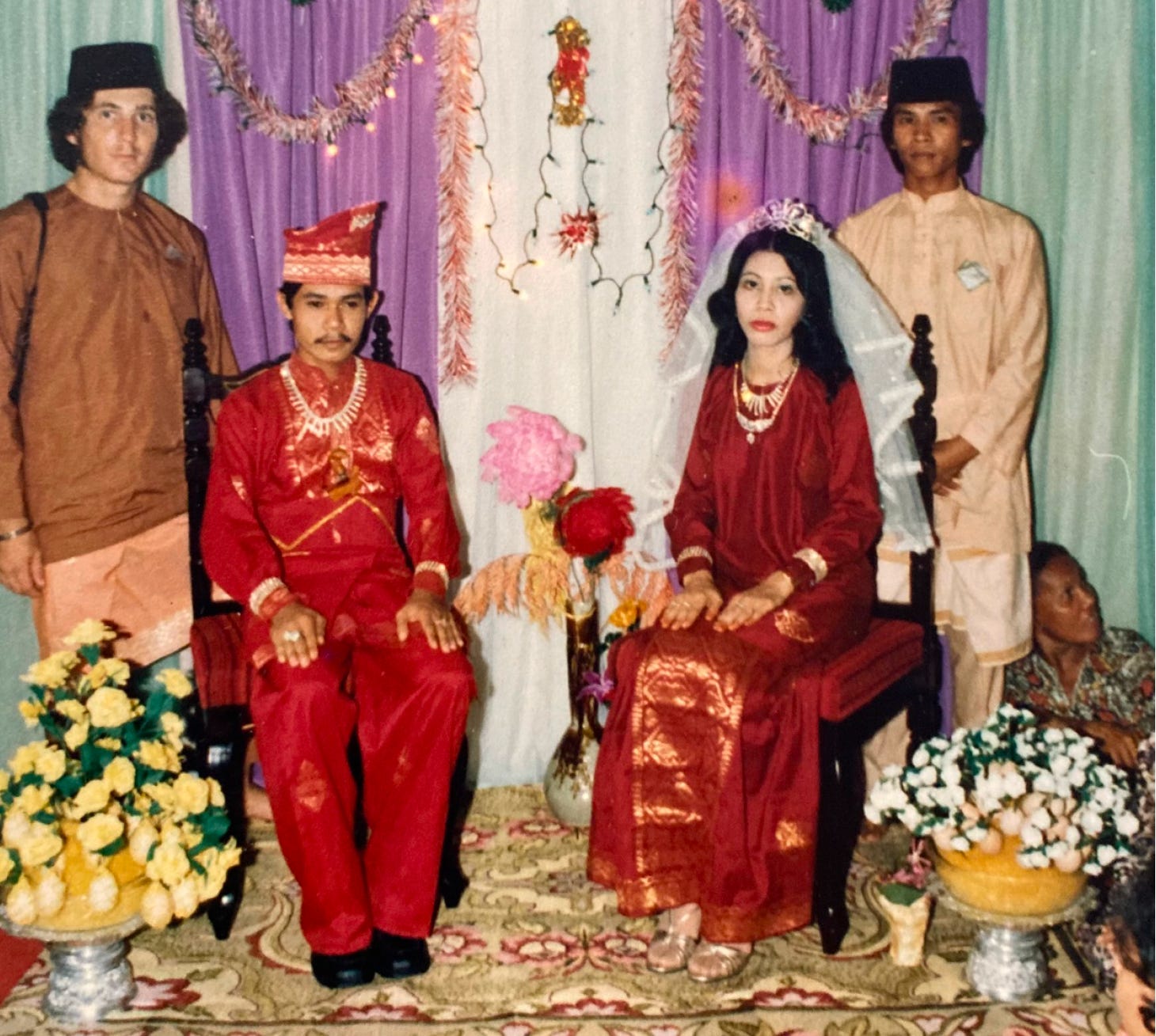
In my junior year, I returned to Malaysia to do field work for my senior thesis. I was best man at my brother Raja Mohamed’s wedding, the pengapit, sleeping on the floor outside the bridal chamber to ensure the groom did not run home to mama. After art school, I returned to Malaysia again on an Institute of Current World Affairs fellowship to study intercultural visual communication, and again with my own family on a Fulbright to teach. I shuttled back and forth between the United States and Malaysia over the ensuing decades, an unofficial ambassador of optimism and hope and connection. I had kids. They had kids. My children got to know their children and their grandchildren, a web of intercultural communication that transcended borders.
Today, Kampung Pasir is nothing like the village I lived in 50 years ago. It’s an urban barrio, swallowed up by Johor Bahru’s urban expansion. The palm trees are gone. The crocodiles are gone. The sandy lanes are asphalt. The kampung houses once cooled by floor-to-ceiling windows and riparian breezes have been replaced by cinderblock homes with air conditioners. The trunk road has been replaced by a freeway cloverleaf. The factory has been replaced by a multistory mall. None of my host family lives there anymore. But the connections remained.
I became intensely curious about the world, traveling widely for study, work and pleasure. Whenever possible, I made a point of connecting with other families: in Tehran, Beirut, Marrakesh, Shanghai, Tokyo. The AFS gamble had paid off. There are half-a-million AFS returnees like me. Adding in host families and other volunteers, the organization is over a million strong.
There’s only so much good will a single organization can create, however. After 9/11, my friends from Johor Bahru, Mark and Sheila, visited me on San Juan Island. Tired of anti-Indian discrimination in Malaysia, they had decided to emigrate. A visit here changed their minds. They moved their family to Perth. Halim (my Berkeley roommate) and his wife Saleha had second thoughts about sending their four children to the United States for university. The kids studied in Sydney and Melbourne instead. Their youngest daughter married an Aussie.
As the education scholars Baoyan Cheung and Manca Sustaric of the University of Hawai’i at Mānoa wrote in 2022, “globalization has provided accelerating forces for countries and peoples to connect and converge. In recent years, however, there has been a counterforce of deglobalization, characterized by the prioritizing of national protectionist policies and a retreat from global integration… in today’s world that faces increasing ideological polarization and social fragmentation along lines of race, class and citizenship, connecting people on the basis of mutual respect and understanding—and thus providing a common humanity so that mankind can live in peace and solidarity—becomes an especially pressing issue.”
It was probably inevitable that the original utopian peace-love-and-understanding ideals of AFS and competing high school exchange programs would become the object of statecraft. Governments now see high school student exchange as just another tool in the soft power toolbox. The Congress-Bundestag Youth Exchange (CBYX), started in 1983 and jointly funded by the American and German governments, provides scholarships for high school students interested in vocational and professional fields. The US Future Leaders Exchange program (FLEX), begun in 1992, recruits high school students from Eastern Europe and Central Asia to cultivate “a network of young leaders who understand and support US culture and priorities, with a focus on entrepreneurship, innovation and leadership…to become lasting partners for the United States.” The Kennedy-Lugar Youth Exchange Study program (YES) created in the wake of 9/11 provides study abroad scholarships to high school students in “countries of strategic importance” with significant Muslim populations to create “a network of young leaders who support US principles.” YES, CBYX and FLEX are all administered by AFS in coordination with the State Department: can’t-we-all-just-get-along meets realpolitik.
Unfortunately for the United States and the world in fiscal year 2025, YES, CBYX and FLEX were three of 22 congressionally mandated cultural-exchange programs to be defunded by the Trump Administration. “Every dollar we spend, every program we fund, every policy we pursue must be justified by the answer to one of three questions,” Secretary of State Marco Rubio said. “Does it make America safer? Does it make America stronger? Or does it make America more prosperous?”
The cuts amounted to $100 million dollars, affecting some 10,000 students. That’s 10,000 students who would not be sharing their cultures with their host families, 10,000 students who would not bring memories of American generosity back to their home countries, 10,000 students whose foreign exchange experience would not shape their futures. In addition to YES, CBYX and FLEX, a partial list of affected programs included the Community College Administrator Program, Community Engagement Exchange, Council of American Overseas Research Centers, English Access Scholarship Program, English Language Fellow Program, Global Undergraduate Exchange Program, IDEAS program, International Center for Middle Eastern-Western Dialogue, Leaders Lead-On Demand, Mandela Fellowship for Young African Leaders, Mike Mansfield Fellowship Program, National Clearinghouse for Disability and Exchange, Professional Fellows Program, Survey of International Exchange Activity in the United States, TechWomen, The J. Christopher Stevens Virtual Exchange Initiative, US Congress-Korea National Assembly Exchange Program, US-South Pacific Exchange Program, Young Southeast Asian Leaders Initiative Academic Fellowship and Young Southeast Asian Leaders Initiative Professional Fellowship.
After the cuts were announced, the Alliance for International Exchange organized a letter-writing campaign. Americans sent 20,000 messages to legislators demanding the reductions be rescinded. Congress restored the funding. But in fiscal year 2027, the White House has again proposed a 68 percent cut in cultural exchange programs and a 93 percent cut in the State Department Bureau of Educational and Cultural Affairs. If enacted, the Fulbright exchange program would lose 80 percent of its budget.
For those ambulance drivers evacuating the survivors of Bergen-Belsen, the lessons of World War II were clear: to break down stereotypes, counteract hate, stop violence and end war, we need more connection, more communication, more sharing. The proposed cuts “will isolate the US in the long term” at “a time in our history when cultural understanding is needed the most,” a former staff member of the Senate Foreign Relations Committee was quoted as saying by The Pie, a digital publication about international education.
For the moment at least, we are going to have to live with less exchange—more alone, more ignorant, looking through a glass darkly, admiring our reflection in a fortress of mirrors.
Bryn Barnard is an artist, teacher and former ICWA fellow. He has worked with Far Eastern Economic Review, Asiaweek, National Geographic and NASA, and also with schools and universities in Kuwait, Korea, Singapore, the US, Europe, the Middle East and Asia. His books include Dangerous Planet: Natural Disasters That Changed History, Outbreak: Plagues That Changed History, The Genius of Islam: How Muslims Made the Modern World and The New Ocean: The Fate of Life in a Changing Sea.