


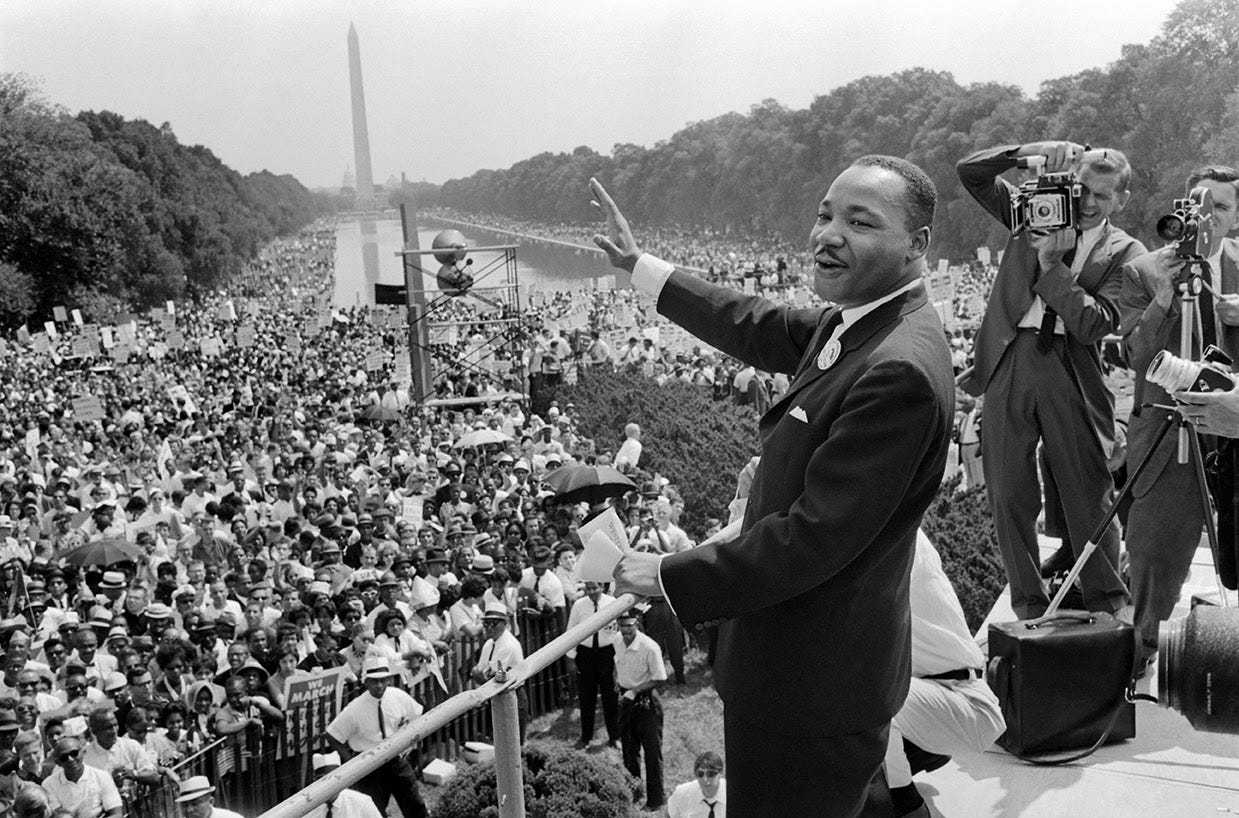
The March on Washington in 1963 remains one of the most iconic moments in modern American history. Martin Luther King Jr.’s famous “I Have a Dream” speech, the event’s highlight, continues to inspire people around the world. The protest helped build momentum for the Civil Rights Act of 1964, which helped lead to the Voting Rights Act of 1965 and the end of the Jim Crow era.
Activists around the world still see the March on Washington as a model. Because it was followed by the greatest victories of the civil rights movement, they assume the march caused those triumphs. In fact, that’s a dangerous misconception.
The civil rights movement didn’t become powerful because of the March on Washington; the event took place because the civil rights movement had become powerful. The march was part of a larger strategy, it didn’t create change by itself.
By 1963, activists were employing a wide variety of tactics, including lawsuits, boycotts, sit-ins, “Freedom Rides” and other campaigns. Each targeted specific institutions: courts, legislatures, corporations, unions, religious institutions and, of course, political leaders like President John F. Kennedy. It was Kennedy who introduced the civil rights bill to Congress and his successor, Lyndon Johnson, pushed the legislation through.
The march was successful because it was aimed at that specific target. On its own, it would almost certainly have fizzled. That’s what usually happens when people march on Washington. There have been more than 300 such marches. If you consider that the famous one was arguably the only such event to have had a historic impact, you begin to understand the challenge.
The odds appear even worse for activists on closer examination. The first march on Washington, the Woman Suffrage Procession in 1913, for instance, was a full-blown disaster. Disrupted by hooligans, it turned into a large-scale riot that greatly discredited the suffrage movement and particularly its leader Alice Paul. The campaign would take years to recover—and a shift to smaller, more controllable protests—before it was able to help finally win women’s right to vote with the passage of the 19th Amendment in 1920.
Gene Sharp, the legendary scholar of nonviolent resistance, identified 198 methods of nonviolent action. Marches are only one, and certainly not the most effective.
So if marches don’t topple dictators, what does? To understand that, let’s leave the civil rights movement and move forward more than 30 years, to a small cafe in Belgrade in 1998.
How five kids in a Belgrade cafe brought down a strongman
One day in 1998, a group of five friends met in a cafe in Belgrade. Although still in their 20s, they were already experienced activists, and most of what they had seen was failure. They had taken part in student protests against the war in Bosnia in 1992, as well as in larger uprisings in response to election fraud in 1996. Neither achieved much.
Having had time to reflect on their successes and failures, they hatched a new plan. They knew from their earlier efforts that they could mobilize people and get them to the polls for a presidential election in 2000. They also knew that if he were to lose, President Slobodan Milošević, who ruled the country with an iron fist, would try to steal the election just as he did in 1996.
So that’s what they planned for.
The next day, six friends joined the five and together formed the original 11 members of Otpor, the movement that would go on to topple the Milošević regime. They began slowly at first, performing pranks and street theater. But within two years, the organization grew to over 70,000 members, with chapters across Serbia. They mobilized people, got them to the polls and helped win the election for the opposition leader Vojislav Koštunica.
Right on cue, Milošević tried to steal it. That’s what triggered the Bulldozer Revolution that brought him down in 2000. He would die in his prison cell at the International Criminal Court in The Hague in 2006. His downfall shocked the world because no one had dreamed his brutal authoritarian regime could be taken down by nonviolent action.
But it didn’t stop there.
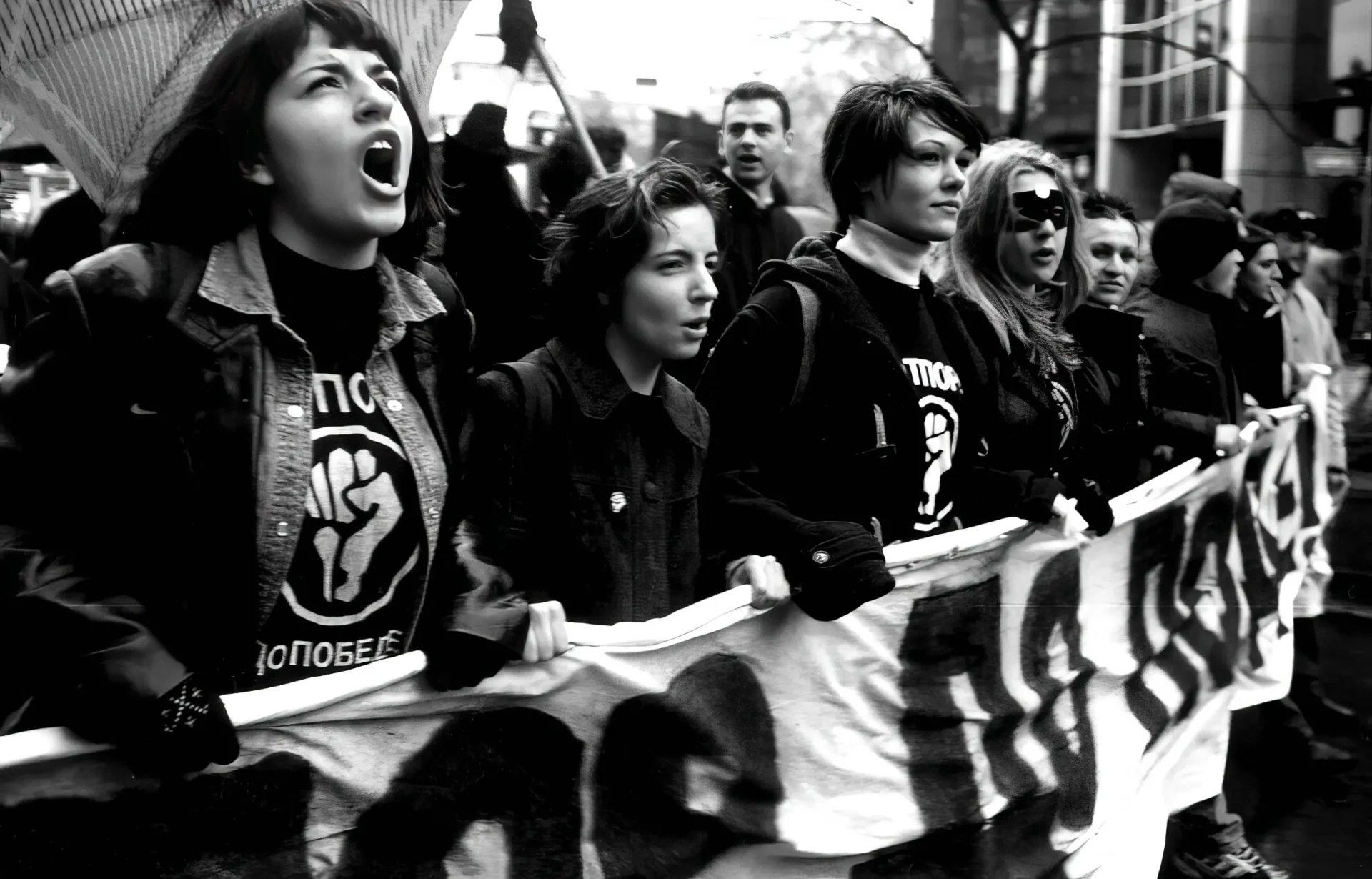
Members of Otpor followed by training activists in Georgia who brought down the former Soviet republic’s own leader in the Rose Revolution of 2003. Otpor also helped Ukrainians the following year in the Orange Revolution, where I was running a major news organization and witnessed the power of their work firsthand. Collectively, these became known as the “Color Revolutions” that changed the face of Eastern Europe and the course of history.
But it still didn’t stop there.
Then came the Arab Spring, Zimbabwe, Myanmar, the Maldives and so many more revolutions. To date, the same Serbians have been active in over 50 countries, helping countless others resist authoritarian regimes and build better lives for themselves. Many of the popular movements have since seen reversals but the fact remains that they were able to unseat powerful autocrats with the real promise of change.
At this point, we have to ask the obvious question: How did a bunch of kids work to bring down a seemingly all-powerful dictator? Not once, not twice but repeatedly over a period of decades?
The answer lies in a basic truth they learned from Gene Sharp: Every regime depends on sources of power to carry out its will, and those sources have an institutional basis. Authoritarians like Milošević, Russian President Vladimir Putin and Hungary’s recent ruler Victor Orbán have been able to wield power not because of their special personal characteristics but their capacity to control and influence institutions. Take that away and the regime will fall.
The simple principle became the basis for the Otpor movement. Its members would identify institutions and develop strategies to influence them. Your targets determine your tactics, they would go on to teach others, not the other way around. That’s why you should never get tied down to any particular tactic. You want to preserve strategic flexibility so you can design strategies and tactics fit for each purpose.
Here’s how that looked in Serbia.
Designing an institutional battle plan
Otpor may have become well-known for its brilliant street theater and creative pranks but underneath them all was a strategy for everything. In Serbia, its leaders identified eight key institutional groups and built sophisticated strategies to influence each one.
Consider the police, a key institutional support for the regime. Control of law enforcement enabled Milošević to order arrests at whim. That struck fear into the general population, making it harder to recruit activists. If Otpor were to succeed, it would need to at least mitigate the effect of police action. But the group’s members did better than that. They actually turned arrests to their advantage.
It started with training. All Otpor activists were taught exactly what to expect when they were arrested, and how they should act and engage with police. Arrests were to be seen as opportunities for infiltration and to win officers to their side. Activists who were arrested were also given a cool “Otpor” t-shirt on their release, which they could wear to school the next day. The more arrests, the better the t-shirt they got.
Perhaps the most sophisticated aspect of the police strategy was something called Plan B. As soon as an activist was arrested, not only were lawyers immediately called to push for release but a secondary protest would be launched outside the police station, where a large crowd would gather. NGOs would be notified. Auxiliary groups such as “Mothers of Otpor” would show up to demand why the police were arresting harmless kids.
Soon arrests became less of a tool of intimidation and more of a liability. Arresting an activist meant lawyers and unflattering media coverage, not to mention growing protests outside your station. The added paperwork burden alone was a deterrent. You’d get nothing else done all day. It just wasn’t worth it.
Otpor developed similarly effective strategies for every institutional group they targeted, identifying their vulnerabilities and pressures that would be most likely to shift their behavior. In 1998, when the movement began, this is what the institutional environment looked like.
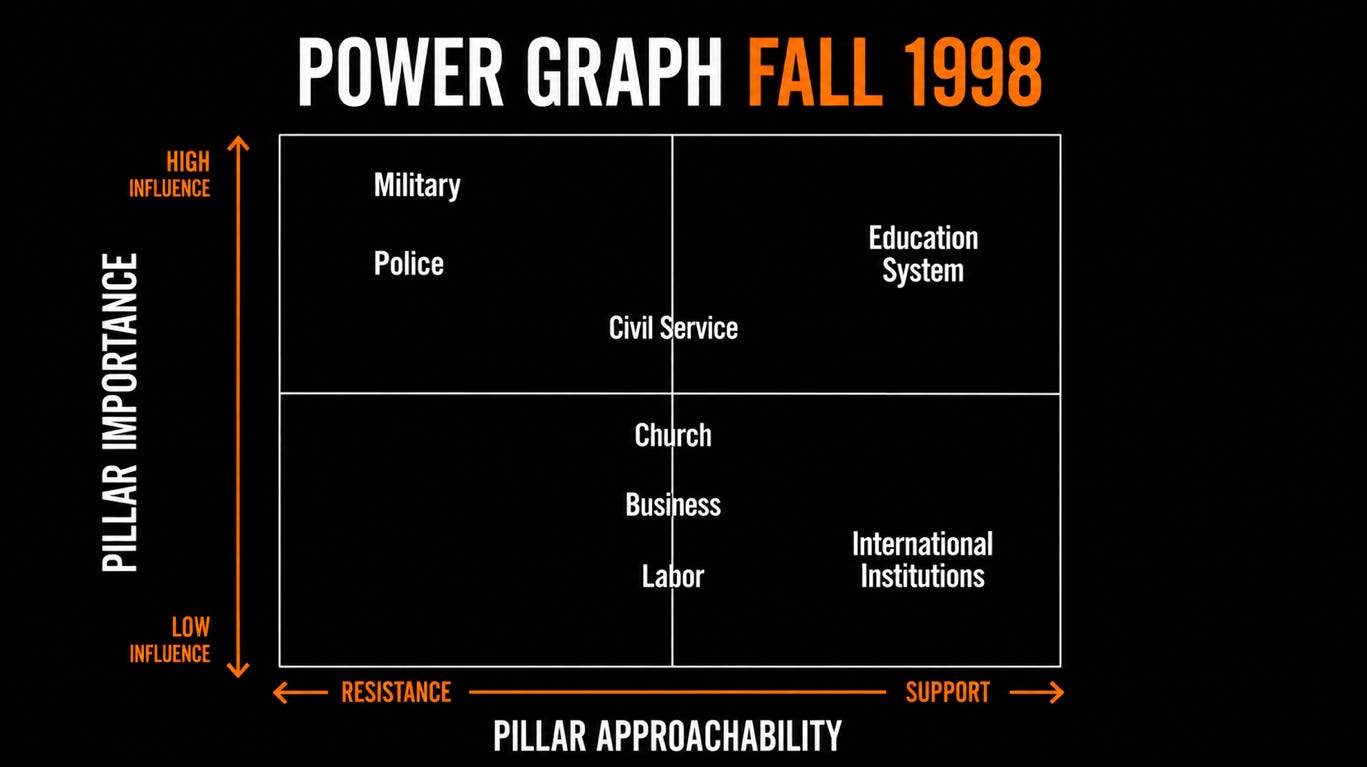
Two key institutions, the military and police, staunchly supported the regime. The education system and international institutions were seen as allies of the activists, and the civil service, Church, businesses and labor were all on the fence, with no love for Milošević necessarily but wary of change and the disruption it might bring.
Then events completely out of Otpor’s control produced a setback. After failed peace talks over Milošević’s incursions into Kosovo, NATO launched a 78-day bombing campaign from March to June 1999. It prompted a “rally around the flag” effect among Serbs and the movement lost ground.
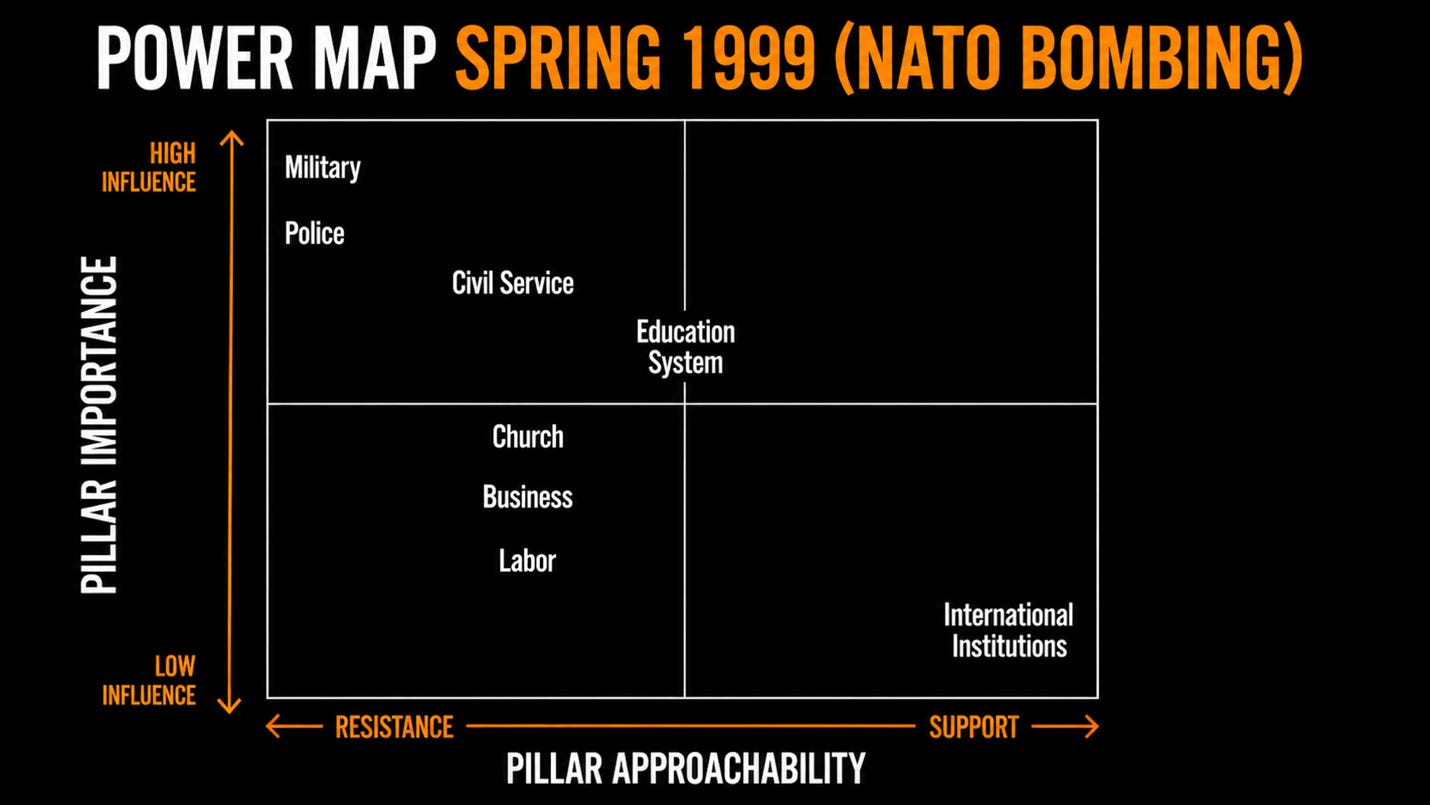
When the conflict ended, the Otpor activists got back to work to win support. They continued mobilizing in the streets but always stayed focused on their institutional targets. By the winter of 2000, they were making progress again and had made up the lost ground.
By spring 2000, the momentum had begun to really shift. Two key institutions, the military and civil service, began to defect. Labor, once reticent to take a side, now moved firmly into the resistance camp.
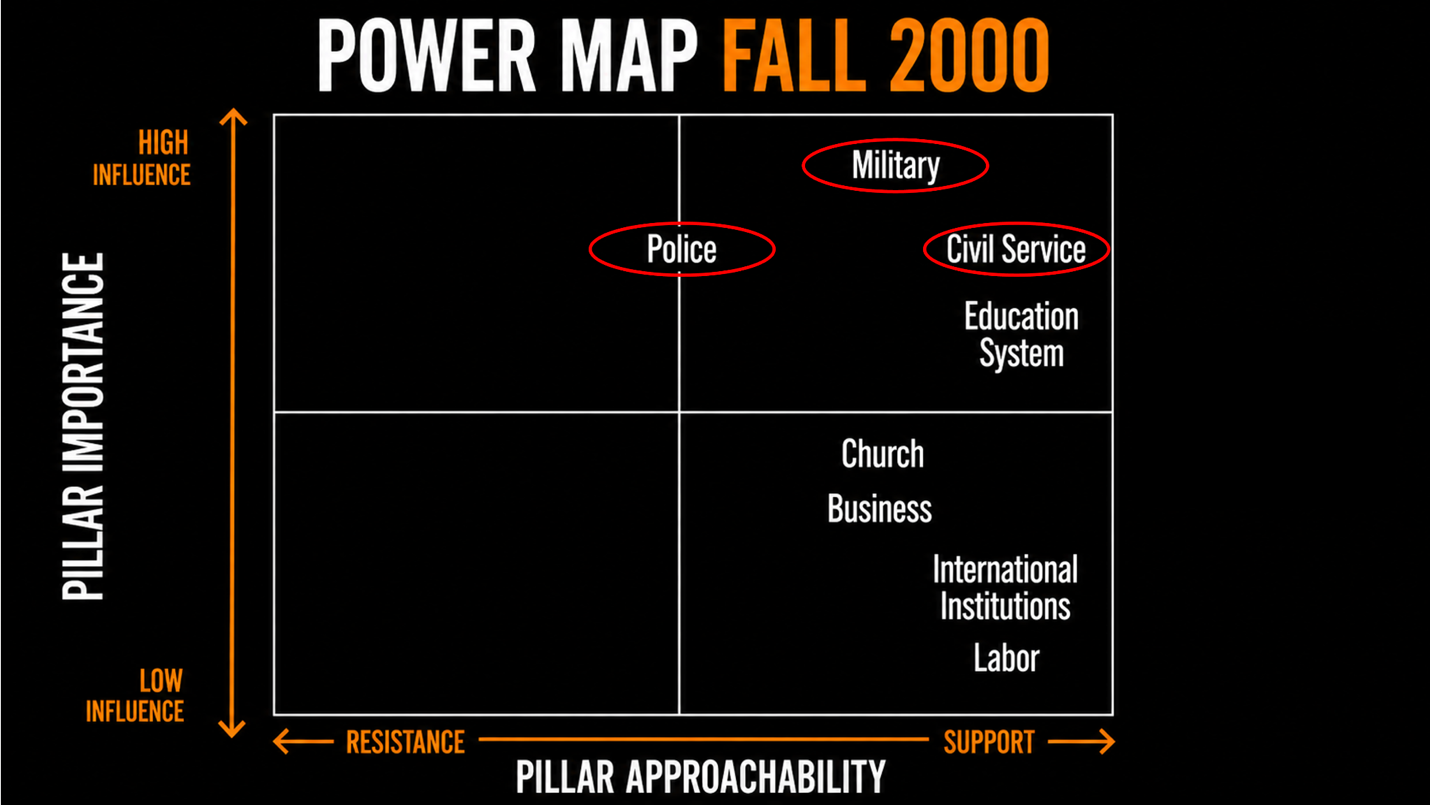
By the eve of the election, Milošević had already lost power; he just didn’t know it yet. All the major institutions had shifted away from the regime. Even the once fiercely loyal police were taking a more neutral stance. Once the Bulldozer Revolution broke out and they were ordered to shoot protesters, they refused.
It was over. The regime had fallen.
Power ultimately rests on legitimacy. Once enough institutions stop believing a regime deserves obedience, its apparent strength can evaporate very quickly.
It’s the institutions, stupid
Today, a global battle is taking place between autocracies and the forces of liberal democracy. It is not a war about ideology, religion or even politics, strictly speaking. It’s about something far bigger and more consequential: control of institutions.
Autocrats work to undermine the independence of institutions. Some are political institutions, such as legislatures and courts, but many—corporations, unions, media, universities and civic organizations—are not. It is by gaining control over institutions that authoritarian leaders can replace competence with loyalty as the coin of the realm, making truth less a matter of facts or evidence than a test of fealty among subordinates.
It is on institutional ground that the most important battles are being fought. Is there equal protection under the law? Do businesses have the right to operate without fear of being shaken down by government officials and the agents of oligarchs? Do people have the right to feel safe in their homes and their communities?
It is the institutions that ultimately hold the answers to each of those basic questions. To build and maintain a free, strong society, you need free, strong institutions. That’s where every strategy for positive change must start: working to influence institutions to rebuild, reform and serve societies more competently and faithfully. That takes more than simply going out into the streets. It requires institutional knowledge, creativity and discipline.
That’s why so many recent movements that have successfully mobilized and brought impressive numbers of people into the streets also fail to achieve meaningful objectives. Unless your actions are aimed at specific strategic institutional targets, you’re just making noise.
Free societies do not survive because people occasionally flood the streets. They survive because citizens are able to build institutions over time worthy of public trust and strong enough to resist those who would capture them.
That’s why the last thing we need now is the belief that bigger marches will produce more change. What we need are strategies that identify specific targets and design viable ways to influence them. That’s how we can bring about a more just and prosperous world.
Greg Satell is co-founder of ChangeOS, a transformation and change advisory, a lecturer at Wharton, an international keynote speaker, host of the Changemaker Mindset podcast, bestselling author of Cascades: How to Create a Movement that Drives Transformational Change and Mapping Innovation, as well as over 50 articles in Harvard Business Review. You can learn more about Greg on his website, GregSatell.com, watch his YouTube Channel and connect on LinkedIn.