


Jill Winder is senior editor at Haus der Kulturen der Welt, the national center for international contemporary arts in Berlin. As an ICWA fellow in the country from 2004 to 2006, she wrote about post-reunification Germany through the work of its artists. She has worked with the Berlin Biennales and Bergen Assembly and art agenda, and holds a master’s degree in art curation from Bard College.

In her July 2006 dispatch, Jill explores Germans’ complicated relationship with their national flag, and what flags mean to all of us.
Berlin (July 2006) — When I first moved to Berlin in July 2002, the FIFA World Cup championship was in progress. My friends took me to a bar to watch a match, South Korea vs. Turkey. The Turkish national team was competing for the first time since 1954 and had been doing well (they ended up finishing in third place). I was living in Kreuzberg, a neighborhood with a significant Turkish immigrant population, and the Turkish fans were loud, proud and thrilled with their team’s progress. Turkish flags were everywhere—flying from cars, hanging off balconies and displayed in shop windows.
The German team, meanwhile, advanced to the final, ultimately losing the title to Brazil. Again, I walked through Kreuzberg with my friends, heading to a bar to watch the game. Turkish flags were still everywhere. Our little group turned a corner and saw a German flag hanging from a balcony. My three friends stopped in their tracks and stared at it. Their discomfort was palpable, yet no one said anything. I remember finding it odd, and later I asked my friend and roommate Tina Holmes what the matter was. Although I was aware of German history and why German nationalism was a difficult, even volatile subject, I was surprised by what seemed to be a taboo against a citizen flying the flag. “The Turks have their flag on everything in the neighborhood—why did seeing one German flag make you guys so uncomfortable?” I asked.
She looked at me and said simply and matter-of-factly, “We don’t fly flags. It’s just not done. The only people I’ve seen walking around with German flags in the last ten years are neo-Nazis.”
Flash-forward to 2006. Germany hosted this year’s World Cup.
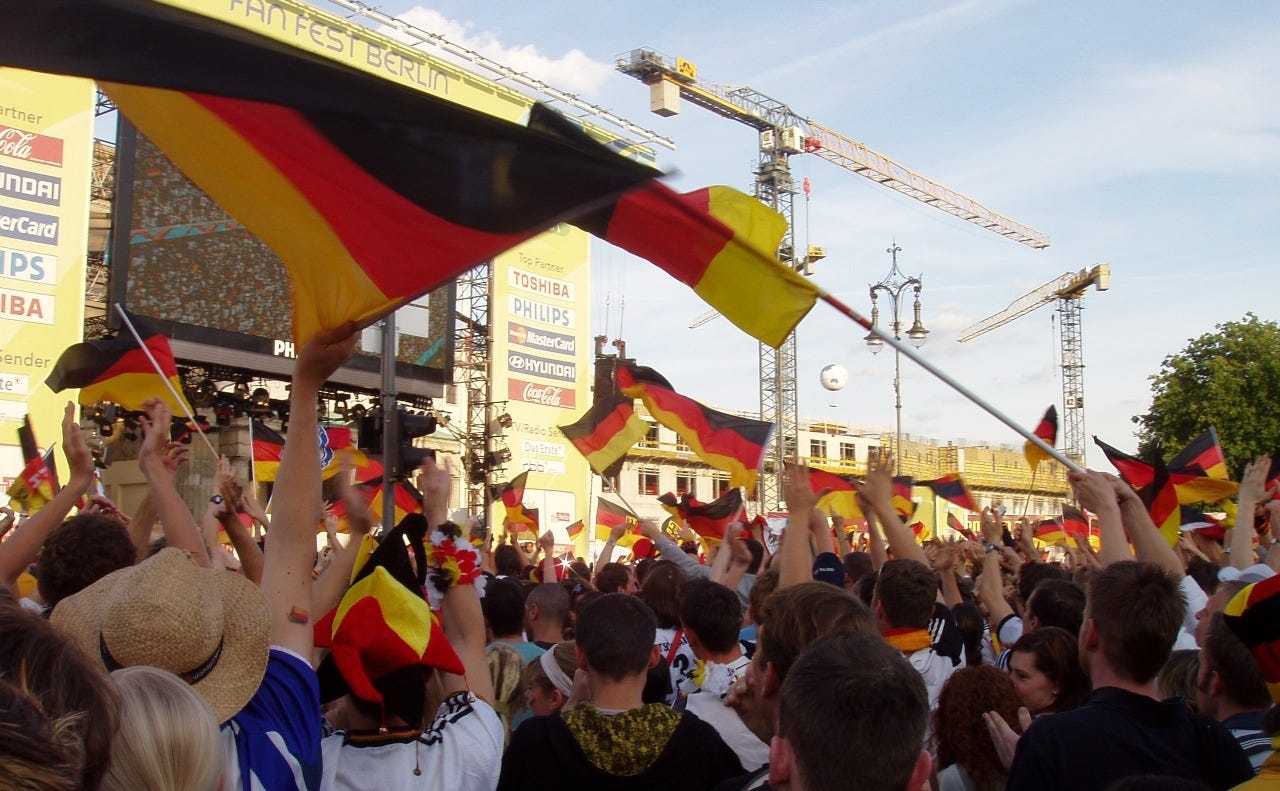
I arrived back in Berlin on the day of the final match between France and Italy. The infectious energy was hard to ignore, especially because the young German national team was doing so well (they finished in third place.) It was striking to see how many German flags were on display as I rode into the city center. The sudden, dramatic increase in Germans proudly displaying the flag became the topic of the day in both the national and international media. In the feuillton section of left-leaning newspapers, intellectuals decried this “resurgence of national symbolism” and went so far as to lament that Germans “have not learned from their history.” Other publications quoted politicians, such as President Horst Köhler, saying that the return of the flag and the general good cheer that Germans felt during the World Cup were positive signs of further “normalization” in the country.
I thought about my own relationship with the American flag and the difference between the ritual gesture of flying a flag and the meaning or symbolism behind it. The first time in my life when I felt truly patriotic, moved and proud to see a flag flown was in New York after the attacks on September 11, 2001. It was the first time I felt that the display of the flag was more than a ritual gesture emptied of meaning by habit or holiday etiquette but was flown to communicate everything from pride and solidarity to commitment to the freedoms the flag represents.
The majority of Germans, I’m sure, flew the flag and donned its colors as a ritual gesture, or perhaps just because they were excited about a football team. For the older generation of Germans, it is probably a relief to see the German flag flown because of a sporting event. This represents an enormous change in German attitudes. Until recently, only conservatives or right-wing extremists dared to use the flag as a national symbol, and they did so as a conscious political act. Even in 1990, when nearly a million people gathered in Berlin to celebrate the one-year anniversary of German reunification, only a scattered group of skinheads and neo-Nazis were holding German flags.
This summer the flag made its reappearance as the de facto mascot of the German national football team, unmoored from its traditional use as a symbol of national identity and even nationalism. And for the younger generation, many of whom resent that Germany is not allowed (or does not allow itself) to leave history in the past, the return of the German flag was seen as something utterly normal and uncontroversial: a long-overdue display that allows them to finally be proud of their country. Even Gregor Gysi, the charismatic intellectual leader of the PDS, the successor party to East Germany’s former communist party, and no friend of the German flag, admitted that these youths represent “a new generation that, when it comes to the German nation, is not as handicapped as my generation.”
Germany still has many challenges to face, not least the shockingly high number of jobless, especially in the former East Germany, but the World Cup presented an opportunity to cast a hopeful eye to the future and to celebrate the achievements of the country, especially since 1989. As Marc Young wrote, “The growing pains of a reunited Germany shouldn’t overshadow the positive and instructive lesson the World Cup has taught us: namely that, in the New Germany, waving the black, red and gold flag in no way suggests any kind of return to a troublesome past.”