


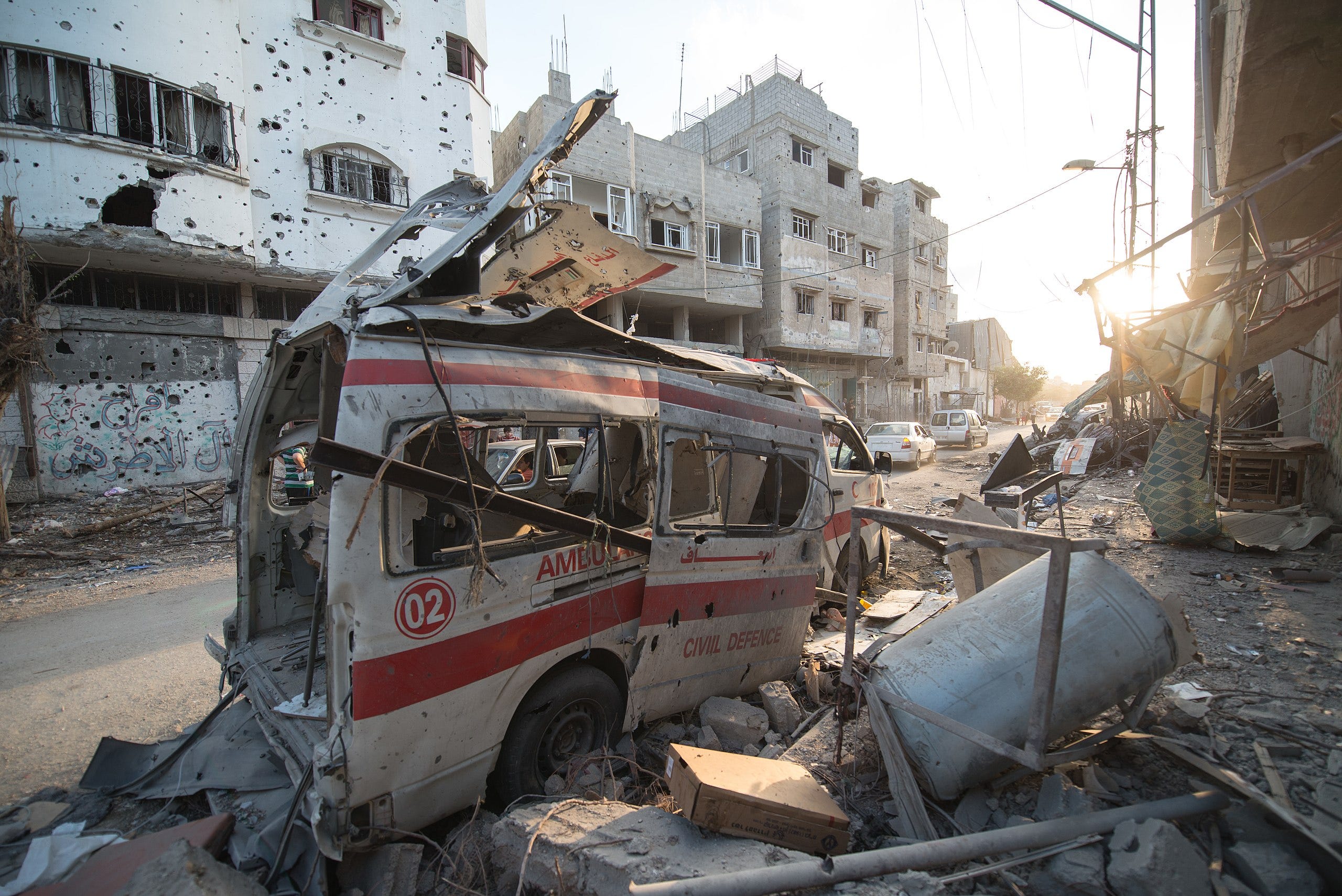
The tenuous ceasefire in Gaza brokered by President Donald Trump and his envoys in October has rekindled some hope for the establishment of an independent Palestinian state juxtaposed to Israel. But the fact is that the vaunted, well intentioned, much studied and repeatedly advocated two-state solutions are all but moribund.
Israel, formally constituted since 2018 as the nation-state of the Jewish people, won’t have it. The Knesset, or parliament, won’t countenance a next-door neighbor with the capacity—and, many legislators would say, the will—to threaten its survival, ever.
The main alternative, a one-state solution, may have merit but only if Arab Israeli Palestinians would be given enforceable equal rights under a formal written constitution. No such document exists even in draft stage at the moment, however, although one could conceivably be forged by enlightened leaders in years ahead. For now, the only one-state solution on offer—that of an apartheid Greater Israel—is anathema to Palestinians, liberal Zionists and much of the rest of the world.
But there might be another way to address one of the world’s most intractable conflicts, a pathway to peace that would result in the coexistence of a sovereign Jewish state and two Palestinian statelets with limited sovereignty not unlike that of Native American tribes in the United States. As an indigenous people struggling to overcome both Israel’s oppressive rule in the Occupied Territories and internal tribal rivalries, the Palestinians could attain leverage and support at the United Nations and elsewhere to achieve a form of self-determination rooted in the Declaration of Rights of Indigenous Peoples.
Although France, the United Kingdom, Germany, Canada and scores of other UN member states have independently recognized a Palestinian state, the effect has remained mainly symbolic: The emergence of a sovereign Palestine hasn’t been possible so far.
The majority Arab enclaves of the West Bank and Gaza don’t qualify as a state under international law, for one. Palestinians can’t attain statehood as long as their territories aren’t contiguous and their political factions remain incapable of coming together to provide sustainable self-government.
Even if a reformed and reconstituted Palestinian Authority (de facto the Palestine Liberation Organization) were to claim jurisdiction over both areas, remnant Hamas militant forces and other factions would almost certainly relentlessly contest the central government’s legitimacy. Without rigorous, forceful and sustained international intervention—supervised sovereignty—the overarching governing Palestinian Authority (PA) would be incapable of enforcing laws and maintaining order, a requirement of sovereign statehood.
The Palestinians have been defeated. From the catastrophic losses of land and displacement of people in 1948—the Nakba—to the repeated violent uprisings against Israeli occupation—the Intifada campaigns—and now the utter devastation of the war in Gaza following the heinous attack on Israel in 2023, Palestinian forces have failed to achieve any sort of victory beyond in the court of world opinion. Still, Palestinians in Gaza and the West Bank have not been completely demoralized, even when Hamas’s core mission to destroy Israel has failed and the Palestinian Authority’s reign in the West Bank has been undermined by deep and lasting corruption.
Palestinians have never had an independent state. Israeli nationalists have been harping on that point for decades, proclaiming themselves to be the inheritors of a sacred covenant stretching back thousands of years, while reminding the world at the same time that Arab states rejected the partition plans forwarded by international authorities before and after Israel was established in 1948. None of that obviates Palestinians’ right to self-determination as indigenous inhabitants of the former Ottoman Empire and the post-WWI British Mandate in Palestine.
But self-determination does not automatically equate with statehood. There are well-established ways of upholding the dignity and guaranteeing the human rights of a defeated people. Never to everyone’s satisfaction, perhaps, but it’s been done in an enduring fashion. In the United States, nominally sovereign Native American tribes are regarded as domestic dependent nations, for example. Disarmed and underdeveloped reservations can be dissolved by Congress, but tribes still have treaty rights and are not subject to state government authority.
The Palestinians may be defeated but they are not vanquished. New leaders, whether they emerge from the fold of Hamas, the PA or Israeli prisons, could invoke the UN Declaration of the Rights of Indigenous Peoples and quickly attain participatory privileges within the UN system and other international organizations. Responsible leaders in the physically separated and politically autonomous enclaves of Gaza and the West Bank could jointly enter into cultural alliances with other indigenous groups with standing in the international community, including Uyghurs, Tibetans, Australian Aborigines and the Inuit of the Circumpolar North. The connections across such great physical and historical distances are not easy to discern but they are readily imaginable. Intense personal suffering and collective trauma are a common thread among Indigenous communities.
During the many days following the still uncertain “day after” arrangements that are part of the tenuous Trump plan, there will be hundreds of thousands of Palestinians who will remain in Israel. They have homes, jobs, educational institutions and more. What they don’t have is equal rights as citizens. That could be remedied by establishing a constitution that legally guarantees the rights of an indigenous minority—which could become a majority if demographic patterns persist and Israel does not incentivize another wave of Russian or Sephardic Jewish immigrants to fulfill what most Israelis consider a demographic imperative. Said constitution, if it materializes, must be framed to protect Palestinians’ individual and collective rights, including land ownership.
There are also hundreds of thousands of Palestinians living in diaspora. They are attending universities in Europe and America, working for transnational corporations all over the world, starting and sustaining businesses that generate sufficient profits to enable remittance payments to relatives and friends in Palestine. That is the way of the world for Indigenous peoples. Many choose to live “off reservation” but hold steadfast to their values and identity. It is also true of the Jewish diaspora community—the other cultural nation indigenous to the Biblical land of Canaan.
The Israeli-Palestinian relationship will remain asymmetrical for the foreseeable future. Israel will have the upper hand, with its security forces surrounding the demilitarized tribal enclaves in Gaza and in the West Bank. Whether or not the United States will or even can veto Israel’s formal annexation of Judea and Samaria, which is still occupied territory under international law, de facto annexation of Palestinian lands continues apace, an explicit goal of which is to render Palestinian communities permanently discontiguous.
But different, creative and authentic ideas have been raised beyond the main two- and one-state solutions. Zeid Ra’ad al Husseini has neatly summarized three in some ways convergent proposals for territorial adjustments, residency rights and a “Holy Land Confederation” in an October essay in Foreign Affairs. The scholar Alon Ben-Meir has also put forward a prescription for an Israel-Palestine-Jordan confederation. (See Israeli-Palestinian Confederation: Why and How.)
Consider one more good faith proposal from outside the region to imagine a way out of the morass: a “Two Tribes, One Nation” formula for the Palestinians. The Confederated Salish and Kootenai Tribes constitute the single Flathead Nation in Montana, and there are other multi-tribal reservations in the American West. A similar self-governing Gaza and a self-governing West Bank “Reservation”—perhaps connected by high-speed rail—could be sufficiently united to become recognized and respected as a Palestinian nation in international law and transnational forums such as the UN Office of Indigenous Peoples. Imagine this political evolution: gradual progression from two tribal governments to a confederation of both to a confederal and interdependent partnership between the Jewish state and a bifurcated but well-connected and networked Palestinian national community.
Such prospective complex relationships would have to be solemnized in writing, justiciable in Israeli courts, referenced in Israel’s Basic Laws and incorporated in a written constitution. In the meantime, the intercommunal relationship would be bound to become increasingly interdependent and intermixed in many ways. Joint economic ventures, business partnerships, common interest environmental projects and even cross-cultural marriages would be inevitable if there is stable governance based on mutual respect. Carefully managed development capital could be a trust multiplier. Business investment from the United States, China, Europe and the wealthy Arab states would accelerate processes of reconciliation and cooperation.
Real work to achieve two kinds of states, one sovereign in the conventional sense, the other(s) in a more limited fashion, would make better sense than endless repetition of failed formulas that ignore the underlying distrust between Palestinians and Israelis. The trust that would be fundamental to any just peace could develop and evolve relatively quickly if leaders of both communities would exhibit sufficient strength of will, and external powers contribute to the security and material well-being of all involved.
It’s easy to anticipate many objections to this proposed plan. Determined Palestinian nationalists demanding a domain from the River to the Sea and religious extremists dreaming aloud about Eretz Israel may howl in anger at such an idea. But ordinary people everywhere are tired of hearing such rants. More important, it is increasingly difficult to contemplate how a one-state or two-state “solution” would ever come to fruition without massive injustice or even genocidal violence.
Stephen Maly has degrees from the University of Colorado and Johns Hopkins University School of Advanced International Studies (SAIS) in Washington, DC. He is a former fellow of the Institute of Current World Affairs and currently chairs the Advisory Council of the Osher Lifelong Learning Institute at Montana State University. This piece is condensed from longer essay posted on Stephen’s bimonthly Substack called Freshpolitique.

Perhaps I give up too easily, but I can no longer imagine a viable one- or two-state solution. So this idea is a ray of hope. Would it be almost-impossibly imperfect and difficult? Certainly. But America's Native reservations began as rather wretched experiments. And though they still have their problems, many have built themselves into communities with strong tribal cultures that contribute to their surrounding communities. They are financially stable and are good places to live. It's well worth a try.
Two statelets like that of Native American tribes in the United States? Let’s ask the Senecas how that’s going for them.