


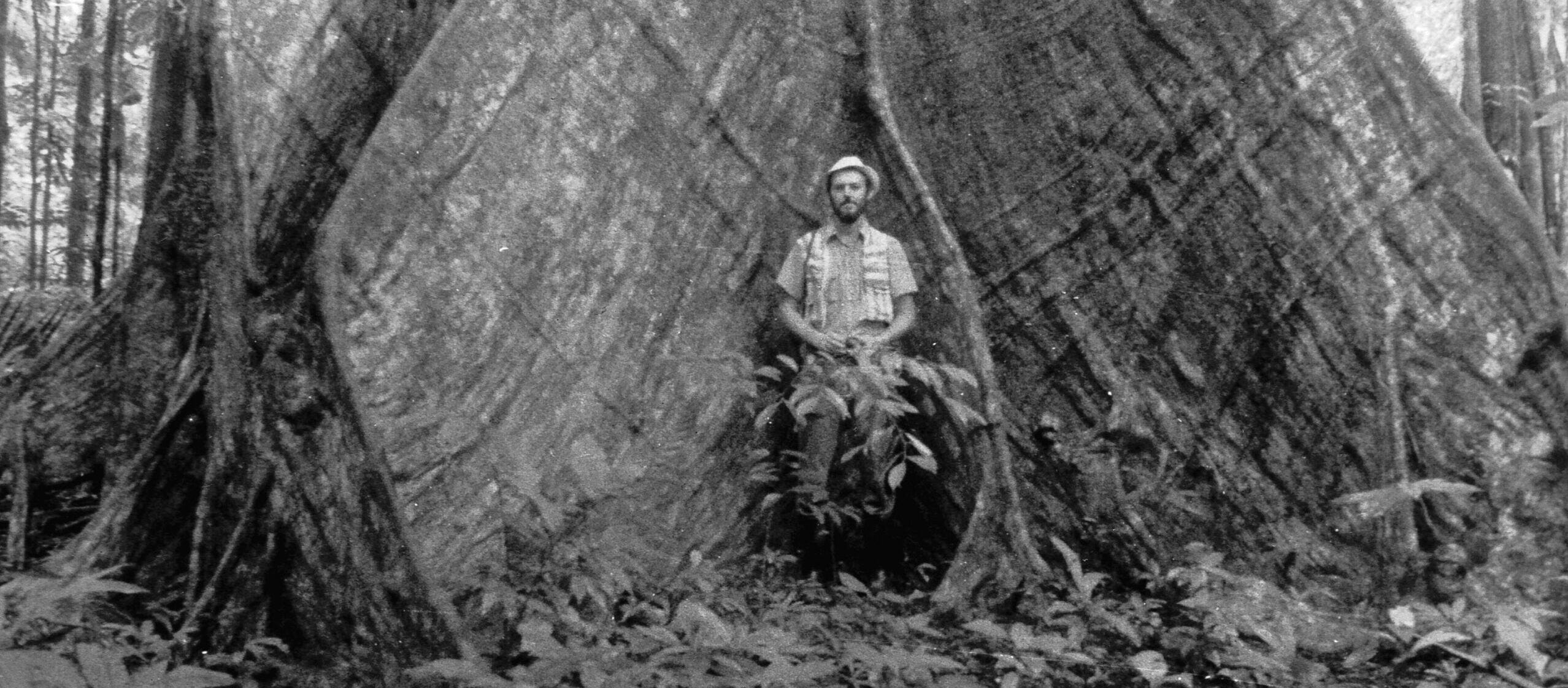
Gary Hartshorn has the singular honor of having three tree species named for him. An expert on tropical forests, especially in Latin America, he has authored hundreds of scientific publications on forest ecology, biodiversity conservation and environmental assessment. Gary’s ICWA Forest and Society fellowship in 1978–1982 was based in South America and Indonesia. He was a Fulbright Scholar for a Distinguished Chair in Biodiversity Conservation and Sustainable Development at the National University of Colombia. He has been president and CEO of the World Forestry Center and Organization for Tropical Studies, chief scientist and vice president of the World Wildlife Fund and the US scientific liaison officer to the Center for International Forestry Research.

In this late 1978 dispatch, Gary describes a month he spent in Bolivia studying its heterogenous forests and land use. While he writes in other parts of his report that the country’s forest resources are being exploited to dangerous levels to pay for development projects, in this excerpt, he describes local mismanagement of a more ordinary type, perhaps funnier in retrospect.
Bolivia (December 1978) — My friend and colleague, Elias Meneces, and I made a one-week field trip into the Chimanes region, south of San Bona. The region is named for the extensive group of Chimán Indians inhabiting the forests of the area. After flying from Cochabamba to Trinidad (capital of Beni department), we found that Lloyd Aéreo Boliviano suspended its “irregular” flights to San Borja because the new road to San Bona was now open. Elias and I therefore booked passage for Sunday on the only microbus making the trip from Trinidad to San Ignacio de Moxos (100 kilometers), with the driver’s complete assurance we would easily find a vehicle to take us from San Ignacio to San Borja (150 kilometers). The first microbus took us the short distance to the Mamore River, where passengers, luggage and cargo were ferried to the other side of the large river. I was pleasantly surprised when the second microbus arrived within half an hour to take us the rest of the way to San Ignacio.
Upon arrival in San Ignacio, we immediately searched for transportation to take us on to San Borja, only to find that we would have to wait until the next morning for the vehicle making the trip. “Panchito,” the owner of a Datsun pickup, makes a daily round trip, except on Sunday, carrying passengers for $5/person for a one-way trip. Panchito agreed to take us to San Borja on Monday morning as regular passengers, then hire out to us for three to four days starting at 2 p.m. Monday.
While killing time on Sunday afternoon in San Ignacio, I found out more about the town. Both San Ignacio and San Borja are at the tips of two fingers of savanna vegetation extending south from the vast Pampas de Moxos and owe their existence to the daily air freighting of meat to the big cities in the mountains. Cattle raised on the savannas are brought to these small towns for slaughter during the night, and the sides of beef are flown out early in the morning in vintage DC-3s. When you fly over the savannas, several cargo planes that didn’t make it can be seen “parked” eerily on the savanna.
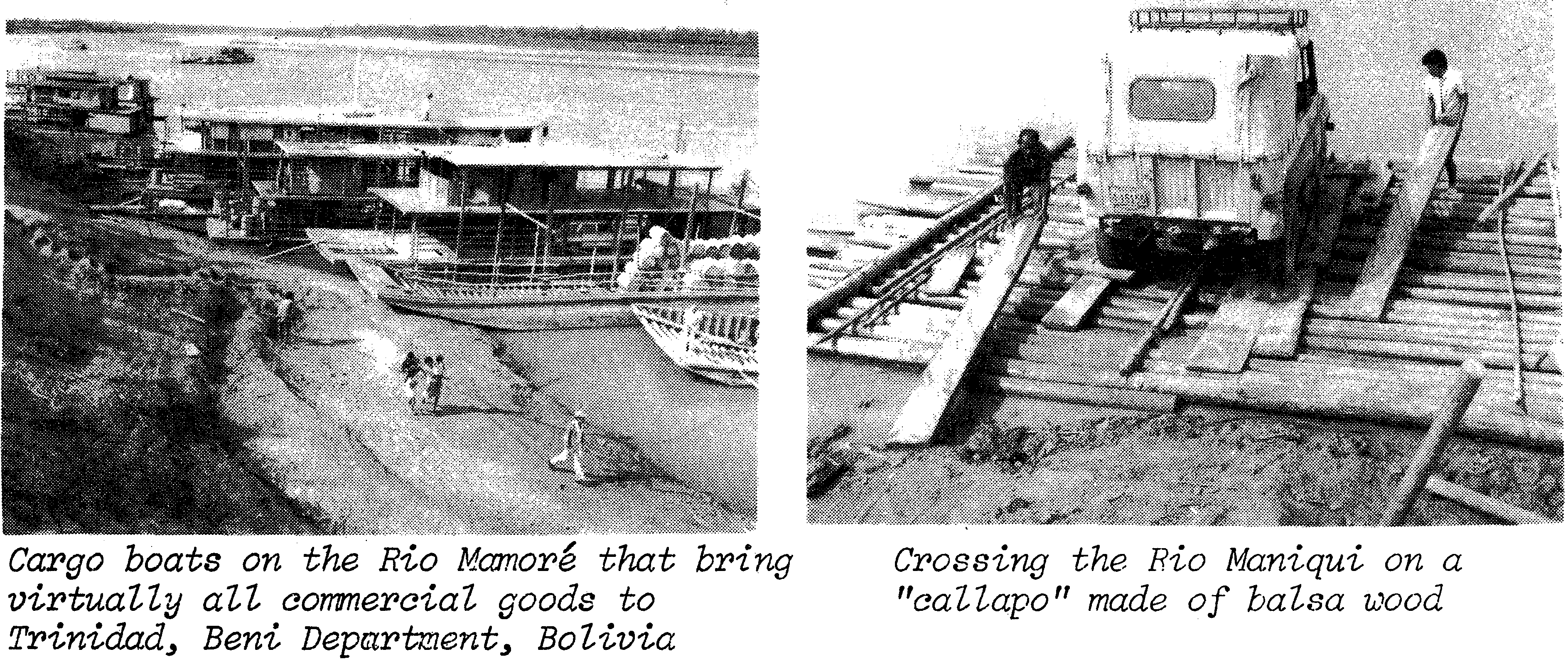
We showed up extra early at Panchito’s on Monday morning to ensure seats in the pickup crew-cab. By the 7 a.m. scheduled departure, 12 people and at least 300 kilograms of cargo were loaded for the 4.5-hour ride to San Borja. I’m certain we were way over the theoretical 0.5-ton capacity of the little pickup. As I expected, the overload contributed to a flat tire about two-thirds of the way to San Borja. Good ol’ Panchito carried neither a jack nor a proper lug wrench, but he did manage to come up with a simple wrench to break loose the lugs. To change the wheel, the passengers had to lift the left rear of the pickup with the two two-by-six planks that served as benches in the back of the pickup. We managed to lift it without unloading the 300 kilograms of cargo.
The spare turned out to be somewhat low in pressure, so Panchito got out his trusty manual air pump, which was not very successful in increasing the tire’s roundness. So off we limped for a few kilometers, until a loud banging noise indicated the wheel lugs had not been sufficiently tightened. This time we lifted the pickup to permit better tightening of the lugs. We continued stopping every l5 minutes to try to squeeze more air into the tire. During one of these stops, Panchito left without two passengers who had gone to a nearby house for water.
Another problem with Panchito’s pickup was that the starter didn’t work, which was no difficulty for the many passengers. But then Panchito didn’t pay attention to the road and got stuck in deep wheel tracks in the sand—and stalled the motor. It took several herculean tries but we finally pushed it free.
We limped into San Borja 2.5 hours late, and I immediately started searching for someone else to drive us around the area. Fortunately, I found two alternatives, so at 4 p.m., I informed Panchito we no longer required his pickup. I didn’t like breaking our verbal agreement, but I decided it was justified since Panchito was to have been ready to drive us around starting at 2 p.m. and his pickup was still perched on a borrowed jack at 4 p.m.
After a very good dinner in such a small town, Elias and I were walking back to our rustic hotel when a National Guardsman intercepted me and asked me to go into the captain’s office. Panchito showed up as the captain informed me that Panchito had made an oral claim against me for breach of contract. It was quite apparent the captain had heard only Panchito’s side of the story, so I calmly explained Panchito’s failure to comply with our agreement to start at 2 p.m. But Panchito countered that the bad road had delayed him with a flat tire and getting stuck. I then proceeded to explain that I had lost all confidence in Panchito and his pickup because of the overload, lack of a jack, non-functional starter, etc. My complaints struck a responsive chord in the captain, who then berated Panchito for not providing better and more dependable service to his passengers. In order to resolve our differences, the captain suggested I pay Panchito $75 as compensation for one day lost. I responded by calmly asking the captain if he would suggest when the lost day should start since the pickup was still on the jack at 4 p.m. The captain then compromised by asking if I would pay $25, which I agreed to do and did. Although I was pleased with not having to write this newsletter in the San Borja jail, I do regret that Panchito will take out his ire on the next foreigner who seeks a ride with him in San Ignacio.