


The leader of a Cold War nuclear superpower orders the invasion of a defiant southern neighbor. The brief campaign ends in total humiliation for the small, impoverished state. Western countries briefly protest the precedent-setting transgression of sovereignty but the victim’s not important enough for meaningful action, it’s a fait accompli.
Encouraged by his projection of power, the leader amasses his military forces to tackle something really big next time, something historic. A blitzkrieg that would right decades of injustice and restore national pride, he promises his supporters. That campaign is supposed to end in days.
Instead, he triggers an escalating regional conflict that engulfs many other countries, shaking up the post-war security order along with the global economy, with highly unpredictable consequences. He responds with a brutal bombing campaign, destroying critical infrastructure and killing thousands of civilians. Close allies refuse to support what even dubious actors understand to be an untenable moral position.
Still, the leader has the advantage of not caring, indeed the disruption of international norms is partly the aim. War with extraordinary powers appeals to him, and he controls his country’s nuclear codes.
Now it’s up to a wobbly alliance of liberal democratic countries to hold together the rules-based order undergirding the free world. Despite their overriding common interest, their governments struggle to agree how to oppose the wanton destruction threatening global stability and prosperity. Under pressure from their own burgeoning anti-democratic nationalist movements and mounting polarization, they don’t want to be seen escalating the conflict. How do they maintain a line in the sand?
By necessity, European countries have come a long way since Russian President Vladimir Putin undertook his first major incursion into another sovereign state by launching his victorious five-day war against Georgia in 2008, which reflected his decision to fully break from the West. Steeling for serious ostracism and exclusion back then, the Kremlin instead saw victory in Western countries’ bending over backward to justify Putin’s war, blame the hotheaded Georgian President Mikheil Saakashvili instead and put the whole thing behind them.
The larger confrontation with the West, as everyone remembers, exploded with Putin’s launching his full-scale invasion of Ukraine in February 2022. More than four years on, European members of the “coalition of the willing” are dealing with the loss of their main ally and security guarantor the United States, together with the European Union’s failure to agree to divert some $300 billion of frozen Russian assets toward supporting Kyiv earlier this year, and now the debacle in the Middle East.
The US-Israeli war against Iran is providing Putin a major boost, shoring up Russia’s petro-economy with ballooning prices for its most important export commodity, oil (together with natural gas and fertilizer), along with the suspension of US sanctions on sales.
Still, the allies’ biggest challenge from Putin may be deciphering his logic. His overarching aim isn’t necessarily taking all of Ukraine, or even just the Donbas—although he surely wouldn’t object—or otherwise achieving any conventional definition of winning the war. Like other consolidating authoritarian leaders, he fans foreign conflict for the sake of building personal power at home together with the necessary enriching of oligarchic interests that profit from financing and otherwise sustaining his rule. Ongoing war has enabled him to impose a previously unimaginable degree of neo-Stalinist repression and a level of administrative control not seen since the 1950s.
Periodic rounds of international negotiations—with zero intention of furthering peace on his part—have enabled Putin to exploit that conventional wisdom, including the idea that he’s acting in his country’s long-term interests and actually interested in Russia’s power—expanding Moscow’s boundaries and influence—ahead of his own. Remember when observers said the path to peace in Syria lay through Moscow?
But assuming his purpose is really guided by the Enlightenment principles that help define “rational” for most Westerners is actually dangerous when his real endgame has already been achieved: maximizing chaos.
The stakes in Ukraine are even higher now that international norms have changed, of course, with the United States, together with Israel, also bombing civilians and infrastructure in its own undefined war of aggression, joining Russia in pursuing a new imperialist vision of vassal states paying the great powers. The very idea of democracy promotion—until recently a key pillar of US foreign policy—is a direct threat to the new scheme of expanding spheres of corruption in the common interest of both countries’ ruling families. No surprise that accusations the Kremlin is providing the Iranian military help identifying American targets in the Middle East—the idea of killing US service personnel—elicited a mere shrug from President Donald Trump. He gets it.
For those still interested in liberal democracy and open society, maintaining a line in the sand will require remaining crystal clear about what the autocrats really want.
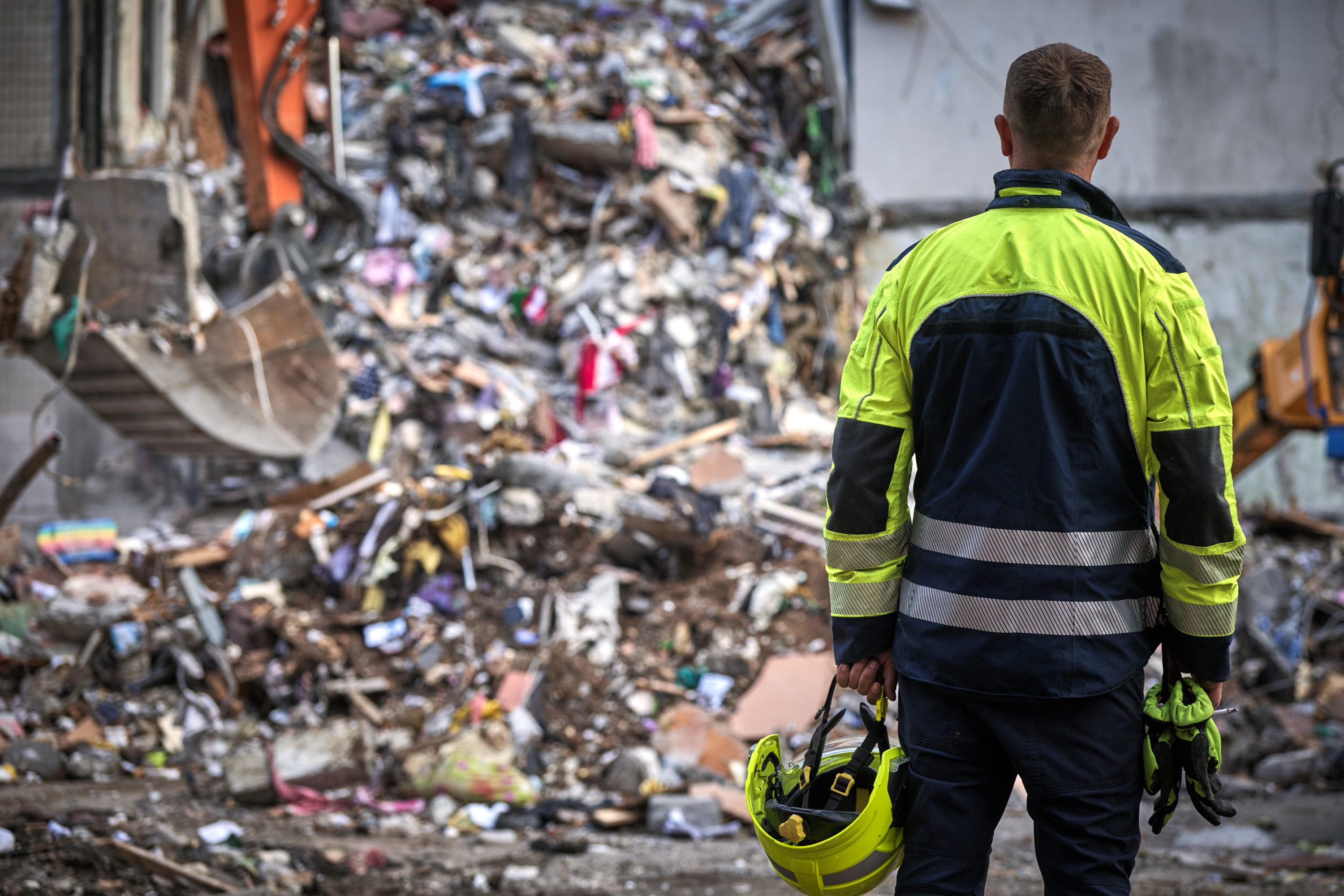
Photo: A bombing site in Kyiv, 2025 (Wikimedia Commons)
Gregory Feifer is executive director of the Institute of Current World Affairs in Washington. A former NPR Moscow bureau chief and author of Russians: The People Behind the Power, he is writing a biography of the Russian politician Boris Nemtsov.
Greg, great article. It refreshed a recent memory: Michael McFaul (a local hero) gave a talk at the Bozeman Public Library. It was part of his recent book tour. He described an experience he had when serving as Ambassador to Russia. Putin got uncharacteristically close in a face to face encounter and said "You think we [Russians] are just like you, and think like you. You are WRONG!" Trump and Putin have a lot in common, it seems--and I'm continually vexed by the President's acting as if he's a Russian operative.