


A Brazilian in Lisbon recently explained to me with striking conviction why now is the right time to move to Russia.
Europe and the United States had unleashed war in Ukraine, he said. The West is decaying. The left has taken over schools and universities. Corruption and chaos suffuse everything. Russia, by contrast, is a place of “peace and clean streets,” where “the metro is efficient,” unlike in America and the European Union, where “everything is trash.”
I’d heard that story many times back home in Russia before I left for exile abroad in 2022. The tropes of Russian cleanliness and public order contrasting with a rotting West have been well worn by state-controlled media under President Vladimir Putin.
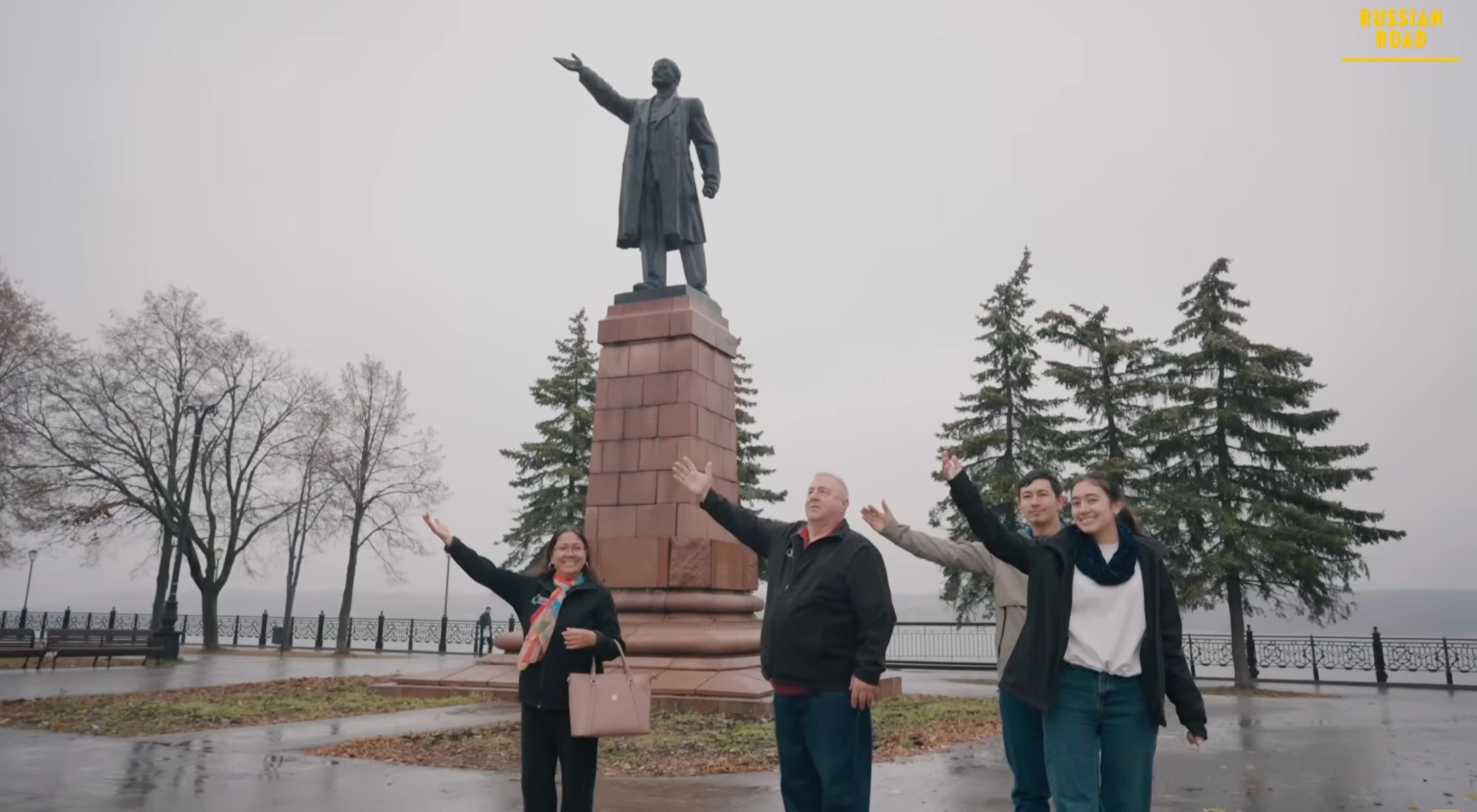
What caught my attention this time wasn’t just the unlikely source but also his delivery: ready-made, polished, consistent. And it didn’t appear to reflect his own experience. He was reciting a narrative taken from a burgeoning genre: expats living in Russia touting the good life, another plank of the Kremlin’s multifaceted propaganda machine. This one is aimed at appearing genuine and heartfelt, with the sheen of outsiders’ objectivity—and it seems to be working.
A familiar story
At least 650,000 people have left Russia since the Kremlin’s full-scale invasion of Ukraine in 2022 without returning, various researchers and media outlets estimate. At the same time, Russian officials and state media have been increasingly promoting a much smaller counter-current of Western relocations. Some 1,500 citizens of so-called “unfriendly” countries applied for Russian residence permits by mid-2025 under a simplified “traditional values” relocation scheme, according the state news agency TASS.
The significance is smaller in scale than media visibility and symbolic value. Parallel to those relocations, an ecosystem of pro-Russia expatriate bloggers and vloggers began to take shape online. Such projects number well over 100 across YouTube, Telegram, Instagram, and Russian platforms VK and Rutube, with a combined audience exceeding 3 million subscribers, based on a database compiled during my research, using deliberately conservative estimates that exclude many smaller or irregularly active accounts. Many produce content in not only English but also French, German and other languages, presenting Russia to foreign audiences through the lens of personal experience rather than official state messaging.
“At First Sight: Foreigners Share Their Favorite Places in Moscow,” “An American Came to Russia to See Lake Baikal and Stayed for Good,” “After the US, I’m Impressed,” “I’ve Already Helped 100 Brits Move Here,” “Fleeing the Criminals. A Village for Americans Is Growing Near Istra.”
Such stories circulate not only in marginal online communities but also through some of Russia’s largest tabloid and mass-oriented media platforms, including the nationwide print, online and regional editions of the popular papers Moskovsky Komsomolets and Komsomolskaya Pravda, as well as media groups such as Shkulev Media Holding, which operates dozens of regional news portals. From there, stories about Western expatriates praising life in Russia are frequently repackaged and redistributed through smaller regional outlets, VK communities and Telegram channels, amplifying their reach.
They arrive in clusters, often with several nearly identical accounts appearing within a few weeks. The repetition is hard to ignore.
The various pieces work together to create a single impression. Alexandra Yost describes Moscow as more developed and safer than Boston or Brussels. Daniel Castle speaks about Slyudyanka, near Lake Baikal, as if he’d always belonged there. Eric Piccione contrasts family life in Russia with the fear, expense and insecurity he says are rife in the United States.
Most such stories begin with the expectation of danger. Family members worry. Friends are confused. Someone recalls some atrocity seen on TV. In Canada, one protagonist was supposedly told directly: “They will kill you” in Russia. In Scotland, as Jim Brown put it, schools teach children that Russia is cold and threatening.
Then comes the reversal. Personal experience upends the inherited script. Russia turns out to be “safe,” “calm” and “clean,” even in the context of war and unpredictable drone attacks. Joseph Rose says he feels safer at night in St. Petersburg than anywhere else. Igor Parri describes Moscow in similar terms.
The aim isn’t making formal arguments about Russian superiority as much as accumulating anecdotes. It’s not “the West has failed,” but “there are rats and garbage in Paris.” Not “Russia is better,” but “you can walk here at night.”
The content creators don’t seem like classic propagandists. They act as intermediaries, bearers of experiences who are trusted more readily than official sources because they use the language of lived experience. The persuasive force lies in the small but vivid details that, with the help of repetition, are meant to stick in the mind.
Although a few of the bloggers appear to have some Russian roots, the vast majority seem to have had no previous connection to Russia. A small number also openly acknowledge they had worked for the state propaganda outlet Russia Today, or RT, before 2022.
The archetypal story continues. A short trip turns into a longer stay. An experiment becomes a decision. Almost imperceptibly, Russia becomes home.
Then the finale. “I’m happy here.” “I’m Russian at heart.” “Back in my country, I feel like a tourist.” Sometimes the formulation is dramatic; sometimes banal. In the end, the foreign protagonist is happily absorbed by the Motherland.
Deeper into Russia
In one account, a British expatriate named Martin Gorton temporarily moves to Russia’s Orenburg region southeast of Moscow and meets a partner, decides to stay and eventually acquires citizenship. His move is explained not only by his new relationship but also a sense of alienation from his native Britain and disagreement with the purported educational and cultural “agenda” associated with LGBTQ+ issues, together with the hobgoblin of “non-traditional values.” He posts a vlog aimed at an international audience that documents his life in Russia, presenting his experience as an example others might follow.
Gorton and his new family don’t reconsider their choices even after a flood destroys their home and all their belongings. The catastrophe is framed not as a reason to leave but confirmation of the right path, a “test from God” that must be endured. The story shifts into the realm of symbolic narrative, where Russia appears not just as a place to live but a haven for Christian faith and values.
A Danish expat named Lars Grebnev, who adopted his Russian wife’s surname, emerges as a celebrant of rural Russia. Despite having no experience, he’s hired to be an English teacher in a village school in the Kirov region northeast of Moscow. In a regional television segment, we see halcyon village routines, a family with three children and a wife working for the local administration.
Again, although the circumstances in each such piece may differ, the overarching narrative remains remarkably unchanged: First comes the language barrier and cultural differences: “Russian is very difficult for me.” Next, acceptance and integration: working with children, engaging with locals. Finally, the inevitable ending: Russia becomes a “second homeland,” where the protagonist has “truly found happiness.”
The Grebnev story popped up in another context. The director of a state program for relocating foreigners from “unfriendly” countries to Russia, Maria Butina (a member of parliament who made headlines in the United States after her arrest for trying to infiltrate the NRA and other conservative groups), mentioned his case in a recent statement lauding foreigners who “share our values,” have rejected “the hostile anti-values of neoliberalism” and “want to work for the good of the country.”
Such tales are no longer just individual journalistic accounts of personal journeys. Butina uses them to illustrate the supposed clash of civilizations between the “collective West” and Vladimir Putin’s Russia, examples of people whose lives are to be officially celebrated and reproduced.
Effective repetition
The protagonists of these formulaic stories don’t appear to be artificially selected. Among the dozens of such bloggers and vloggers (many more don’t publish but occasionally give interviews to Russian media) are people from various backgrounds, teachers, former military personnel, farmers, entrepreneurs, family members with children.
Some of their accounts include genuine rough edges: conflicts, everyday difficulties, critical observations. In the Irkutsk region in Siberia, Castle was once mistaken for a spy—his bag was torn and he was nearly drowned, according to an interview with Russian media. Castle himself later dismissed the attackers as “three drunk people” who did not represent Russia as a whole.
Gabrielle Duvoisin calmly notes that rural France is actually more developed than rural Russia, where the croissants are “terrible” and the language is hard to master. Many complain about the roads, omnipresent dill in cooking, interminable winters, lack of good seafood, bureaucracy and difficulty of the language. But those imperfections don’t disrupt the overall effect, they reinforce it by adding an air of credibility and objectivity.
Behind the stories
Over the past few years, expat bloggers in Russia have become the subject of an almost distinct strand of investigative reporting in Russian exile media outlets. Reporters have been looking into who helps the stories appear, how they’re scaled and what kind of environment enables the accumulation of such private experiences to become an export genre.
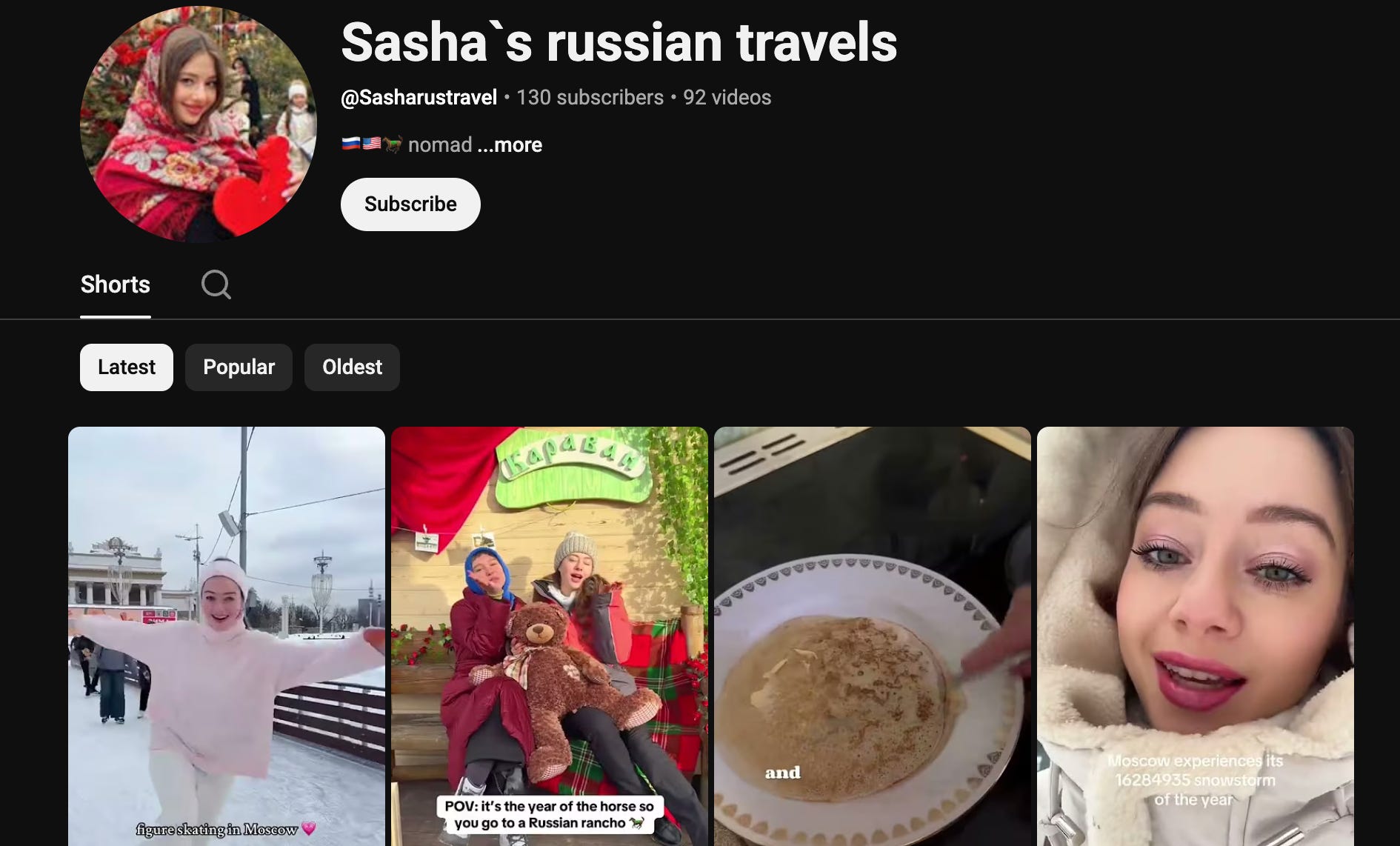
The Russian investigative website Important Stories has directly linked several English-language projects on YouTube and other channels aimed at international audiences—Russian Road, Real Reporter, Sasha Meets Russia—to staff and funding connected to RT. The journalists have been able to show the same faces and narratives migrating from one platform to another while maintaining the appearance of independence.
The case of American Alexandra Yost is illustrative. According to Important Stories, she was employed by RT starting in March 2023, roughly the same time her new vlog began to actively develop after her previous channel was blocked by YouTube moderators. The report even specifies her official salary: 160,000 rubles ($2,000) per month.
Direct payments aren’t the only rewards. There’s a broader support system of access, facilitation and institutional hospitality. It’s fuzzy, not always formalized, but no less visible. It includes tours of far-flung regions, invitations to state-sponsored events, appearances on national television talk shows, organized trips to World War II Victory Day parades, curated routes through Volgograd and St. Petersburg, journeys across the “real Russia” showcased for an external audience.
Narratives without sponsors
Some bloggers haven’t appeared in any investigative reports and have no publicly documented ties to RT but have nevertheless followed strikingly familiar trajectories.
Nick Darlison, a British expatriate who relocated to Khabarovsk in Russia’s far east, produces content that initially focused on Russian landscapes, Orthodox traditions, everyday life in the region and a new sense of identity outside the West.
Then he began to report from Russian-occupied eastern Ukraine, framing it as an attempt to “see the truth” beyond Western media bias. He also describes the UK as a place in decline: London overrun by non-white migrants, with public spaces unsafe and degraded. “Liberalism” and “diversity” are immediate causes. In a recent post, he compares “London in 1960 (98 percent British)” to “London now (36.8 percent British)” together with reflections about cultural loss and personal memories.
Of course it’s very possible some Russia-bound expats are motivated by genuine enthusiasm or their individual pursuit of audience growth and monetization: Darlison’s example is notable for its absence of any clearly identifiable institutional sponsor. But perhaps that’s a reflection that organized messaging has already had its effect and evolved into organic expression. The narrative can be adopted, adapted and extended by people acting on their own.
From story to pathway
The government introduced its special relocation regime for foreigners who share the country’s “traditional spiritual and moral values,” run by parliament member Maria Butina, in 2024. It’s had the effect of providing expat bloggers with a practical frame as well as an ideological one—with intermediaries, consultants and relocation agencies channeling emotional narratives about clean metros into pathways for emigrating. Some bloggers and vloggers even glowingly describe cooperating with migration agencies that help foreigners start businesses.
In the more extreme cases, narratives shift from sympathy toward Russia and what it supposedly stands for to direct political and even military action. Affinity is no longer affirmed through the supposed sharing of “traditional values” but a desire to take part in Putin’s war against Ukraine.
Derek Huffman, an American who moved to Russia in 2025, enlisted in the military. From a combat zone in Ukraine, he publicly declared: “I received Russian citizenship and it is a great honor and pride for me to officially become a citizen of Russia… I want to thank President Putin, Russia, and the Russian people.” Patrick Lancaster, an American journalist and former US serviceman produces frontline narratives and stories about Ukrainian soldiers switching sides.
Subtle shifts
John Kopiski, a British expatriate who’s lived in Russia for decades and long embodied the classic narrative of a foreigner who “found a home” there, built a farm, started a business, spoke about the “Russian soul” and describes himself as a “Russian Englishman.” In 2025, his son joined the war in Ukraine, wanting to “continue family traditions.” The transition from a focus on everyday life, comfort and prosperity to the more extreme examples is gradual and almost seems natural or inevitable.
If frontline stories are partly meant to demonstrate Russian resilience in wartime, lifestyle videos perform an analogous function. Seemingly obligatory clips insist that Western sanctions “do not work,” featuring scenes of crowded shopping malls, visits to new restaurants and profiles about the latest delivery services—carefully staged impressions of abundance intended to dispel external expectations of scarcity.
The messages resonate among people discontented or displaced by the challenges of life in the West. In Lisbon and many other places, the arguments take root precisely because they’re not produced by Russian state media but are the seemingly heartfelt musings of Europeans themselves using their own experiences to depict an unlikely garden of Eden existing all around the jagged teeth of the Kremlin’s towers.
Andrei Prudnikow is a political scientist, former Russian journalist and doctoral researcher at the University of Lisbon studying conspiracy narratives and political discourse in contemporary Russia.